

[비즈한국] Although recent fallout from the Middle East conflict has led to a decline in sales for the self-employed, the situation has generally improved compared to the worst of the COVID-19 pandemic. However, it has been found that this modest recovery shows clear discrepancies depending on the age group. While sales for self-employed young people have largely recovered to pre-COVID levels, those in their 60s and 70s have seen their sales drop even further compared to before the pandemic.
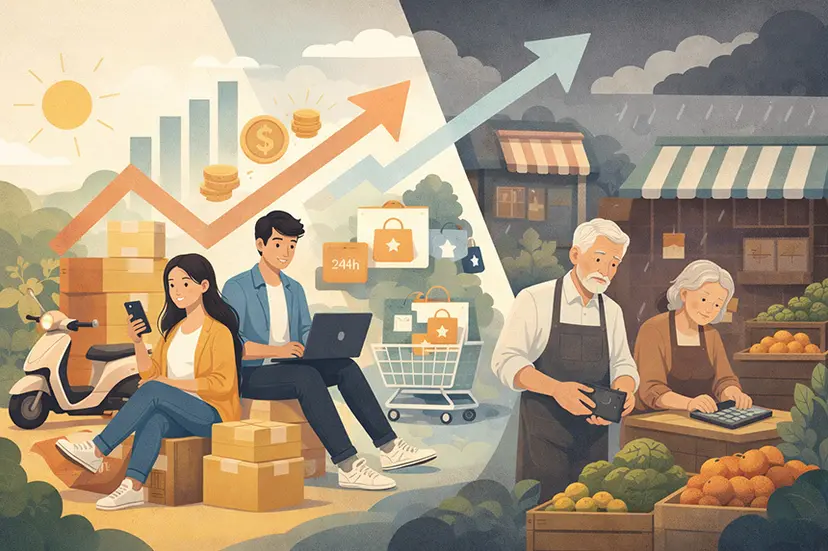
This is because while young self-employed business owners have managed to recover their sales by increasing online sales during the pandemic, older adults still rely heavily on offline sales at physical stores. Additionally, because older adults are more likely to borrow funds from sources like family rather than from Tier 1 financial institutions such as banks, there are concerns that if their financial difficulties persist, their entire family could fall into economic hardship.
According to the National Assembly Futures Institute and other sources, the average annual revenue of self-employed individuals, which was 171.4 million won before COVID-19, plunged by 18.1% to an annual average of 140.5 million won during the pandemic period from 2020 to 2021. However, as the pandemic subsided and social distancing eased, sales began to rise, and the annual revenue of self-employed individuals increased to 172.4 million won, a 22.7% jump compared to the pandemic period. This is even a slight increase of 0.6% compared to the pre-COVID annual average revenue.
While the earnings of self-employed businesses have entered a recovery phase since COVID-19, the gap is wide across age groups. For businesses run by young people aged 39 and under, revenue jumped from an annual average of 179.7 million won before COVID-19 to 195.4 million won after the pandemic, following a dip to 172.2 million won during the crisis. This is an 8.7% increase compared to pre-COVID levels. Self-employed individuals in their 40s also saw an increase in revenue compared to before COVID-19; their revenue rose by 6.2% from 169.7 million won before the pandemic to 180.3 million won after.
In contrast, the older generation has been unable to recover their sales even after the pandemic. The revenue of self-employed individuals in their 70s averaged 183.1 million won annually before COVID-19—higher than those aged 39 and under or in their 40s—but it plummeted to 145.3 million won during the pandemic. Even after the pandemic, their average annual revenue stood at 154.5 million won, a 15.6% decline compared to pre-COVID levels. Those in their 60s were also unable to fully escape the impact of COVID-19, with their average annual revenue falling by 2.8% from 152.3 million won before the pandemic to 148.1 million won after.
In fact, while 59.4% of self-employed individuals aged 39 and under responded that their current sales had recovered compared to pre-COVID levels, a staggering 70.6% of self-employed individuals aged 60 and older reported that their sales had declined.
The disparity in the proportion of online sales is analyzed as a factor in why the older generation remains left behind while the youth have successfully ridden the post-COVID sales recovery wave. As the online market began to grow in earnest after COVID-19, older self-employed individuals, unfamiliar with the online environment, have faced difficulties in adapting to these changes.
Looking at the sales composition of self-employed individuals aged 39 and under, online sales accounted for 24.9% and delivery apps for 4.1%, totaling nearly 30%. In contrast, for those 70 and older, online sales were only 9.6% and delivery app sales were just 1.1%, barely reaching over 10%. Instead, the proportion of offline sales in the revenue of self-employed individuals 70 and older reached 85.9%.
For those 70 and older struggling with poor sales recovery, the higher reliance on private loans rather than Tier 1 financial institutions like banks indicates that if store operations falter, there is a high possibility that their entire families will fall into economic crisis.
For the youth aged 39 and under, the proportion of debt from Tier 1 financial institutions was 72.8%, whereas for those 70 and older, this figure was only 48.0%. Conversely, the reliance on private loans between individuals reached 36.9%. This is because older adults often borrow funds from family members due to difficulties in accessing financing from financial institutions or government loan programs.