

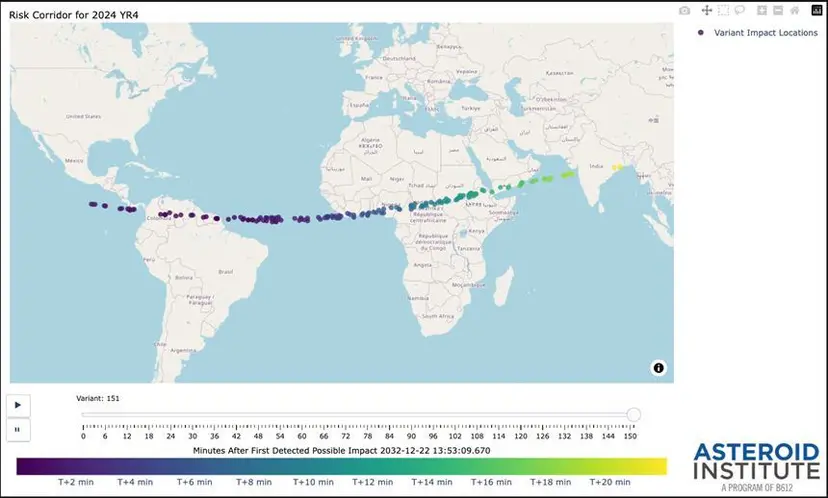
[비즈한국] On December 27, 2024, the asteroid 2024YR4 was detected by ATLAS, an automated asteroid warning telescope in Chile. Soon after, it garnered attention when the probability of it colliding with Earth in 2032 was estimated to be over 3%. Initially estimated to be between 50 and 100 meters in size, it was comparable to the asteroid suspected of causing the mysterious Tunguska explosion in 1908, which devastated a vast area of the Siberian forest. It was truly terrifying news. Fear spread that Earth might once again face a violent collision.
Fortunately, subsequent observations showed that the probability of an Earth collision was effectively zero. However, the probability of it hitting the Moon instead rose to 4.3%. In the end, it seemed 2024YR4 was targeting at least one of them, whether it be Earth or the Moon.
More than a year has passed since this asteroid was first discovered. This is enough time to track the trajectory of a fast-moving near-Earth asteroid with greater precision. In the meantime, the trajectory of 2024YR4 has changed in real-time. Is it still targeting our Earth or the Moon?
The reason 2024YR4 first drew special attention was because the Torino Scale, which measures the danger level of an asteroid, rose to Level 3 for the first time in history. While it didn't mean the entire planet would be destroyed, it was an event that reminded us that Earth could face sudden, unexpected crises at any time. Anxious astronomers rushed to track every move of this asteroid. Massive telescopes on the ground, such as Gemini South and the VLT, split their remaining time to chase 2024YR4. The results revealed some interesting facts.
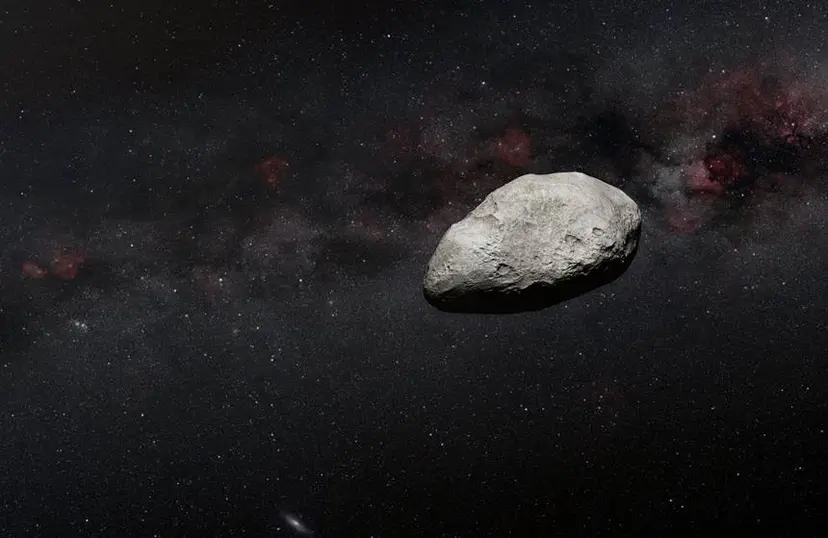
When this asteroid was first discovered, it was assumed to have a simple, rounded, crushed shape. However, further identification showed it is much flatter, more like a crushed potato. We were able to figure this out thanks to the asteroid's rapid rotation. This asteroid spins in place with a very short cycle of about 20 minutes. Because its shape is asymmetrical, the cross-sectional area of the asteroid viewed from Earth changes as it rotates, and its brightness periodically fluctuates. Through this, we can tell how round or crushed the asteroid is.
Even more interesting is that the asteroid is undergoing 'retrograde rotation,' spinning in the opposite direction to its orbital motion around the Sun. This significantly affects the asteroid's orbit. When sunlight hits the asteroid's surface, it heats up and releases heat. The heat being released creates a tiny propulsive force that pushes the asteroid in the opposite direction. Put simply, it feels like the sunlight is so hot that it moves slightly in the other direction. This is called the Yarkovsky effect.
Generally, asteroids whose orbit and rotation are in the same direction have their orbits expand due to the Yarkovsky effect as they are pushed further out into the solar system. However, 2024YR4 is undergoing retrograde rotation, so it is actually moving closer into the inner solar system from its original asteroid belt between Mars and Jupiter due to the Yarkovsky effect. Such cases are rare.
Fortunately, as 2025 passed, the probability of the asteroid colliding with Earth converged to zero. It seems we can rest easy now. Instead, the probability of it colliding with the Moon once soared to 3-4%. You might think it has nothing to do with us since it would collide with the Moon, far from Earth, but that's not necessarily true. Simple calculations suggest that it could release energy equivalent to 6.5 million tons of TNT upon impact on the lunar surface. Even during the day, one could see a bright flash on the lunar surface with the naked eye. Of course, the Moon wouldn't be destroyed entirely. Instead, one might be able to witness a giant crater nearly 1km in diameter forming on the lunar surface.
In fact, the bigger problem is that the debris from the shattered lunar surface would obscure the area around Earth for some time. Up to 100,000 tons of lunar rock could turn into dust, and nearly 10% of that would spread to the vicinity of Earth. It is extremely rare for it to fall on our heads on the ground, as most would burn up as micro-meteors in Earth's atmosphere. However, it would be fatal to artificial satellites. Sharp lunar dust and regolith fragments could pour onto solar panels and electronic equipment, causing great chaos. One could even imagine a situation where the Kessler Syndrome (a chain reaction of satellite collisions and explosions) occurs due to small fragments from the Moon.
We can also ponder another concern. If these shattered lunar fragments remain near Earth for a long time and obscure our view, Earth would be covered in a state similar to being blocked by massive volcanic ash. This would significantly reduce the amount of sunlight entering Earth for a long time. Similar to the premise in the movie 'Project Hail Mary,' we can imagine a situation where the Sun in Earth's sky suddenly dims and the climate freezes. Ultimately, from our perspective, we can only hope that this asteroid passes safely by both Earth and the Moon.
Very fortunately, the most recent additional observations by the James Webb Space Telescope reassure us. In February, the James Webb Telescope captured 2024YR4, which was barely visible at the limits of the telescope's performance. It is the faintest asteroid image humanity has ever observed. Snapshots capturing more moments allow us to grasp the movement of the asteroid more accurately. Thanks to this, NASA finally officially announced that the probability of this asteroid colliding with not only Earth but also the Moon has become 0%.
But what if, by any bad chance, this asteroid were heading toward Earth or the Moon—would we be safe? The success of the DART mission, which flew toward another binary asteroid system, Dimorphos and Didymos, and attempted to change its orbit by slamming a probe into it, remains our only hope. However, the situation might be a little different for 2024YR4.
The fact that the asteroid has not disintegrated or broken apart despite spinning so fast means that the rocks forming it are packed together quite firmly. If it were an asteroid made of simple loose gravel, like Ryugu or Bennu, which probes have visited, it would have shattered and scattered in all directions at such a high rotation speed. But 2024YR4 is enduring a fast rotation speed despite its small size. This means it is a fairly solid 'pebble' asteroid. One can expect its destructive power to be significant if it were to fall to Earth.
However, this shows that the asteroid has considerable internal strength. That is, if this celestial body were a simple 'rubble pile' like Ryugu or Bennu, it should have already scattered to pieces at such a high rotational speed. Yet, the fact that it maintains its integrity while rotating rapidly means it is a single mass of rock with relatively high density and tensile strength.
So, what is it made of? At present, it seems likely to be an S-type rich in silicates, or perhaps a K-type relatively rich in carbon compounds. In this case, identifying its composition, density, and type is extremely important. If a situation arises where we actually have to change the orbit of this object—for example, by slamming something into it like NASA's DART mission—we need to know what it is made of to predict how its orbit would change.
What researchers wanted to know was not just its potential orbit. They also wanted to know exactly where it came from. In other words, they wanted to determine if it came from the asteroid belt or somewhere entirely different.
In fact, one can now see a 3D map showing the known trajectory of this object. The map shows that this object generally came from somewhere between Mars and Jupiter. More precisely, it seems to have come from the central part of the asteroid belt. For astronomers, this is slightly unusual. This is because asteroids that cross Earth's orbit often come from the inner region of the asteroid belt, much closer to Mars.
Therefore, it seems possible that this asteroid's position was shifted by gravitational interaction with Jupiter, pushing it our way. Jupiter is often called the protector of Earth. It clears away many dangerous rocks and changes the orbits of various comets to prevent them from colliding with Earth. However, in this case, it seems to have done almost the exact opposite. It acted like a gravitational slingshot, hurling YR4 almost directly toward Earth.
However, thanks to its rotational characteristics, we know a bit more about this object. This asteroid appears to have 'retrograde rotation.' In other words, it is rotating in the opposite direction to its orbital motion. This suggests that the object moved from the center of the asteroid belt inward due to the Yarkovsky effect.
The Yarkovsky effect refers to the phenomenon where sunlight, after hitting an object's surface and being re-emitted as heat, creates a very subtle propulsive force, which leads to the orbit changing little by little over millions or tens of millions of years. This phenomenon actually occurs in most asteroids. This is the main reason why it is difficult to predict asteroid orbits. Because the Sun gradually changes their orbits over a long period.
Good. We now know the basics of what this rock is and where it came from. So, what is the final destination for this object? Is it Earth, the Moon, or nowhere at all?
At least for now, the Moon is safe, and Earth is safe. At least in terms of interplanetary space hazards. So, we just need to worry about the problems already existing on Earth.
Who is the author, Ji Ung-bae? He loves cats and the universe. After watching 'Galaxy Express 999' as a child, he dreamed of making the beauty of the universe known. He is currently an assistant professor at Sejong University's College of Liberal Arts, participating in various science communication activities such as lecturing and writing. He has written books such as 'A Piece of the Universe Every Day', 'Scientists of the Starry Universe', 'Things I Can Know Even Though I Can't Go', and 'Strange Questions That Come to Mind When Looking at the Universe', and has translated 'The Hitchhiker's Guide to the Real Universe', 'How I Killed Pluto', 'Quantum Life', and 'Cosmigraphics'.