

[비즈한국] In recent years, premium automakers have been rolling out electric vehicles one by one. This is an inevitable choice as the European Union (EU) plans to mandate a reduction in new vehicle emissions by 2030. Lotus, a brand known for top-tier lightweight sports cars, is no exception. In the 2020s, Lotus launched the electric SUV 'Eletre' and the sedan 'Emeya.' Both vehicles were officially released in the domestic market in 2024. Can Lotus maintain its reputation as a premium brand in the local electric vehicle market? On April 15, I attended a Lotus test-drive event, where I drove the Eletre from Gangnam-gu, Seoul to Gapyeong-gun, Gyeonggi-do, and the Emeya on the return trip.
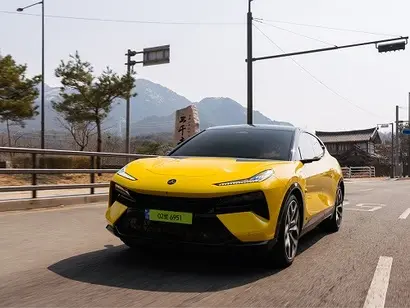
Pure Electric Hyper SUV 'Eletre'
The Eletre is the first pure electric hyper SUV introduced by Lotus. As soon as I saw the Eletre, I couldn't help but think, "It really is a premium brand." Its sleek headlights, radiator grille, and deeply sculpted side and rear designs immediately evoked Lotus's traditional image. It demonstrated that an SUV can fully embody the aesthetic of a sports car.
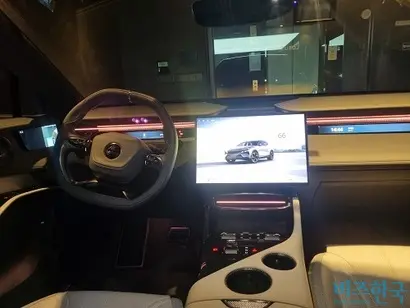
Upon entering the interior, the dashboard caught my eye the most. Compared to the instrument clusters in typical vehicles, it had a very flat design. Instead of a traditional speedometer, it displays the current speed only in numbers. In its place, the center fascia features a large display, allowing for the adjustment of vehicle settings such as air conditioning. There were no physical buttons to be found around the center fascia.
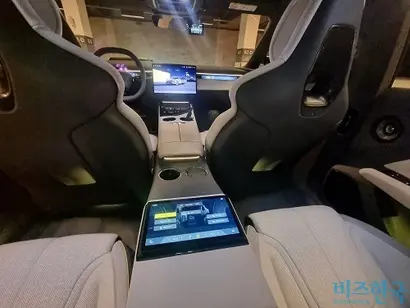
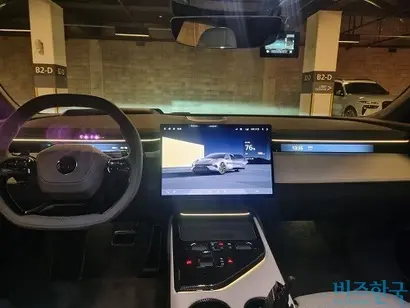
The basic operations of the car are identical to existing vehicles, with the exception of adjusting the side mirrors using buttons on the steering wheel. Unlike some electric vehicles that remove the gear shift lever and place the transmission under the steering wheel, the Eletre uses a standard form of gear selector rather than buttons or dials. While the interior was unconventional, they left the basic control methods untouched.
The driving experience will not feel unfamiliar to anyone who has driven an electric vehicle before. It features paddle shifters, which are almost standard on Hyundai Motor Company005380 electric vehicles. However, depending on the options, side mirrors can be replaced with side cameras, which may take some time to get used to. It works by installing cameras where the side mirrors would be and viewing the feed on a screen inside the cabin.
The acceleration felt smooth. The electric vehicles I had driven previously felt like they had heavier accelerator pedals compared to internal combustion engine vehicles. The Eletre's pedal responded more softly than other EVs, and it gained speed quickly even with slight pressure. According to Lotus, the 0-100 km/h acceleration time is 4.5 seconds for the Eletre 600 and 2.95 seconds for the Eletre 900.
The Eletre offers six driving modes: Track, Individual, Sport, Tour, Range, and Off-road. When switched to Sport mode, the driver's seat adjusts to give a sense of bolting the driver in. A Lotus representative explained that this is a function to prevent the driver from shifting during high-speed driving. At the same time, it adds a psychological effect for those who enjoy spirited driving.
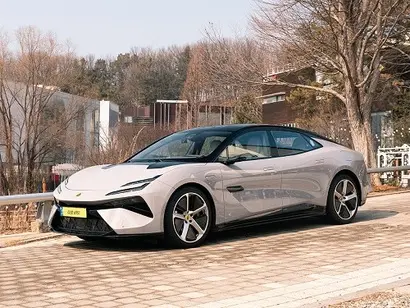
Electric Hyper GT 'Emeya'
The Emeya is a pure electric hyper GT (Grand Touring) car. Like the Eletre, it boasts an unconventional exterior. In a way, it felt like the Eletre's design had been translated into a sedan. Naturally, since it is lower and smaller than the Eletre SUV, the sleek feeling was even more pronounced.
The interior was not significantly different from the Eletre. The flat dashboard and wide center fascia display stood out, and while other areas had stylish design elements, they didn't exactly break the mold. The feeling when seated was certainly different; compared to the Eletre, I was looking straight ahead from a slightly lower position. However, this can be seen as the inherent difference between an SUV and a sedan.
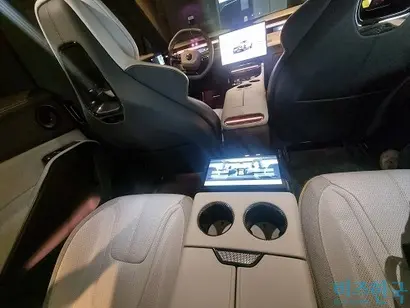
Contrary to my initial expectations, the interior space of the Emeya was quite roomy. Since the Lotus brand is synonymous with small sports cars, I think I had a preconceived notion that the space would be cramped. The Emeya is actually larger than its competitor, the Porsche Taycan. This can also be read as an attempt by Lotus to break away from its existing image.
When accelerating, the Emeya also felt faster than the Eletre. There isn't a significant difference in specs between the two, but because the Emeya is relatively lighter and lower to the ground, it may have also been influenced by psychological factors.
To summarize, the Eletre and Emeya are vehicles that maintain the familiarity of electric cars while maximizing performance. Their exteriors also reveal their premium brand status at every turn. If you want to drive a car that is different from others, they are worth considering as options. The issue is the price. Even the base model starts at over 100 million KRW, and with options, it can exceed 200 million KRW. While it is not an easy price, it is not exceptionally expensive compared to other premium brand vehicles. If you are considering purchasing a premium brand car, the Eletre and Emeya are models worth checking out at least once.