

[비즈한국] There are broadly two aspects from which the public pays attention to BTS. One is because BTS hits number one on the Billboard charts or is nominated for U.S. Grammy Awards. The other is its economic impact, and the attention it receives grows as its scale increases. Titles like 'World No. X' have become the standard for national prestige in Korea, and economic effects are accepted as positive not only for the national interest but also for the livelihood of the people. As the concept of nationalism from the authoritarian government era of the past disappears, the atmosphere is increasingly shifting toward focusing on economic effects.
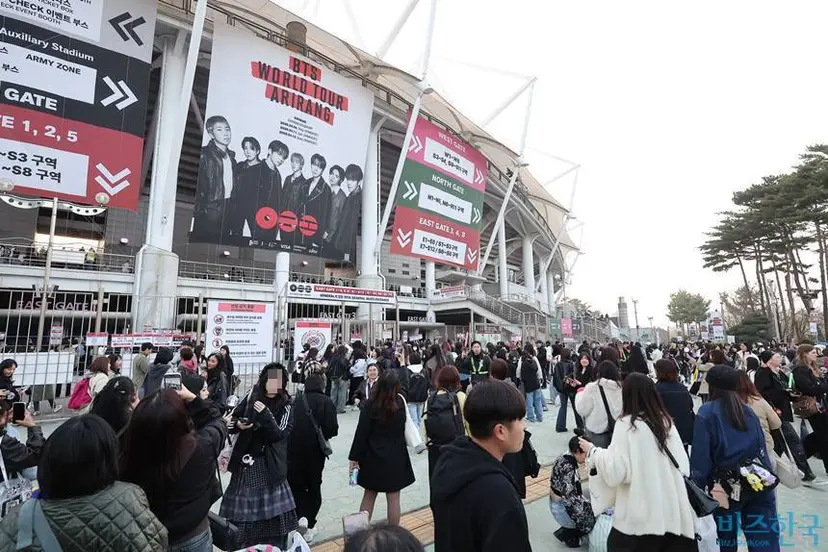
In 2018, the Hyundai Research Institute estimated the 'economic impact of BTS' to be an average of 5.56 trillion won per year. The research method used regression analysis, a statistical technique. The economic effect was estimated based on the assumption that a 1-point increase in awareness leads to a 0.45%p increase in the rate of foreign tourist growth three months later. Since 2013, the number of foreign tourists has increased by an average of 796,000 per year. Calculating that a 1-point increase in BTS awareness results in an export growth rate of 0.18% for clothing, 0.72% for cosmetics, and 0.45% for food, it was estimated that since 2013, there has been an average annual export effect of $233.98 million for clothing, $426.64 million for cosmetics, and $456.49 million for food. The study also concluded that the average annual production-inducing effect of BTS is 4.1 trillion won and the value-added effect is 1.4 trillion won, and articles even appeared noting that this is comparable to Tesla's operating profit (4.3 billion dollars) last year. At the time, the Hyundai Research Institute predicted that an economic impact of 56 trillion won would be generated by 2023.
A research team led by Professor Pyeon Ju-hyun of the Korea University Business School calculated the economic impact of the 'Love Yourself: Speak Yourself' final concert held by BTS for three days at the Seoul Jamsil Olympic Main Stadium in 2019 using the same method, estimating it at 922.9 billion won. In 2020, the Korea Culture and Tourism Institute under the Ministry of Culture, Sports and Tourism released a calculation that the economic effect of a Billboard No. 1 hit is 1.7 trillion won. The U.S. business magazine Fortune reported that BTS generates more than $3.6 billion (approximately 4.7 trillion won) in revenue annually.
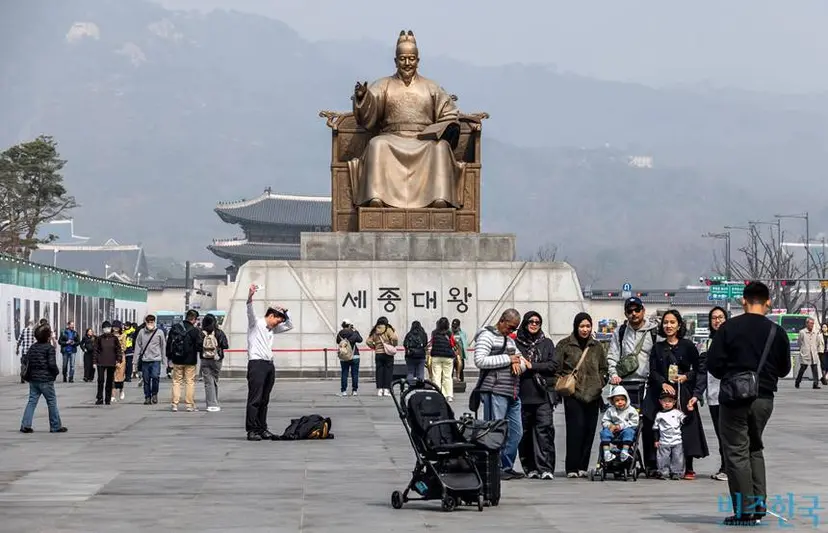
Bloomberg recently estimated that BTS would generate about $177 million (approximately 266 billion won) in revenue just in Seoul from airlines, lodging, restaurants, and merchandise. According to the Korea University research team's assumption, the revenue from the concert at Goyang Stadium, the first performance of the three-day 'Arirang' world tour, reaches 1 trillion won, and 800 billion won according to Bloomberg's estimate. If so, an economic impact of around 1 trillion won was achieved through the Gwanghwamun Square and Goyang concerts. Applying this, approximately 1 trillion won in revenue is collected for every four performances in each country. Performing 82 times would generate about 20 trillion won in revenue, surpassing the economic impact of Taylor Swift.
According to past reports from The Washington Post and others, the revenue for one show of Swift's Eras Tour was $14 million (approximately 18.3 billion won). Indirect consumption generated during Swift's 2023 U.S. city tour was around $5 billion (approximately 7 trillion won), and it was considered to have increased the U.S. Gross Domestic Product (GDP) by about $4.3 billion to $5.7 billion (approximately 5.6 trillion won to 7.4 trillion won). However, Taylor Swift is largely limited to the U.S., and even broadly speaking, it is restricted to English-speaking countries such as the U.K., Australia, Singapore, Hong Kong, and the Philippines.
However, the economic impact of BTS may initially have low accuracy, and most of it was calculated based on activities before their military enlistment. Since they strengthened individual activities alongside military enlistment, the reach of their fandom has expanded even further. Therefore, the economic impact could be even greater than before. Moreover, it is difficult to calculate the economic impact that the Arirang concert at Gwanghwamun Square, which was broadcast live to about 190 countries via Netflix, will bring. Now, cases of live broadcasts in theaters have emerged. In Mexico, the video of the BTS concert held at KINTEX in Goyang ranked second at the weekend box office on the 11th. Sales reached 48.1 million pesos (approximately 4.1 billion won). This is higher than in the U.S. Sales outside the English-speaking world are highly anticipated, with particular attention focused on South and Central America, where BTS's popularity is high.
Being enthusiastic about hitting No. 1 on the Billboard Hot 100 or Billboard 200 may inevitably involve a nationalistic perspective. What is more important is how long they stay on the charts; the longer the duration on the charts, the greater the economic impact. Since it is believed that having an economic impact is helpful to the nation and the livelihoods of its people, it can be a valid means of highlighting the importance of BTS. However, the effects caused by the fandom's love for BTS cannot be measured by such things.
The thought that no economic impact is made just because the ranking slips slightly on the charts is merely an external perspective. In a loving relationship, external gazes cannot intervene. In particular, because the core fandom is solid, there is no means or value to replace it. Looking at that heart makes us think not only about the economic aspect but also about the progress of our society. It means that the way for the whole world to become a better place is contained in that heart. It is a sustainability that goes beyond loyalty in a consumption relationship.
What is important is not the immediate effect. BTS fans are going through their teens and 20s and growing into the central pillars of society. It can be called the growth of a future generation. Especially abroad, early adopters are the ones who like BTS. In many countries, those who are middle-class or higher and have promising futures are K-pop fans. This can be called a massive, immeasurable future asset. Now, parents are influenced because their children are fans, but after these fans grow up and become parents, they will influence their own children. The so-called 'Disney Effect,' where three generations enjoy something together, can also emerge in K-pop. The value of K-pop that transcends generations will grow to be immeasurable.
The author, Kim Heon-sik, has been walking through or navigating the forest of pop culture phenomena since his 20s with the expectation that there is a way to make the world a better place through culture. In the 21st century, where artificial intelligence and quantum computers are active, he still walks the same path with the same belief.