

[비즈한국] The operator of the Hangang Bus, Seoul's first aquatic public transportation system, fell into a state of total capital impairment after recording a net loss of 14.2 billion won last year, its first year of official operation. By the end of last year, total capital had shifted into negative territory at -6.1 billion won, and liabilities reached 153.8 billion won, exceeding the company's total assets. Seoul Housing & Communities Corporation (SH), the largest shareholder which has injected 114.1 billion won into the Hangang Bus, also saw its consolidated performance deteriorate and its debt-to-equity ratio rise last year. The financial burden of the Hangang Bus project is clearly beginning to surface.
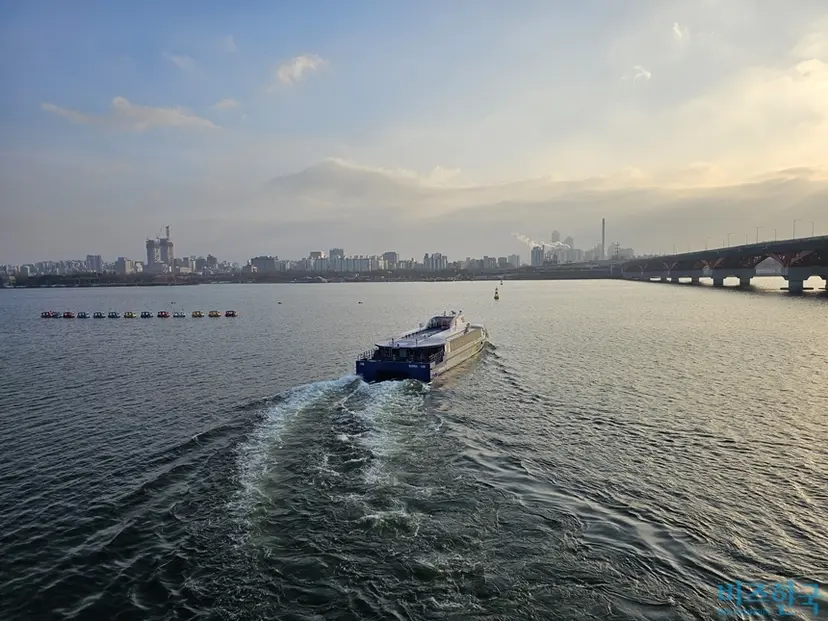
According to the audit report, Hangang Bus Co., Ltd. recorded a net loss of 14.2 billion won last year, its first year of official operation. Since starting operations in September 2025, it generated 5.4 billion won in revenue, but failed to cover the cost of sales (8.2 billion won) and selling, general, and administrative expenses (6.6 billion won), resulting in an operating loss of 9.4 billion won. When adding 5 billion won in loan interest, a massive net loss was incurred. Last year's Hangang Bus revenue breakdown included 2.9 billion won in product sales, 1.7 billion won in food and beverage sales, 200 million won in transport revenue, 300 million won in rental income, and 200 million won in advertising revenue.
The Hangang Bus fell into total capital impairment due to the massive net loss last year. By the end of last year, total capital turned negative to -6.1 billion won after reflecting a deficit of 16.1 billion won. While it had entered a state of partial capital impairment in 2024 by eroding the capital invested by shareholders, it effectively exhausted all capital and entered negative territory last year. By the end of 2025, the Hangang Bus debt scale stood at 153.8 billion won, exceeding its assets of 147.6 billion won.
Hanil Accounting Corporation, which conducted the audit of the Hangang Bus, pointed out in its report: “The company incurred an operating loss of 9.4 billion won and a net loss of 14.2 billion won during the current period, and its net assets are in a state of capital impairment as of the end of the period. Furthermore, as of the end of the current period, current liabilities exceeded current assets by 70 billion won. This situation signifies the existence of material uncertainty that casts significant doubt upon the company’s ability to continue as a going concern, and as such, the company needs to improve its financial structure by achieving stable operating profits in the future.”
The performance of the parent company, SH, also regressed. According to the SH ‘2025 Fiscal Year Settlement (Draft)’ obtained by Bizhankook from the office of Representative Chae Hyun-il of the National Assembly’s Public Administration and Security Committee, SH’s consolidated operating profit last year was 58.6 billion won, a decrease of 73.2 billion won (56%) compared to the previous year, and net profit was 85.2 billion won, a decline of 66.6 billion won (44%). The causes were sluggish internal businesses, such as rental business losses, and the worsening performance of consolidated subsidiaries like the Hangang Bus. SH reflected 54.2 billion won in equity method losses from investment companies, including the Hangang Bus, in its separate financial statements last year.
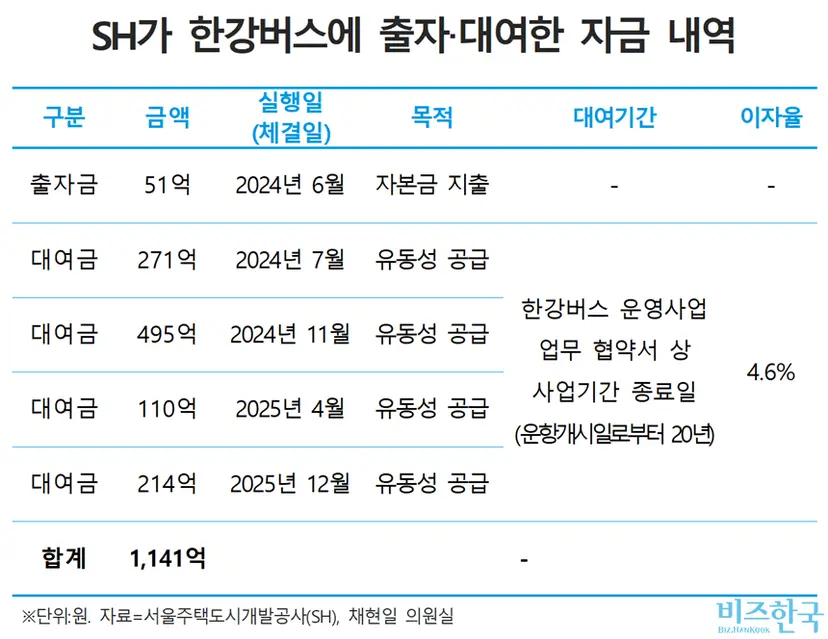
The funds injected by SH into the Hangang Bus to date amount to 114.1 billion won. Following the initial capital contribution of 5.1 billion won in June 2024, it loaned 27.1 billion won in July 2024, 49.5 billion won in November 2024, 11 billion won in April 2025, and 21.4 billion won in December 2025. Excluding the equity capital, the loan amount alone reaches 109 billion won. These were all intended to provide liquidity to the Hangang Bus. Although the Hangang Bus is eligible for subsidies from the Seoul Metropolitan Government for operational deficits, no instances of subsidy payments have been confirmed to date.
SH itself is not in a position with abundant financial flexibility. According to the aforementioned settlement documents, SH’s separate debt-to-equity ratio rose by 11 percentage points from 195% in 2024 to 206% in 2025. As of the end of last year, the total debt amounted to 21.583 trillion won, an increase of 1.5594 trillion won compared to the previous year. Generally, if a corporation’s debt-to-equity ratio exceeds 200%, its financial structure is considered unstable. While SH analyzed this debt ratio as “a somewhat high level” in its settlement documents, it projected in its mid-to-long-term financial management plan that the debt-to-equity ratio would reach the 250% level by 2026.
The Hangang Bus is Seoul's first aquatic public transportation system. It was first introduced last September by the Seoul Metropolitan Government to supplement severe traffic congestion and public transportation crowding during commuting hours. It operates in the form of passenger vessels traveling along a total 28.9km route with 7 piers on the Han River: Magok, Mangwon, Yeouido, Apgujeong, Oksu, Ttukseom, and Jamsil. The Hangang Bus operator is Hangang Bus Co., Ltd., a joint venture between SH, an affiliate of the Seoul Metropolitan Government, and E-Land Group’s E-Cruise. The two companies hold 51% and 49% stakes respectively, effectively making the Seoul Metropolitan Government the largest shareholder.
The Hangang Bus experienced a suspension of operations on some sections due to an incident last November. At that time, the Hangang Bus vessel No. 102 became stuck on the bottom of a shallow section near the Jamsil pier around 8 p.m. The causes of the incident were identified as deviating from the navigation route and insufficient brightness of navigation buoys. After the incident, the Hangang Bus stopped operations on the Apgujeong-Jamsil section and only operated between Magok and Yeouido. The Seoul Metropolitan Government resumed full operations in March after securing navigation depths and completing safety inspections.