

[비즈한국] The Public Deliberation Committee under the National Assembly’s Special Committee on the Climate Crisis reported the “Results of Public Deliberation on Climate Crisis Response Measures,” which underwent deliberation by a citizen delegation, to the Special Committee on April 13. The consensus shifted toward strengthening the 2035 Nationally Determined Contributions (NDC) and accelerating the reduction path.
This process was initiated by the Constitutional Court’s ruling of unconstitutionality on certain provisions of the Framework Act on Carbon Neutrality on August 29, 2024. At the time, the Court judged that the legal vacuum regarding the lack of specific greenhouse gas reduction targets from 2031 to 2049 infringed upon the fundamental rights of future generations, ordering the National Assembly to complete relevant legislation by February 28, 2026.
The National Assembly’s Special Committee on the Climate Crisis introduced the public deliberation process to hear directly from the public and reflect their voices in legislation. Accordingly, the Public Deliberation Committee, chaired by Lee Chang-hoon, a special professor at the Seoul National University Graduate School of Environmental Studies (former president of the Korea Environment Institute) and composed of ruling and opposition party coordinators and experts from various fields, was officially launched in February 2026.
The deliberation process began with a large-scale baseline survey of 10,000 people, followed by two weeks of self-learning and a four-day intensive deliberative forum involving a 312-member citizen delegation representing gender, age, and region, along with a 40-member future generation delegation who will be affected by these policies in the long term. The citizen delegation was randomly selected by reflecting not only demographic variables but also the distribution of stances on the climate crisis.
Reduction targets and pathways: "Stronger, faster"
The first core agenda was the "level of South Korea's greenhouse gas reduction targets." As a result of the deliberation, public perception shifted in a more proactive direction over time. In the first survey, 24.5% supported a target "higher than the global average reduction rate," but after four days of discussion, this rose to 35.8% in the second survey, an increase of 11.3 percentage points. Conversely, support for the "global average level" decreased by 11.0 percentage points, from 50.1% to 39.1%. The results showed support for the 61% upper limit, which aligns with the IPCC (Intergovernmental Panel on Climate Change) recommendation, rather than the 53% lower limit of the government’s original 2035 NDC.
A particularly noteworthy set of data is the change in the responses of the future generation. In the first survey, only 12.5% of the future generation agreed with a "level higher than average," but after the deliberation, this figure surged to 50.0%. This suggests a consensus that South Korea should play a leading role commensurate with its international status to resolve the climate crisis.
The second agenda, the "reduction pathway," was where the fiercest debate occurred. The committee presented three scenarios to the citizens: a method of reducing more at the beginning (early reduction type, concave), a method of reducing similar amounts throughout (linear), and a method of reducing more later (late reduction type, convex).
In this process, a serious rift occurred within the Agenda Deliberation Group over whether to include the so-called "convex path" option. The Agenda Deliberation Group is a collective of experts and stakeholders formed to set and refine the key issues for the citizen delegation. Eight participants, including the Korea Federation for Environmental Movements, the Federation of Korean Trade Unions, and Youth Climate Action, resigned en masse in protest of the Public Deliberation Committee's decision to ignore their recommendation to exclude the convex path and include it in the questionnaire, arguing that it was an unconstitutional option that shifts responsibility to future generations. This is because the Constitutional Court specified that when setting greenhouse gas reduction targets, one must "avoid taking a method that shifts an excessive burden to the future." However, the committee insisted on providing all information and pros and cons of paths to the public, leaving the final judgment to them, and pushed forward with the process.
Despite this controversy, the citizen delegation chose a method that reduces carbon emissions quickly. Support for the early reduction method, which was 51.2% in the first survey, surged to 77.9% after deliberation, an increase of 26.7 percentage points. Conversely, the controversial convex path gained only 2.1% support after deliberation, and linear reduction also fell to 19.9%. This is interpreted as the citizen delegation concluding that minimizing the risks to future generations is the most moral and rational choice, even if it requires paying costs right now.
A noteworthy point in the third agenda, "implementation measures," is the capacity to bear economic burdens. When asked if they were willing to endure energy price hikes or lifestyle inconveniences for carbon neutrality, a massive 94.6% of the citizen delegation answered positively. Notably, the active willingness to "willingly endure" jumped dramatically from 30.1% before deliberation to 51.0% after.
Chairman Lee Chang-hoon stated, "I hope the National Assembly reflects these deliberation results well in legislation," adding, "I hope that not only the citizen delegation but the entire nation will become more aware of the climate crisis, leading to a broader public deliberation."
Ruling and opposition parties clash over fairness; citizen delegation gives 'positive' rating to balance
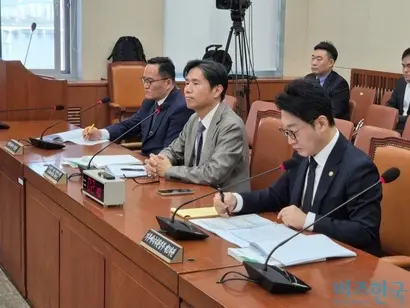
At the plenary session of the National Assembly's Special Committee on the Climate Crisis, where the results were reported, a fierce war of words took place between the ruling and opposition parties over the fairness of the deliberation process.
Rep. Kim So-hee of the People Power Party said, "Normally, public deliberation processes take a year abroad, but this period was too short," and "We need to look back at why the industrial sector was not able to participate actively in the process." In response, Chairman Lee Chang-hoon replied, "We tried to present the industrial sector's position as well and answered questions raised by the citizen delegation regarding transition costs and feasibility. Even when there were opinions to exclude the convex path during the agenda deliberation stage, we made an effort to ensure it was not excluded from the options until the end."
Kim Chun-seok, a division head at Hankook Research who designed the survey, said, "I think it is important how the citizen delegation evaluated the issue of bias," and "More than 90% evaluated the appropriateness of the deliberative material and the balance of opposing views as appropriate. This means that citizens answered that there was no information inducement." 90.7% of the citizen delegation evaluated that opposing views were composed in a balanced manner in the deliberative materials. Also, 80.0% responded that "expert presentations were balanced with opposing views," giving a positive evaluation.
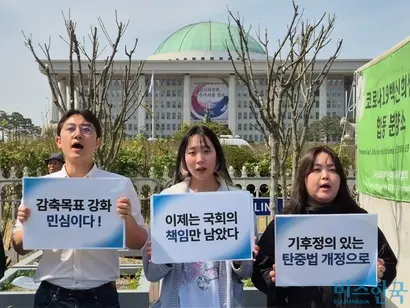
Civic society welcomed these results. On the afternoon of April 13, the Climate Crisis Emergency Action held a press conference in front of the National Assembly, welcoming the results and urging the completion of the amendment to the Framework Act on Carbon Neutrality reflecting these results by the end of May.
Kim Bo-rim, an activist from Youth Climate Action, said, "This result proves what direction our society should move toward only when diverse generations, who were previously alienated from the climate policy decision-making process, participate," adding, "The National Assembly must now move away from industrial lobbying, choose the people's right to safety, and immediately legislate the minimum climate response standards confirmed by the citizens."