

[비즈한국] A year has passed since the Seoul Metropolitan Government installed dedicated return bins for reusable containers at the delivery zones in Ttukseom and Yeouido Han River Parks. Although the bins were installed to reduce single-use plastics, doubts about their effectiveness are being raised as actual usage remains difficult to find on-site.
On the lunch hour of the 11th, Ttukseom Han River Park was bustling with citizens enjoying their outings. Crowds of people gathered at the delivery zones to pick up food, and delivery motorcycles were coming and going incessantly. In contrast to the busy atmosphere, users of reusable containers were rarely seen.
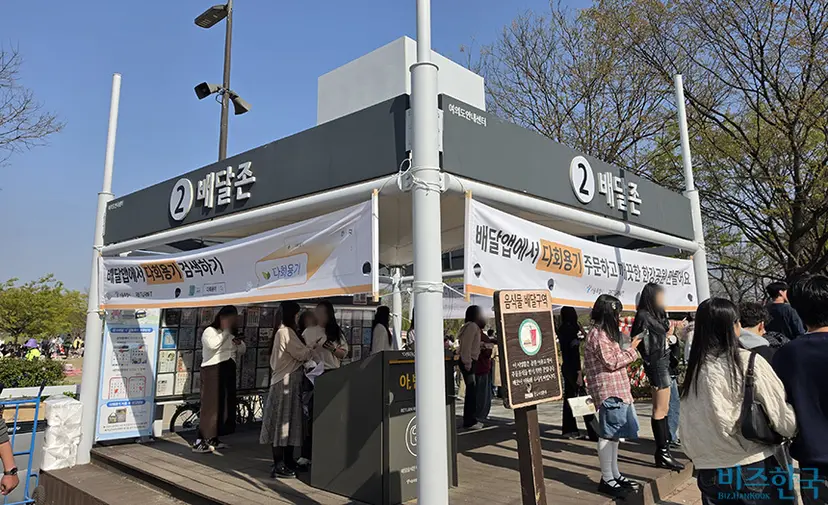
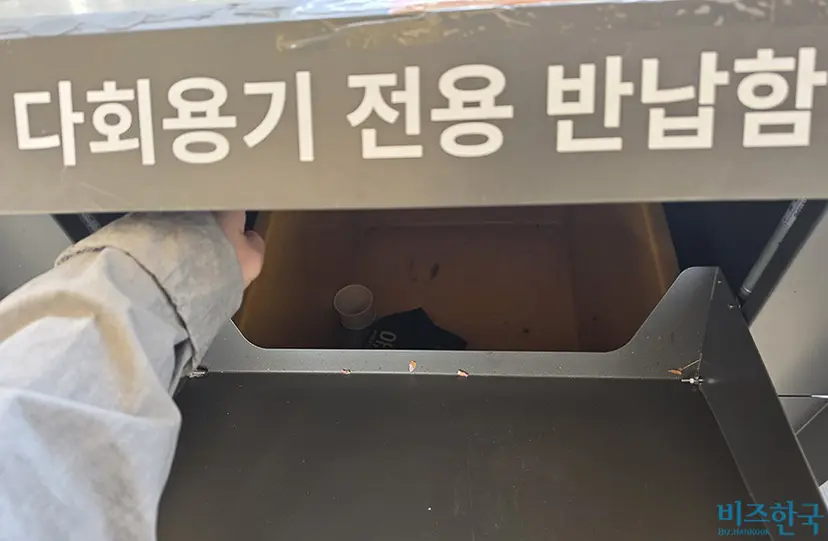
After observing Delivery Zones 1 and 2 at Ttukseom Han River Park from 11 a.m. to 2 p.m., only one group, excluding this reporter, was found to have ordered with reusable containers. When checking the dedicated return bins, no containers were found other than the ones I had returned myself.
Many of the citizens met that day were unaware of both the existence of the return bins and the fact that ordering with reusable containers is possible via delivery apps. A person surnamed Moon, whom I met at Ttukseom Delivery Zone 1, said, "I've come to the Han River often to order delivery food over the last year, but this is the first time I've heard of reusable container return bins."
It was not that there was a lack of signage. Banners encouraging reusable container orders were hung in the delivery zones, and information boards explaining how to order were also installed. However, they seemed unable to catch the citizens' attention. In fact, a woman in her 20s (Ms. A) who was picking up food at Ttukseom Delivery Zone 2 said, "I've never seen that before," even though she picked up her food right next to the information board when shown a photo of it.
The reactions from delivery drivers were similar. The drivers I met that day unanimously said, "I have never seen a case of delivery using reusable containers."
The situation was not much different at the Yeouido Han River Park delivery zone, which I visited around 3 p.m. This place was also crowded with citizens waiting for deliveries, but it was difficult to find anyone using the reusable container service. Upon checking the return bins at Yeouido Delivery Zones 1, 2, and 3, only one return case was confirmed at Zone 3.
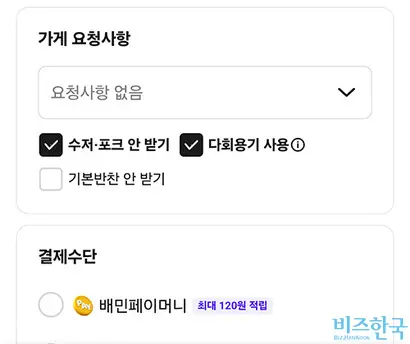
After personally trying the reusable container delivery service, I found that the ordering and return processes were cumbersome. In the case of 'Baedal Minjok' used that day, I had to search for 'reusable container' to find participating restaurants and then separately configure the reusable container usage through store request options during the checkout phase.
The return process was not simple either. After the meal, I had to put the containers in the provided return bag, register the orderer and return information via the QR code attached to the bag, and then drop it back into the dedicated bin. The fact that the user has to walk back to the delivery zone with the return bins after finishing their meal was also an inconvenience.
Different ordering methods for each app acted as another barrier to entry. While Baedal Minjok requires a separate setting in the store requests, Coupang Eats requires adding a menu item labeled 'reusable container' to the cart. Although the information banners at the delivery zones had brief instructions for each app, they did not contain specific ordering steps, which limited actual usage.
Another limitation is that the selection of menus and restaurants is not diverse. Available options are concentrated on items like malatang, jjimdak (braised spicy chicken), and kimchi stew, leaving limited choices. Furthermore, popular items at Han River parks such as chicken or franchise tteokbokki could not be ordered in reusable containers. A person surnamed Kang, whom I met in Yeouido that day, said, "I saw the banner on a delivery app recently and wanted to try it, but gave up because I couldn't order the menu I wanted."
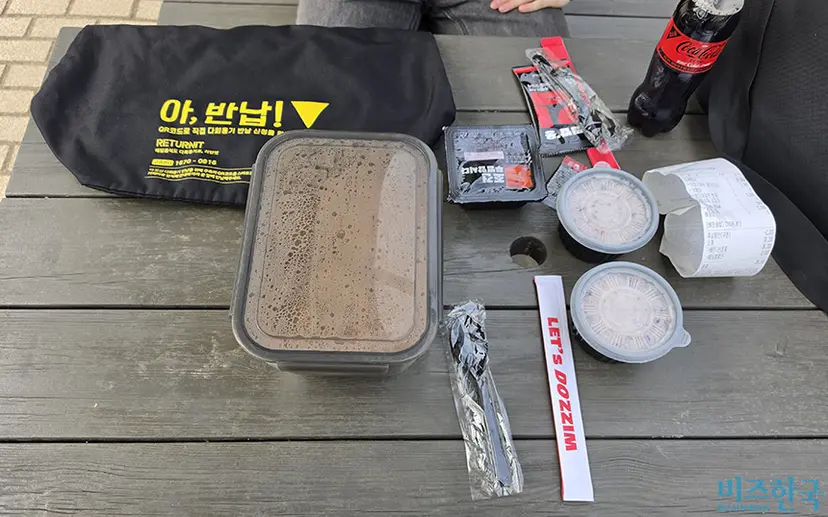
Even when ordering with reusable containers, not all components were provided as such. While the main dish was in a reusable container, the rice came in a plastic bowl, and the spoon and chopsticks were also provided as disposables. Contrary to the purpose of reducing single-use plastics, some components were still reliant on disposables.
According to the Seoul Metropolitan Government, from April to December 2025, the first year of the return bin introduction, there were 221 reusable container orders and 212 returns within Han River Parks. Compared to the atmosphere of the park, where delivery demand is high, the usage rate was relatively low. A city official stated, "As it is still in the early stages of introduction, we will expand the project in phases."
While the policy objective of reducing plastic was clear, the reusable container delivery service has yet to take root in the field. Most citizens were unaware of the service itself, and the ordering and return processes were hardly simple. For the return bins to be more than just a gesture for show, it appears that supplementary measures are needed, such as raising citizen awareness, improving the ordering process, and expanding the number of participating restaurants.