

[비즈한국] "Industrial competitiveness without employment is meaningless, and employment without industrial competitiveness cannot exist." The industry, academia, and government have put their heads together to address the paradoxical task of balancing industrial efficiency with labor. As the rapid expansion of generative artificial intelligence (AI) and the on-site deployment of physical AI and humanoid robots become tangible, concerns about "jobless growth" are mounting. A forum was held at the National Assembly to discuss how to turn this technological transition into an "opportunity" for jobs.
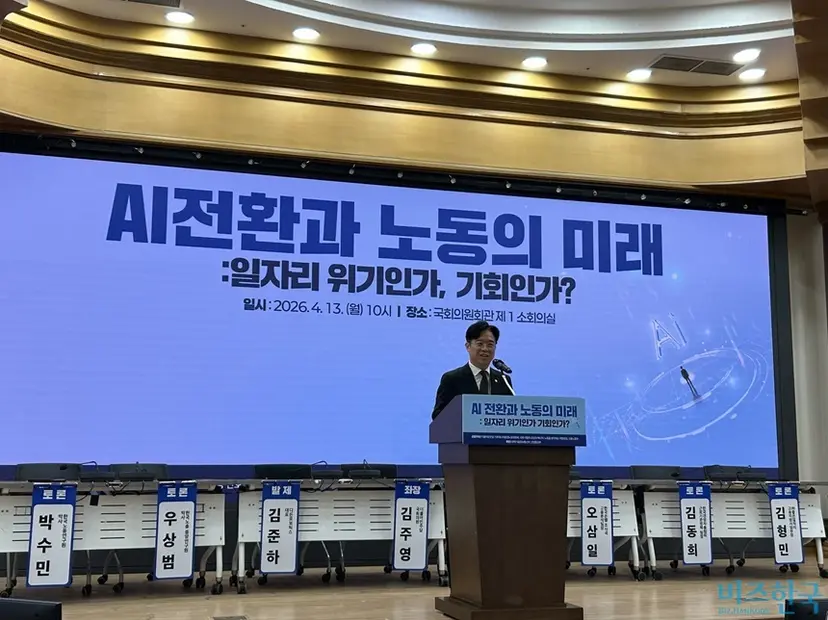
In this era of transition where AI is reshaping all industries, the clash between the industrial demand for maximizing efficiency and labor values summarized by employment stability has emerged as a key challenge. At the National Assembly forum on the morning of the 13th, titled "AI Transformation and the Future of Labor: Job Crisis or Opportunity?", experts agreed that technology should not simply be viewed as a means to replace labor, but as an opportunity to redefine the role of labor.
Minister of Employment and Labor Kim Young-hoon, who attended the event, emphasized, "Protecting vulnerable workers and identifying high-risk workplaces in a timely manner through AI means that the Ministry of Employment and Labor is leading AX (AI Transformation)," adding, "The government's role is to turn the crisis caused by AI into an opportunity."
'Dark Factories' Become Reality... Human Labor Patterns Must Change
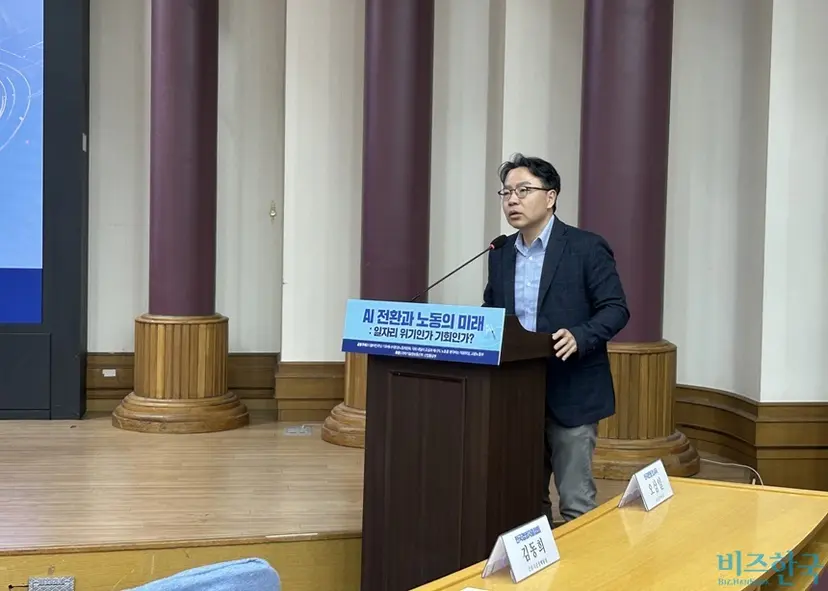
The first presenter, Professor Jang Young-jae of the Department of Industrial and Systems Engineering at KAIST, cited the case of "KAIROS," an operation platform for unmanned factories ("dark factories"), to suggest how the grammar of labor would change. KAIROS, co-developed by KAIST and the AI-based autonomous manufacturing startup Dime Research, is an integrated control system that allows different technologies—logistics, assembly, inspection, etc.—to move organically. Professor Jang is also the CEO of Dime Research. The core is a "digital twin," an exact implementation of an actual factory in a virtual space. AI agents clear paths for robots so they do not overlap and determine collaboration scenarios in real-time, while humans resolve issues by talking to the AI via voice when equipment malfunctions.
Professor Jang compared this to the Greek terms "Chronos" (quantitative time) and "Kairos" (decisive timing). He argued that Chronos-like labor, which involves repetitive tasks at the speed of machines, should be left to robots, while humans should focus on the role of designers who grasp context and make optimal decisions. Professor Jang stated, "Humans are now moving to the layers of design, modeling, and operation," adding, "In the AI era, if you have the will and the desire, you can transition and develop your own job alongside AI. We must focus on the job opportunities that AI can create."
Kim Jun-ha, CEO of physical AI startup Diden Robotics, highlighted the practical limitations and possibilities of the field simultaneously. Diden Robotics focuses on developing physical AI technology that can be deployed in workplaces with high risks of industrial accidents and labor shortages, such as shipyards or construction sites.
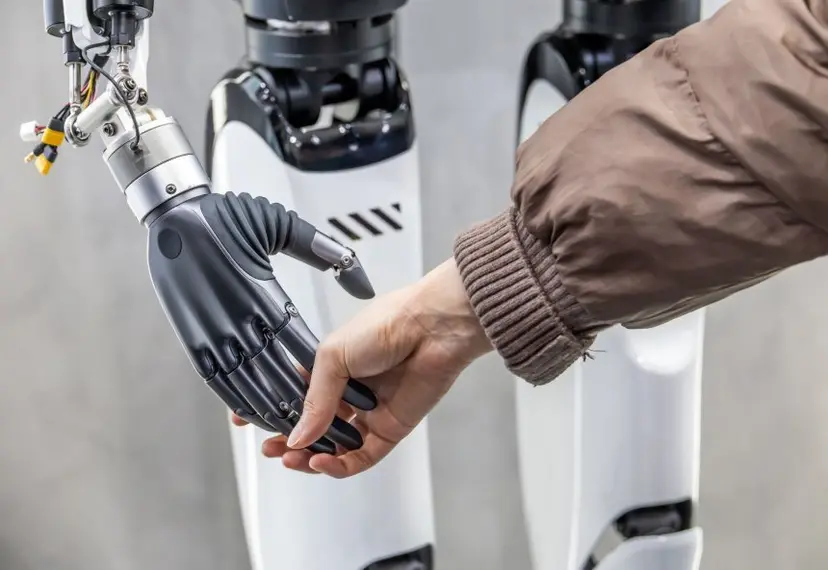
CEO Kim raised the issue of the price of "hands," a key bottleneck for humanoid robots, and diagnosed that there is still physical time to build a symbiotic relationship between humans and AI before actual industrial field adoption, as technical and economic challenges in hardware mass production remain. "With a single robot hand costing around 75 million won, and the total cost for full arms and legs exceeding at least 300 million won, it is not realistic to replace general manufacturing processes," Kim said, viewing this delay as an opportunity for us to prepare.
"Unless robot prices drop, it will take time for them to enter industrial sites," Kim said. "In the meantime, we must think about a relationship where humans, AI, and humanoids can coexist." Citing a case from a shipyard, he added, "Field workers say, 'I hope my children don't work in this field.' Robots should be introduced starting from harsh industrial sites where humans should no longer enter."
Discussions on Soft Landing Strategies for Employment and Labor in the AX Era Begin
In the subsequent discussion, structural challenges beyond technological optimism were brought to the table.
Warnings were also raised that the impact of AI could go beyond the mere increase or decrease in the number of jobs, potentially deepening the dual structure of the labor market and issues of distributive justice. Dr. Park Soo-min of the Korea Labor Institute pointed out that AI technology is being projected through the lens of a labor market that is already entrenched in a dual structure, rather than in a vacuum. "The impact of AI technology on the labor market could refract or amplify polarization and inequality between large companies and SMEs," Dr. Park suggested. "For an inclusive transition, we need to consider governance that recognizes the value of data production that occurs during the labor process and shares the profits."
Dr. Woo Sang-beom of the Federation of Korean Trade Unions (FKTU) Central Research Institute raised the issue of compensation during the process of digitizing worker skills. "All the skills that physical AI learns came from workers, but there is no compensation or measures for this," Dr. Woo said. "We must seriously discuss tax reform, such as a robot tax or digital tax, to share the fruits of productivity improvement, and this is an area of collective assets that should be resolved through social dialogue between labor, management, and government."
Oh Sam-il, head of the Employment Analysis Team at the Bank of Korea, analyzed based on data from the past three years that "while working hours have decreased by approximately 1.5 hours due to AI utilization, this has not led to increased production, but is largely being enjoyed as personal leisure." The contribution of AI utilization to overall economic productivity is estimated at about 1.0%. Team Leader Oh explained, "If this information mismatch persists, companies will have no choice but to make decisions to hire fewer people, which could eventually lead to job disappearance."
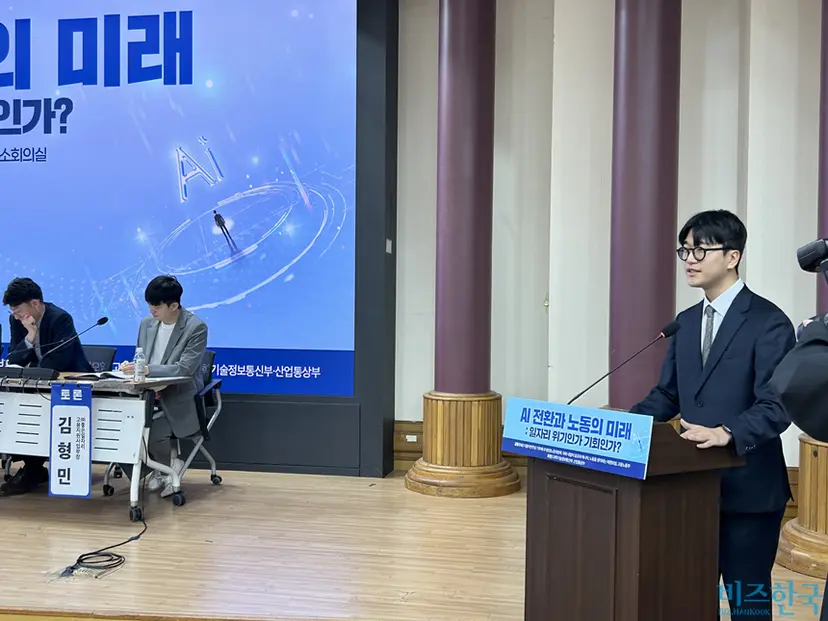
Kim Dong-hee, a team leader at the Korea Enterprises Federation, spoke for the corporate stance for survival and requested labor market flexibility. "In the AI era, the quality and method of labor change rather than the quantity, so rigid labor norms must be innovated," said Team Leader Kim. "The policy paradigm must shift toward ensuring sustainable employment across the entire labor market, not stability at a single workplace."
Kim Hyung-min, head of the Good Job Business Division, who conveyed the voices of the younger generation, pointed out the digital divide by company size. "Unlike large companies, young people working at SMEs have to rely solely on their own will due to a lack of infrastructure and training opportunities," said Manager Kim. "Along with government-level AI competency voucher support, it is urgent to support job redesign that can foster human-like capabilities as the greatest competitive advantage rather than just immersing in technology."
Relevant government ministries expressed their policy will for a soft landing in the AX era. Kim Hyung-gwang, Director of Labor Market Policy at the Ministry of Employment and Labor, introduced the five core pillars of the "Basic Plan for Industrial Transition and Employment Security" currently being established. Major tasks include: △establishing a real-time AI technology field monitoring system, △innovating the vocational training paradigm such as specializing for the youth, △reviewing the tax system for fair distribution of profits, △supporting AI-based startups and new job creation, and △strengthening social dialogue with stakeholders.
Kwon Soon-mok, Director of the Industrial AI Policy Division at the Ministry of Trade, Industry and Energy, emphasized that "the completion of industrial policy is ultimately jobs." He explained, "While increasing corporate competitiveness through AX in manufacturing sites, we will protect jobs by discovering new job demands where field workers, such as robot and AI system managers, can transition with willingness."
Choi Woo-seok, Director of the Artificial Intelligence Safety and Reliability Support Division at the Ministry of Science and ICT, cautioned against vague fear and urged a meticulous approach. This means prioritizing policy responses by precisely analyzing phenomena occurring in the actual field rather than accepting the ripple effect of AI as a single threat. Director Choi stated, "We will build concrete governance through the 'AI Social Policy Forum,' which will launch at the end of this month, to ensure that technology can enhance the benefits for society as a whole."
Rep. Kim Ju-young, who moderated the discussion, responded, "In the process of AI transformation, the effort for labor and management to find common ground through social dialogue is more important than anything else. The National Assembly will also do its best to create an inclusive and sustainable future of labor through legislation and institutional support."
The forum was co-hosted by the Democratic Party of Korea's Climate, Energy, Environment, and Labor Committee, the National Assembly's "Group of Lawmakers Thinking about Tomorrow's Public Service, Energy, and Labor," and the Ministry of Employment and Labor, and was sponsored by the Ministry of Science and ICT and the Ministry of Trade, Industry and Energy. Kim Jung-ho, Chairman of the National Assembly Climate, Energy, Environment, and Labor Committee; Lee Hak-young, Deputy Speaker of the National Assembly; and lawmakers Cho Jung-sik, Eo Gi-gu, Park Hae-chul, Park Hong-bae, and Kim Tae-sun were in attendance.