

[비즈한국] In November 2024, the revision of corporate disclosure requirements led to the introduction of the 'Work-Life Balance Disclosure System,' which requires companies to disclose the usage status of parental leave and flexible working systems in their business reports. Accordingly, starting from the March 2025 business reports (for the 2024 fiscal year), companies have been disclosing whether these systems are in place and their usage rates. As the government actively pursues policies to reduce actual working hours and improve work performance methods to achieve better work-life balance, we examined the status of flexible working systems within the banking sector.

Under the work-life balance disclosure system, companies are required to disclose whether they use flexible working systems and the number of employees using △staggered commuting, △selective working, and △remote working (including telecommuting). Staggered commuting is a system that allows employees to adjust their start and end times while maintaining total working hours, while selective working is a system that allows employees to adjust their daily or weekly working hours as long as the monthly average does not exceed 40 hours per week. Selective working is categorized as a more favorable system for independent work compared to staggered commuting. Remote work refers to working from home or near a business trip destination using mobile devices.
A review of the work-life balance disclosures of major domestic banks shows that all four major commercial banks (KB Kookmin, Shinhan, Hana, and Woori) utilized flexible working systems, but the specifics varied. The number of employees is based on those who used the flexible working system at least once a year. Based on the 2025 business reports, Kookmin Bank and Shinhan Bank were the only ones that disclosed using all three systems: staggered commuting, selective working, and remote/telecommuting.
The number of employees using flexible working systems was overwhelmingly higher at Shinhan Bank than at Kookmin Bank. At Shinhan Bank, a total of 12,121 employees used flexible working: 9,722 for staggered commuting, 2,393 for selective working, and 6 for remote/telecommuting. At Kookmin Bank, a total of 1,176 employees used the system: 1,005 for staggered commuting, 139 for selective working, and 32 for remote/telecommuting.
It is also notable that remote/telecommuting has been rarely used since the end of the COVID-19 pandemic. The number of remote/telecommuting users at Kookmin Bank, which reached 3,948 in 2022, dropped significantly to 1,018 in 2023, 200 in 2024, and 32 in 2025. Similarly, at Shinhan Bank, the number of users plummeted from 364 in 2022 to 61 in 2023, 17 in 2024, and 6 in 2025.
Hana Bank and Woori Bank utilized only some of the systems. Hana Bank specified only staggered commuting (538 employees) and remote/telecommuting (11 employees), while Woori Bank only specified the number of users for staggered commuting (12,557 employees). A Woori Bank official explained, “Remote/telecommuting has not been in use since COVID-19. Our flexible working system allows for 9 hours of work per day within the 52-hour workweek, with options for employees to choose from three different shift start times.”
The proportion of employees using flexible working systems varied significantly among the four major banks. Hana Bank had the lowest usage rate, with only 4.6% of its 11,837 total employees (excluding part-timers) participating. Kookmin Bank followed at 7.6% out of 15,389 employees. Shinhan Bank and Woori Bank were the most active users. Shinhan Bank was the most proactive, with 94.8% of its 12,781 employees utilizing the system, while Woori Bank also showed a high rate of 88.4% out of 14,203 employees.
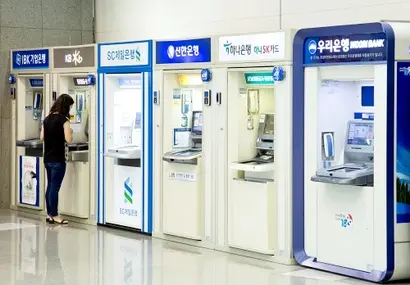
While some institutions have usage rates exceeding 90%, some regional banks do not operate flexible working systems at all. Daegu-based iM Bank and BNK Financial Group's Kyongnam Bank disclosed in their business reports that they do not use flexible working systems. Jeju Bank, a subsidiary of Shinhan Financial Group, stated that it operates a flexible working system, but the number of users was zero for three consecutive years (2023–2025). However, it did disclose that 121 employees worked from home in 2022 due to COVID-19.
Among the remaining regional banks, Gwangju Bank and Jeonbuk Bank (under JB Financial Group) and Busan Bank (under BNK Financial Group) utilized flexible working systems. All three banks only had users for the staggered commuting system, with Gwangju Bank having the highest number of users at 136, followed by Jeonbuk Bank with 44, and Busan Bank with 36. As a percentage of total employees, the rates were 7.7% for Gwangju Bank (1,759 employees), 3.1% for Jeonbuk Bank (1,432 employees), and 1.6% for Busan Bank (2,295 employees).
Meanwhile, as the Lee Jae-myung administration actively pushes for the introduction of a 4.5-day workweek to ensure work-life balance, the reduction of actual working hours and the adoption of flexible working by companies are expected to accelerate. This year, the Ministry of Employment and Labor is conducting a project to support companies that reduce working hours without reducing wages through labor-management agreements, providing up to 7.2 million won per year per employee. Furthermore, the government is pushing for the enactment of the 'Actual Working Hour Reduction Support Act' to protect workers from work-related directives outside of working hours and to create conditions conducive to flexible working.
The financial sector, which previously introduced the 5-day workweek ahead of others, has been discussing the introduction of a 4.5-day workweek led by labor unions since last year. However, as critics point out the low feasibility due to potential inconvenience to financial consumers and the lack of government guidelines, the banking sector has recently been introducing the so-called '4.9-day workweek,' which allows employees to leave work one hour early on Fridays. An industry insider remarked, “Since branches often have overtime even after closing, we must improve operational efficiency to ensure that shorter hours do not lead to an increased workload.”