

[비즈한국] Following the Middle East war that began in late February with attacks by the U.S. and Israel on Iran, the South Korean won-to-dollar exchange rate has surged, ranking as the 4th highest among 39 major global currencies. An increase in the won-to-dollar exchange rate signifies a depreciation of the won, indicating that the South Korean economy is perceived as more vulnerable to this Middle East conflict compared to other nations. Because South Korea relies heavily on Middle Eastern crude oil, global investors have viewed the Korean economy with concern.
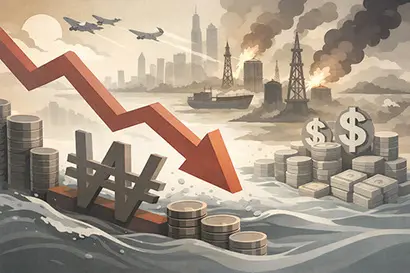
According to the Bank of Korea on the 10th, from February 27, before the U.S. and Israeli attacks on Iran, to March 31, the won-to-dollar exchange rate rose by 6.28%, from 1,439.7 won on February 27 to 1,530.1 won on March 31. This means that the value of the won fell by 6.28% compared to the dollar, which is the foundation of global trade. Consequently, the amount of foreign goods and services that can be purchased with the won has decreased, increasing the cost of external payments.
Furthermore, the depreciation of the won leads to rising import prices, which in turn causes domestic inflation. The burden on households and companies that must remit money to students studying abroad or expatriate employees also increases due to the rapid rise in the exchange rate. As such, a high exchange rate triggers high inflation, which leads to base rate hikes and high interest rates, creating the worst-case scenario for the economy known as the "triple high" (high exchange rate, high inflation, and high interest rates).
The jump in the won's exchange rate is due to increased demand for the dollar, a safe-haven asset, in the international community following the outbreak of the war in the Middle East. The problem is that while it is true the exchange rate rose as the value of the dollar increased, the blow dealt to the won was exceptionally severe. Among 39 major countries, only three saw their exchange rates against the dollar rise more than South Korea: Egypt (13.56%), South Africa (7.99%), and Hungary (6.37%).
In the case of Egypt, the aftereffects of the Middle East conflict, starting with the Gaza war, have continued, and the exchange rate surged due to concerns over the Suez Canal after the Yemen-based Houthi rebels, who support Iran, declared a blockade of the Red Sea. In South Africa, high foreign investment exposure led to capital flight caused by the war, driving up the exchange rate. In Hungary, anxiety over the potential collapse of Viktor Orban's administration in the first general election in 16 years influenced the rise.
South Korea saw the 4th highest exchange rate increase, a rate higher even than that of Israel, a country directly involved in the war, or Middle Eastern oil-producing nations caught in the crossfire. The Israeli shekel exchange rate rose by only 1.62% during the same period, from 3.12 shekels on February 27 to 3.17 shekels on March 31. The Kuwaiti dinar rose by 0.47%, the Bahraini dinar by 0.14%, and the Saudi riyal by 0.06%.
The Jordanian dinar remained unchanged, the United Arab Emirates (UAE) dirham actually fell by 0.01%, and the Qatari riyal also saw its exchange rate against the dollar drop by 0.04% over the same period. Israel's situation is interpreted as being due to its economy being structured for war and its military performance. For Middle Eastern oil-producing nations, their status as crude oil exporters prevented the depreciation of their currencies despite some damage.
The exchange rate surge was also higher than that of other Asian countries such as Japan, Taiwan, Vietnam, Indonesia, and India. The Japanese yen rose by 2.50% against the dollar, from 155.96 yen on February 27 to 159.86 yen on March 31, less than half of the won's increase. The New Taiwan dollar rose by 2.53% during the same period, similar to the yen. The Vietnamese dong rose by 1.04%, the Indonesian rupiah by 1.40%, and the Indian rupee by 3.72%.
The reason the won is weaker than other emerging market currencies is interpreted as a combination of worsening terms of trade due to an energy import structure that relies 70% on the Middle East and a cumulative increase in money supply driven by expansionary fiscal policies that were in place even before the war.