

[비즈한국] It has been confirmed that the number of workers who died at construction sites of the top 7 domestic construction companies last year increased by one compared to the previous year. The number of major accidents also decreased by only one. Although large construction companies are touting strengthened safety management and institutional improvements, there is criticism that headquarters' management is not functioning properly on-site.
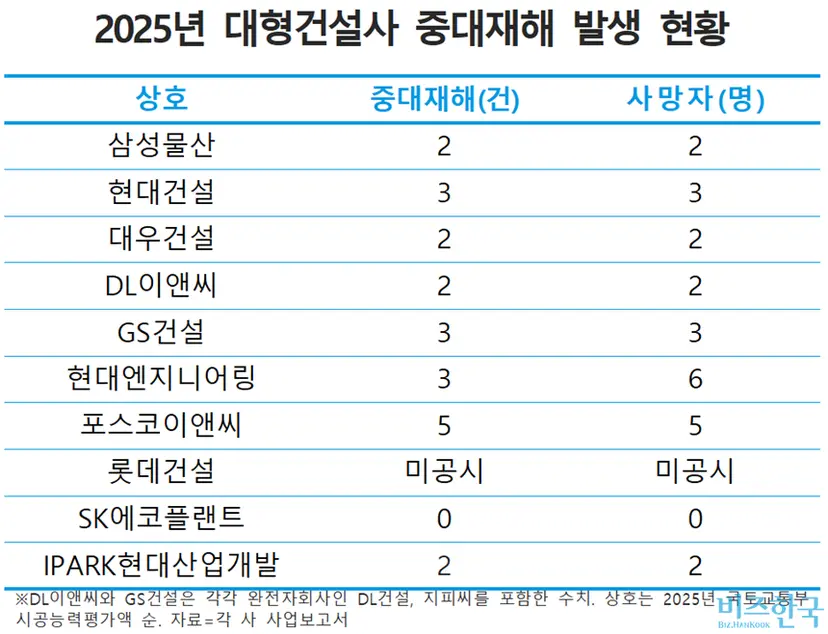
After analyzing the business reports of the 7 major construction companies that disclosed major accident occurrences, Bizhankook found that 23 workers died at their construction sites last year, an increase of 1 compared to the previous year. By company, Hyundai Engineering had the highest number of deaths with 6 (an increase of 4 from the previous year), followed by POSCO E&C with 5 (an increase of 2), Hyundai E&C000720 with 3 (an increase of 1), GS E&C006360 with 3 (including its wholly-owned subsidiary GPC, a decrease of 3), Samsung C&T028260 with 2 (an increase of 1), Daewoo E&C047040 with 2 (a decrease of 5), and DL E&C375500 with 2 (including its wholly-owned subsidiary DL Construction, an increase of 1).
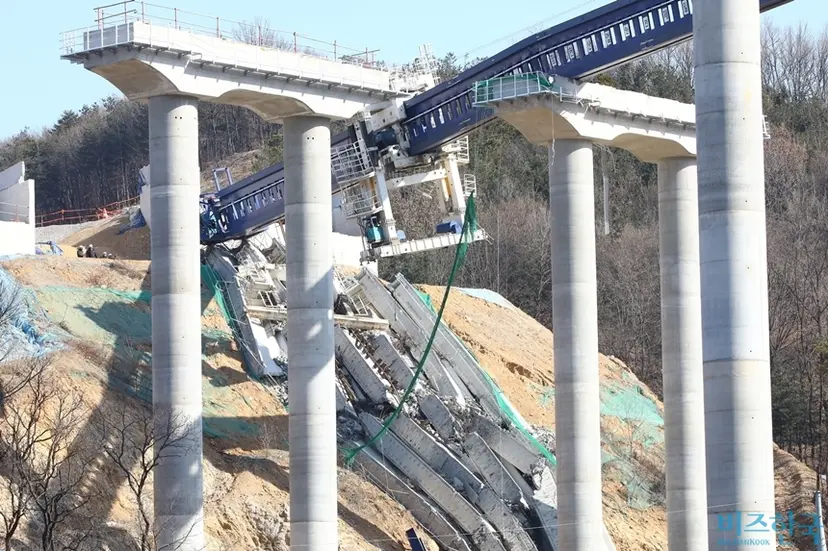
The site with the highest number of fatalities was Hyundai Engineering's Sejong-Anseong Expressway construction site. In February of last year, during bridge construction in Seowon-myeon, Anseong-si, Gyeonggi-do, a device used to transport bridge deck structures overturned, causing the bridge to collapse. At the time, 4 workers died and 6 were injured. The Ministry of Land, Infrastructure and Transport's accident investigation committee pointed to the unauthorized removal of anti-rollover facilities and unauthorized movement of devices as the causes of the accident in August of last year. It was also noted that overall site management and supervision were poor, including instances where operators other than those designated in the construction plan operated the equipment.
The number of major accidents also remained similar to the previous year. Last year, the number of major accidents at the 7 major construction companies was 20, which is only a decrease of 1 compared to the previous year. By company, POSCO E&C had the most major accidents with 5 (an increase of 2), followed by Hyundai E&C with 3 (an increase of 1), GS E&C with 3 (including GPC, a decrease of 3), Hyundai Engineering with 3 (an increase of 1), Samsung C&T with 2 (an increase of 1), Daewoo E&C with 2 (a decrease of 4), and DL E&C with 2 (including DL Construction, an increase of 1).
A major industrial accident is defined as an accident where: △ at least one person dies, △ two or more people suffer injuries requiring treatment for six months or more from the same accident, or △ three or more people develop occupational diseases such as acute poisoning from the same harmful factor within one year. Under the Serious Accidents Punishment Act, if a major industrial accident such as a worker's death occurs at a workplace, business owners or management responsible for failing to fulfill their duties to prevent accidents can face imprisonment of at least one year or fines of up to 1 billion KRW.
Meanwhile, Lotte E&C is the only company among the top 10 construction companies that did not disclose its major accident status. Following the Korea Exchange's guideline revision last year, listed companies must disclose major accident occurrences and reflect them in their periodic reports. While non-listed companies are not obligated to disclose, Hyundai Engineering, POSCO E&C, and SK Ecoplant included such facts in their business reports. Last year, SK Ecoplant, which ranked 9th in construction capacity, had no major accidents, while 10th-ranked HDC Hyundai Development Company experienced 2 major accidents resulting in 2 deaths.
The government's stance on major accidents is firm. In a cabinet meeting last July, President Lee Jae-myung said, "I hope this year can be the first year of eradicating industrial fatalities," adding, "Safety is an obligation, and life is more precious than money." In March of this year, he again mentioned major accidents as one of the tasks for the 'Normalization of the 7 Major Abnormalities.' The Ministry of Employment and Labor announced last year that it would actively utilize compulsory investigations such as search and seizures and arrests in the event of major accidents. Nevertheless, the fact that major accidents at large construction companies are not easily decreasing shows the gap between the government's tough stance and the reality of construction sites.
Choi Myung-ki, a professor at the Korea Industrial Site Professors Association, pointed out, "Even though construction companies say they have increased safety inspections and support from their headquarters, it still does not work properly on-site. There is an aspect of showmanship or performative safety enhancement," adding, "No matter how much safety inspections and punishments are strengthened, if the on-site conditions do not change, accidents will not decrease. It is necessary to guarantee workers the authority to stop work if it is dangerous, and to ensure sufficient construction costs and time so that workers are not forced to work excessively."