

[비즈한국] There was one scene that particularly caught the eye during the state banquet for French President Emmanuel Macron held at the Blue House on the 3rd. It was Samsung Electronics 005930 Chairman Lee Jae-yong having a lengthy conversation with the young foreigner sitting next to him.
This foreigner is Arthur Mensch, the co-founder and CEO of the French startup 'Mistral AI.' Mistral is a three-year-old startup, and CEO Mensch is 33 years old this year, 24 years younger than Chairman Lee.
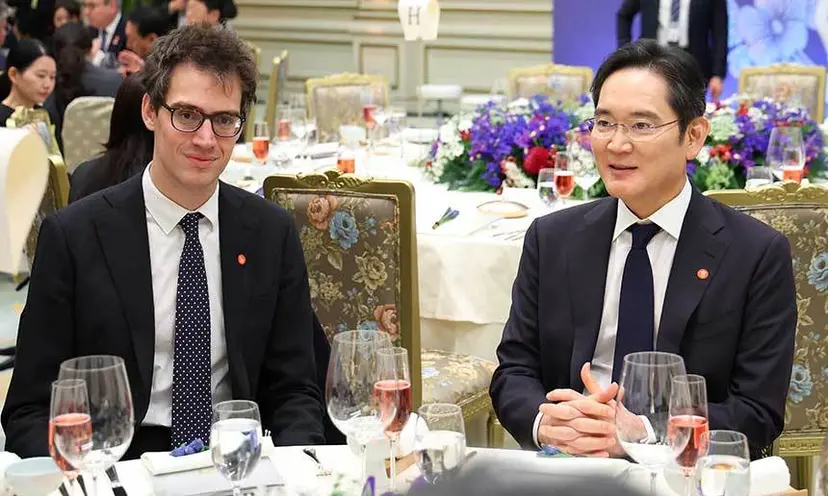
Of course, there is no reason why this shouldn't happen. However, it is customary in such business diplomatic settings to assign seats to business leaders based on their field and 'status.' In the past, the seat next to Chairman Lee would have been occupied by seasoned chairmen of massive corporations with decades of tradition, such as TotalEnergies or Airbus.
It appears that CEO Mensch's placement was requested by the French side during the protocol negotiation process between the two countries. It was a decisive scene showing where the weight of the future industries France is picturing is shifting.
The European version of OpenAI, standing at the center in just 3 years
Mistral was co-founded in 2023 by Mensch, who is from Google DeepMind, and two other large language model (LLM) developers from Meta. From its first year of operation, it gained the nickname 'the European version of OpenAI' by unveiling 'Mistral Large,' an LLM that rivals GPT-4. Due to this, it attracted 1.7 billion euros (approximately 3 trillion won) from semiconductor equipment company ASML last September, and its corporate value rose to the 12 billion euro (approximately 20 trillion won) level just two years after its founding. Previously, in 2024, it also received 600 million euros (approximately 1 trillion won) in investment from companies including Samsung and Nvidia.
The reason CEO Mensch joined this delegation seems clear. Mistral is currently building a new data center near Paris, France. This facility, which is expected to be equipped with approximately 14,000 of Nvidia's latest GPUs, aims to be operational in the first half of this year. To train and service AI models, a massive amount of memory semiconductors must be secured. Samsung is the most viable partner as a supplier.
CEO Mensch already visited the Samsung Electronics Hwaseong Campus on the 2nd, the day before the welcoming luncheon, to meet with Young Hyun Jun, the head (vice chairman) of Samsung Electronics' Device Solutions (DS) division, to discuss a wide range of AI semiconductor supply chain and technology cooperation plans. Beyond just the stable supply of HBM (High Bandwidth Memory), there is speculation that Samsung's foundry could become a key partner if Mistral begins designing its own AI chips. Furthermore, a cooperation scenario involving the default installation of Mistral's chatbot model on Galaxy devices in the European market is also being mentioned.
The final condition for AI sovereignty
There was another fresh scene. CEO Mensch personally requested a meeting with the Korean government's National AI Strategy Committee. On the afternoon of the 3rd, Deputy Chairman Im Moon-young, Blue House AI Future Planning Secretary Ha Jung-woo, and the Mistral management team met. The committee stated that they formed a consensus that securing 'Sovereign AI' is the core of national competitiveness in the AI era.
The grand discourse of Sovereign AI—or AI sovereignty—begins with a highly common-sense and existential fear. The current global AI ecosystem is effectively dominated by a small number of companies based in the U.S. and China. If they cannot break free from this structure, each country will inevitably be dependent on the outside for data, industrial competitiveness, and ultimately, technological sovereignty.
For example, through the so-called 'CLOUD Act,' the U.S. government can obtain data stored on servers operated by U.S. companies like Google, Microsoft, and AWS upon request, regardless of which country the server is located in. There are no exceptions whether the server is in Seoul or Paris. In other words, the moment medical records, government documents, or design data from a defense company are processed on a U.S. cloud, it means they are placed under the jurisdiction of U.S. law.
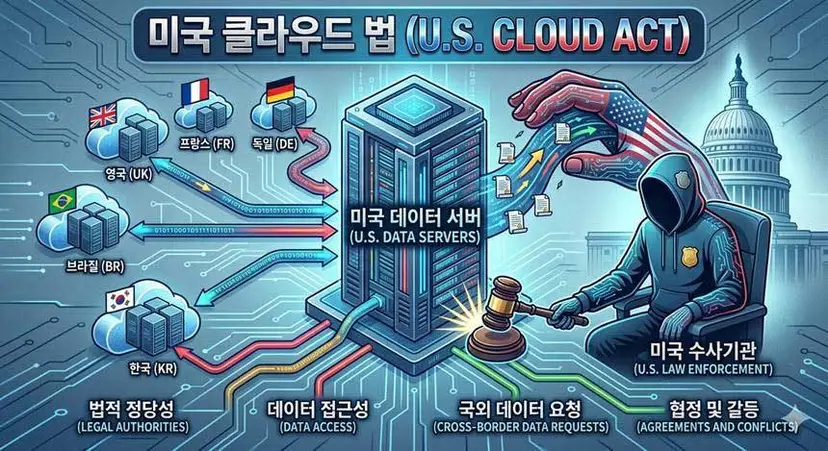
At an AI summit in India last February, CEO Mensch said, "Anyone who operates AI workloads must have their hands on the on/off switch. You must not rely on an external provider who can turn that switch off."
This implies that if a provider suspends service for its own national interests or political reasons, a country that has not secured AI sovereignty could see its entire industry paralyzed. This means AI sovereignty is not just about the pride of having built one's own AI ecosystem.
The Korean government is also accelerating its technological independence by selecting companies to launch the 'Independent AI Foundation Model' project, with the goal of 'leaping to one of the world's top 3 AI powers.'
The direction of securing national-level infrastructure is correct. However, looking at France, Mistral AI was not an organization created by government planning. Researchers who honed their skills at Google DeepMind and Meta entered the market on their own, and the market recognized their technical prowess first. The French government merely placed a 'strategic umbrella' over the value they had already proven.
Korea also has AI startups founded by researchers from Big Tech. It's not that the seeds themselves don't exist. France intentionally laid the soil so those seeds could grow. They invested in the research ecosystem, attracted global Big Tech AI laboratories to Paris, and created an environment where the talent that honed their skills there could emerge as entrepreneurs. Mistral is a company that grew in that soil.
Is Korea's soil sufficient? And are we ready to place such companies at the forefront of state-level diplomacy, as Macron did? Those two questions remain.
The author, Lee Jung-woo, worked as a journalist for 17 years, covering various fields including major industries such as automobiles, secondary batteries, and heavy industry, as well as defense, diplomacy, environment, education, and health and welfare. In particular, he covered on-site reports on industrial structural changes centered on mobility, energy transition, and sustainability. He currently resides in Berlin, Germany, and serves as a partner at the startup accelerator '123 Factory'.