

[비즈한국] Following the revision of the 'Act on the Promotion of the Development, Use, and Diffusion of New and Renewable Energy (New and Renewable Energy Act)' last year, the mandatory installation of solar power facilities in public parking lots nationwide has entered the full-scale implementation stage. However, as there are no restrictions on the 'operating entities' of power generation facilities under current laws, issues regarding this have emerged. Civil society and experts suggest that to prevent the privatization of profits generated from public land, entities with public characteristics, such as public institutions or local community cooperatives, should lead the operation.
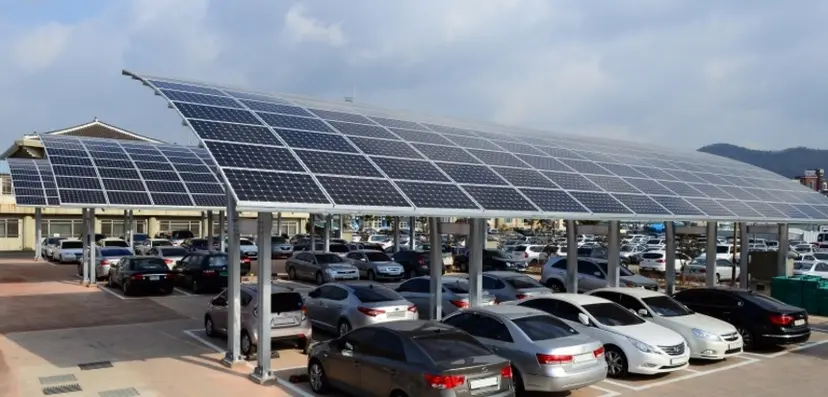
Public parking lots are evaluated as the optimal idle sites for expanding renewable energy in terms of land use efficiency. This is because solar facilities can be constructed without the need for separate forest destruction or land expropriation procedures. According to analysis by the Korea Federation for Environmental Movements, if solar power plants were installed at approximately 8,000 public parking lots with 50 or more spaces (approximately 1,000㎡ each) nationwide, the theoretical potential for power generation would reach about 2.5 gigawatts (GW). This is a scale capable of producing approximately 5,000 gigawatt-hours (GWh) of electricity annually, which is nearly 80% of the total new solar facility capacity in Korea as of 2024. Converted into economic value, it is a level sufficient to cover about twice the annual power consumption of all electric vehicles in the country.
Concerns over private monopoly… "Securing energy publicness is urgent"
However, the current enforcement decree of the New and Renewable Energy Act and the Ministry of Trade, Industry and Energy guidelines only specify which entities are subject to mandatory installation; there are no restrictions or priorities mentioned for the operators who will actually carry out the projects. Civil society warns that this legal vacuum could lead to a 'concentration of profits' from public assets.
If the current public bidding method is applied as-is when selecting operators for public parking lot solar power, private power developers with strong capital and track records will have an overwhelming advantage. Generally, public land bidding is structured so that the entity offering the highest rent (lease fee) wins the bid to maximize local government revenue. Large private developers with abundant capital can offset high initial lease fees with long-term generation profits. On the other hand, local community-led cooperatives or local public corporations that prioritize public interest struggle to make aggressive bids because they must return profits to the community.
Currently, the share of private operators in Korea's renewable energy generation market reaches about 90%. If private power developers preempt even public assets like parking lots, excess profits beyond public land rental income may not be returned to the local community but instead concentrated in specific companies. Conversely, analysis suggests that if public institutions and resident-led cooperatives lead the projects, the generated profits can be fairly returned through support for vulnerable groups or the creation of village welfare funds.
Kwon Woo-hyun, a senior campaigner at the Korea Federation for Environmental Movements' Policy Team, pointed out, "If renewable energy projects rely solely on the private sector, there will be setbacks in terms of planning and controlling national energy from a public perspective. Responding to labor and employment issues resulting from the energy transition also becomes difficult."
On the other hand, there are opinions that private sector participation is necessary. Because solar power projects require large initial investment costs and expertise in operation and maintenance, the participation of private companies with capital and technical skills can enhance project efficiency and stability. There are also assessments that selecting operators through competitive bidding has advantages in terms of cost reduction and project speed.
However, a public-oriented approach is being discussed in terms of resident acceptance. As in the past case of the Gwacheon Seoul Grand Park parking lot, when public or private operators pursued projects without sufficient consultation with residents, they were scrapped due to fierce opposition over concerns like landscape destruction or light reflection. If local residents participate directly in the construction and operation of power plants and share the profits, acceptance of solar facilities can be increased.
Need for an approach at the local economy level
The importance of securing publicness is also highlighted at the local economy level. It is viewed as a way to prevent the outflow of power generation profits to other regions and promote local capital circulation. If external large corporations or private capital monopolize the solar power projects in public parking lots, profits leak outward, but if cooperatives led by local residents take the lead, profits circulate within the region.
Kim Jin-seop, Secretary-General of Anyone Solar Power (a non-profit organization), explained, "If public parking lot solar power is operated under resident leadership, a virtuous economic cycle can be completed: residents invest directly to earn dividend income, local construction firms handle the installation, and even interest income generated by procuring necessary funds from local financial institutions returns to local residents."
Against this backdrop, the Public Renewable Energy Alliance and the Korea Federation for Environmental Movements recently jointly proposed a 'Model Ordinance for the Installation and Operation of Solar Power in Public Parking Lots.' The core of the ordinance is for local governments to conduct a status survey of parking lot solar power and provide priority rights to public institutions or resident-led renewable energy cooperatives when promoting projects. Specifically, it includes provisions to prioritize leasing land to public renewable energy operators and providing benefits such as rent reductions and simplified administrative procedures.
An official from the Ministry of Climate, Energy, and Environment stated, "Since public institutions are basically responsible for the installation, the method of selecting operators is an issue that each public institution must decide," adding, "We are internally reviewing the suggestions for securing publicness."
System implementation is gaining speed, with each public institution required to submit detailed installation plans by this coming November. The Korea Energy Agency's New and Renewable Energy Center is scheduled to officially operate the 'Mandatory Installation System for Renewable Energy Facilities in Public Parking Lots' starting April 10.
An official from the Korea Energy Agency's New and Renewable Energy Center said, "We are currently supporting the inquiry of installation plan forms through the trial operation of the system," and "Starting from the 10th, we plan to receive installation plans submitted by each institution through the system, review them, and then notify them of their suitability."