

[비즈한국] An alley near the Gyeongdong Senior Nursing Home in Dongdaemun-gu, Seoul. On this street, where dance halls and traditional markets sit side-by-side, most pedestrians are elderly. Although there are 'Silver Zone' signs indicating a senior protection zone, there are no traffic-calming structures or enforcement cameras to be seen. When asked if he knew this was a senior protection zone, a man in his 70s walking past a senior citizen center asked back, "Was this a senior protection zone?" A zone unknown even to the people it is meant to protect. In this location, accidents have occurred repeatedly for three consecutive years from 2022 to 2024.
Silver Zones are effectively being neglected. A cross-verification of the status of automated traffic enforcement cameras and designated senior protection zones across 13 districts in Seoul revealed that out of 90 Silver Zones, only 21 are equipped with traffic enforcement cameras. Seven districts had an installation rate of 0%. This contrasts sharply with the 238 child protection zones (School Zones) equipped with such cameras. According to data from the Korea Road Traffic Authority, the number of traffic accidents in Seoul's Silver Zones was 202 in 2022, 210 in 2023, and 196 in 2024. Despite a steady increase in the number of Silver Zones since their introduction in 2007, the number of accidents remains stagnant.
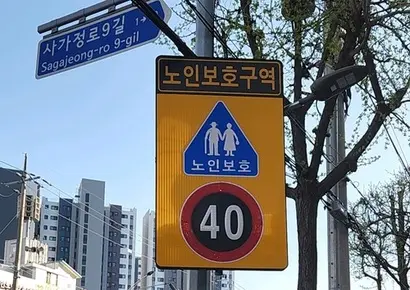
Many citizens were unaware of the very existence of Silver Zones. A resident in his 20s living near the Gyeongdong Senior Nursing Home mentioned, "I didn't even know there were Silver Zones near my home or school." Neither the elderly, who are the ones to be protected, nor the young residents passing through the area are aware of these protection zones.
The response from local governments has been limited. An official from the Transportation Division of Dongdaemun-gu explained, "This section has the highest number of accidents, but a high proportion of them are caused by pedestrians violating traffic laws. While we operate CCTVs, they are not for traffic enforcement." When asked if there were any specific accident prevention activities for Silver Zones, the official replied, "There are no special activities other than designating protection zones and maintaining facilities."
An official from the Elderly Welfare Division of the Eunpyeong-gu Office also stated that there are no separate activities when asked about accident prevention efforts in Silver Zones. A representative from the Traffic Improvement Team of the Gangdong-gu Office explained, "It is difficult to manage Silver Zones because the facilities designated as such are mostly in narrow residential areas, and installing enforcement equipment or enforcing parking and stopping violations is realistically not easy. We are operating mainly by installing signs to draw driver attention."
The budget structure is also an issue. According to the Enforcement Rules of the Road Traffic Act, the principle is to install automated traffic enforcement cameras in areas with frequent traffic law violations or high accident rates. However, because local governments must bear the entire cost of installation, the reality is that they are installed primarily in School Zones where public complaints are concentrated.
There is also a structural void in the system. According to the 'Rules on the Designation and Management of Protection Zones for Children, the Elderly, and the Disabled,' once a protection zone is designated, mandatory requirements are limited to the installation and maintenance of traffic lights. There are no regulations compelling the installation of additional safety facilities or enforcement, even in high-accident zones. A structure that only mandates designation without prevention effectively renders Silver Zones meaningless.
Experts agree that a fundamental redesign of the system is necessary. Lee Soo-beom, a professor of Transportation Engineering at the University of Seoul, emphasized, "The effectiveness of Silver Zones is low because the elderly, unlike children, do not gather in specific facilities. We should not stop at simply designating protection zones but rather analyze the behavioral characteristics of the elderly and prepare customized countermeasures." Hong Jung-yeol, a professor of Transportation Engineering at Keamyung University, said, "Korea has already entered a super-aged society, and the elderly population is growing rapidly. The effects of signs alone are limited. We need to combine speed management, road markings, lighting improvements, police enforcement, and street environment maintenance to create a road structure that truly guarantees the safety of the elderly."
Traffic accidents involving the elderly have shown a steady upward trend recently. According to the Traffic Accident Analysis System of the Seoul Road Traffic Authority, traffic accidents involving the elderly in Seoul increased by over 1,000 cases, from 4,829 in 2021 to 5,926 in 2024. The national figure shows a similar trend, increasing from 34,907 cases in 2021 to 40,208 in 2024. This is why there are calls for institutional support that includes management standards and liability regulations beyond simple designation, to ensure Silver Zones become effective in line with their purpose.