

[비즈한국] It is no longer news that K-pop idol photocards have moved beyond simple fan collectibles to become items with their own independent market values. However, recent instances of individual cards fetching hundreds of thousands, or even millions of won, have sparked concerns that the photocard market is becoming increasingly overheated.
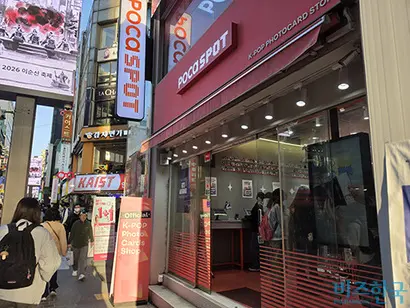
Around 4 p.m. on the 6th, the Myeong-dong branch of 'Poca Spot,' a specialty photocard store in Jung-gu, Seoul, was bustling with customers looking to buy cards. The store operates by having customers select and pay for their desired photocards via tablet-based kiosks. While the cards on screen varied in price, several from popular groups like BTS and ENHYPEN were priced well over 1 million won. A store representative said, "It is always busy with people. Some customers even spend in the range of millions of won. The scale of photocard trading has grown to a level that cannot be ignored. According to the used goods platform Bunjang, the number of second-hand photocard transactions surged by 93% in a single year, from 830,000 in 2024 to 1.6 million in 2025. As of the 6th, there were approximately 610,000 items registered as 'photocards' on Bunjang. Additionally, the photocard trading platform Poca Market reached a cumulative 5 million cards in stock just two years after its 2024 launch, recording 1.5 million members as of 2025.
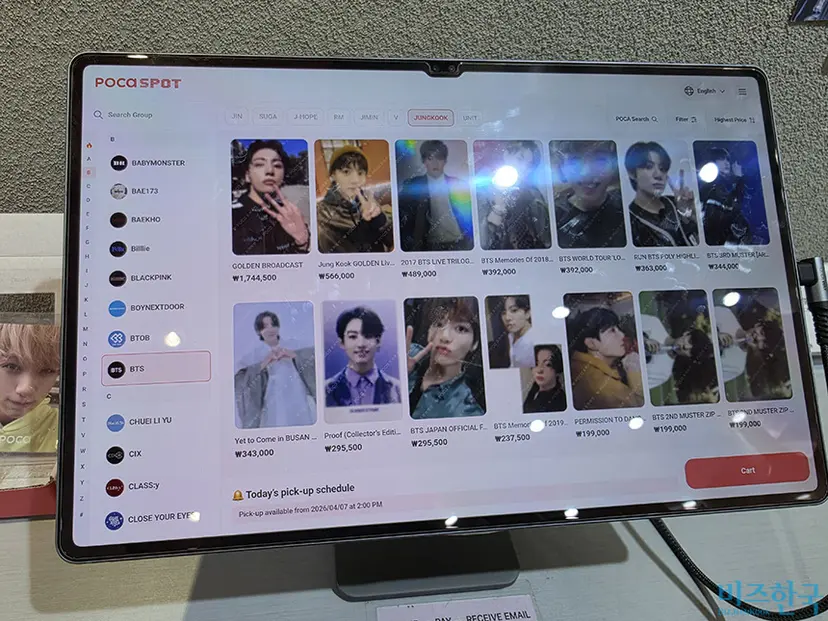
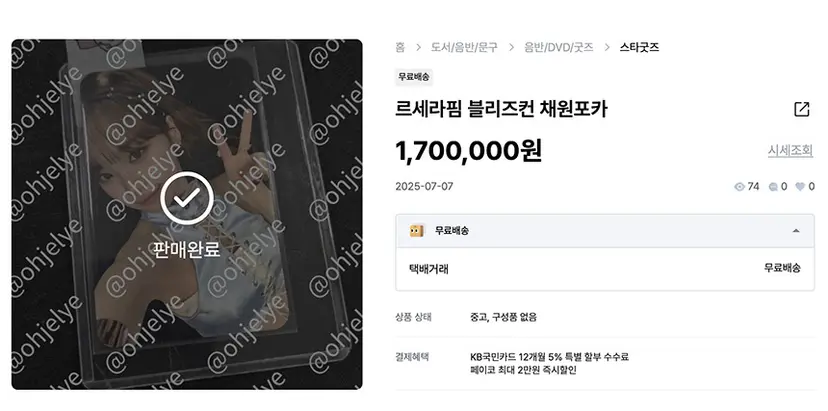
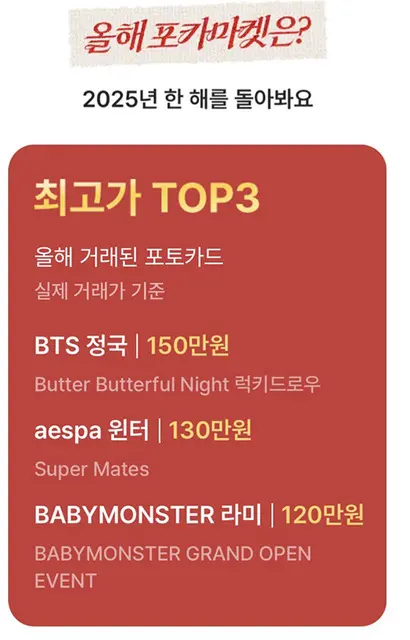
High-value transactions have become common. According to data released by Poca Market, a BTS Jungkook photocard traded for 1.5 million won, and an aespa Winter photocard sold for 1.3 million won in 2025. On Joonggonara, another trading platform, a LE SSERAFIM Kim Chae-won photocard was traded for 1.7 million won. In 2024, a case of a BTS Jimin photocard trading for 3 million won was also confirmed. Photocard trading itself is not a new phenomenon; fans have long traded and exchanged cards to collect their favorites. The difference is that the market has recently become overheated, leading to excessively inflated prices.
At the root of this market overheating is an increasingly complex photocard collection structure. While album photocards used to be the centerpiece, there is now an increasing number of hard-to-find items, such as photocards distributed exclusively at offline events like open broadcasts, concerts, and pop-up stores, as well as fan sign event perks and limited-edition album exclusives.
Analysts suggest that entertainment companies are fueling this overheating. By increasing the number of limited distribution events and album varieties, companies are artificially inflating scarcity and stimulating consumption by bundling 'pretty photocards'—featuring fans' favorite outfits, poses, and expressions—with expensive merchandise. A fan named A, met in Myeong-dong on the 6th, said, "It used to be fairly easy to collect all the photocards of my favorite member, but lately, there are so many types to collect that it's no longer a fun hobby." The structure has become one where prices are bound to rise as the desire to collect remains, but the avenues for acquisition become more complex and quantities remain limited.
Adding to this, interest from overseas fans in K-pop has further stimulated the high-value market. In fact, Maria, a Russian national met at a Hongdae photocard store on the 7th, said, "I visited Hongdae today specifically to come to this photocard shop. More of my friends who recently got into K-pop are visiting these stores or using second-hand platforms to buy photocards." A store official also confirmed, "The proportion of foreign customers is definitely high, and the amount they spend is also significant."
The overheating of the photocard market is causing other problems as well. Professional resellers targeting rare photocards are monopolizing demand by frequenting open broadcasts and pop-up stores, and situations where opportunities to receive photocards are resold like scalper tickets are emerging. There are also rising reports of scams involving the sale of counterfeit photocards that imitate expensive official ones.
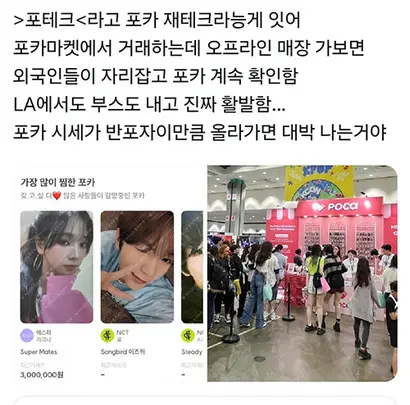
Market overheating is also changing how fans treat photocards. It is no longer uncommon to see fans checking for scratches the moment they receive a card or calculating its resale value immediately. Online communities now share posts related to 'Poca-tech,' a term for treating photocards as investment assets. A long-time fan of the boy band LUCY said, "I recently sold a photocard I received at an event for 200,000 won. When I first got it, the first thought that crossed my mind wasn't that I was happy to have it, but that I could sell it for a high price." This illustrates that photocards are beginning to be viewed by fans themselves as commodities with trade value.
Nevertheless, the core motivation for purchasing photocards remains the desire to collect. Many fans still view photocards as tokens of affection featuring the faces of their favorite artists, and they enjoy sharing their collections on social media. However, as the focus on trade value deepens, the perspective on photocards is shifting. Experts point out that for photocards to remain a record of fandom, there needs to be a re-evaluation of the sales methods and high-value trading structures that fuel this overheating.