

[비즈한국] Last February, posts about a strange, unidentified flying object spotted in the skies over Mexico went viral on social media. It wasn't a blurry, low-resolution image, but a very clear photograph. Looking at the photo, it appears to be adorned with various strange devices, making it hard to believe it’s an object from Earth. Consequently, there was an uproar, with many claiming it was finally the sharpest UFO photo ever taken. In truth, however, someone had enhanced an original photo using AI. If you look at the known original, it is much blurrier and looks more like a vinyl balloon than a metal machine. Some speculated it might have been an event balloon shaped like a clapperboard with "Hollywood" written on it.
As such, many people are still waiting for UFOs. They hope that somewhere out there in the vast universe, living, breathing aliens are secretly observing Earth. Why are we waiting for UFOs so much? Just how lonely are we that every time we spot something in the sky, we hasten to put an alien inside it? And is there really no astronomical evidence that definitively proves the existence of UFOs? Today, we delve into the topic of UFOs, long shunned by astronomers.
Around 4 a.m. on January 17, 1994, a powerful earthquake hit Los Angeles. The entire city experienced a power outage, and residents who had been sleeping ran out of their buildings in shock. That dawn, 911 was flooded with reports of UFO sightings. Embarrassingly, the culprits were the Milky Way, which had appeared in the dawn sky. Because the Milky Way, usually hidden by the dazzling city lights, was suddenly revealed, many LA residents who had never seen it before were frightened, mistaking the clear view of the galaxy for UFOs. This is a famous incident.
Just like this, people have long looked up at the night sky and, upon seeing something unfamiliar, immediately thought of a UFO. The true nature of these sightings could be ordinary clouds, stars, Venus, or a distant passing airplane. Perhaps they really were alien spacecraft secretly watching Earth. So, has the US government ever conducted a serious investigation into UFOs? Surprisingly, they have.
The most famous case is "Project Blue Book." This project, running from 1952 to 1969, collected and investigated various UFO sightings reported by people across the US and around the world. Tens of thousands of reports were gathered, and occasionally, investigators were sent to the field for closer examination. However, most cases were concluded to be either simple misunderstandings—such as mistaking planets or stars for something else—or deliberate lies. While there were a small number of cases where the identity remained unknown, most were inconclusive from the start, as they relied solely on eyewitness testimony without clear photographic or video evidence. Furthermore, even if an object remains unidentified, it is not a logical conclusion to jump to the assumption that it contains aliens.
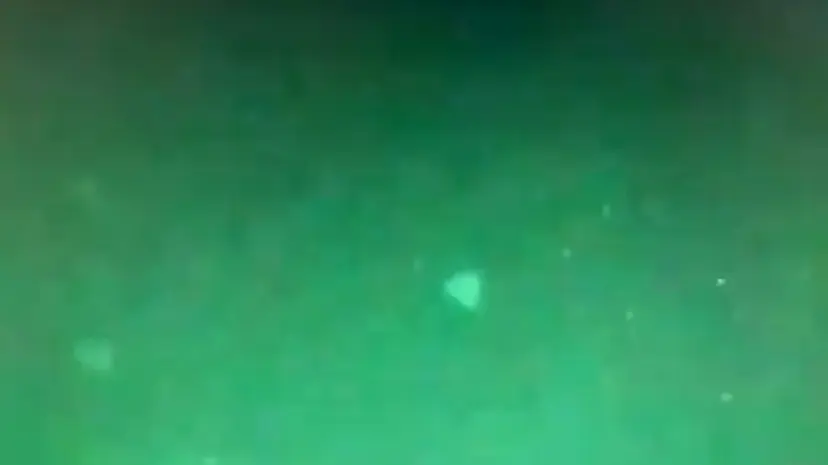
We still misunderstand many things. UFO scandals born from misconceptions continue to occur. One of the most interesting cases is the so-called "Pyramid" UFO video, which was reportedly captured by a sailor on the USS Russell off the coast of San Diego in July 2019. At a glance, the video shows a blurry triangular object flying and blinking lights in the sky, as captured through night-vision goggles. It does not look like a simple natural phenomenon and appears to be an artificial flying object.
However, this is one of the most anti-climactic cases ever solved. When the aperture of a camera is narrowed, it creates a triangular hole; in dark environments, distant lights caught by the lens create "bokeh" or light remnants in the shape of that aperture. Additionally, the blinking pattern of the lights in the video perfectly matches the lighting patterns of US military fighter jets. Therefore, the video was a type of "happening" where the photographer mistook the lights of a nearby airplane for something else while shooting through a camera with a narrowed aperture on a cloudy night.
So, if people say they see something strange in the sky, should we just dismiss everything as a misunderstanding and ignore it? This is where the core dilemma regarding UFO discussion lies. Scientifically, there is definitely something above our heads that we do not yet understand. However, we cannot conclude that it is an aircraft operated by an intelligent being. We cannot exclude the possibility that it is simply a natural phenomenon on Earth or in space that we have yet to grasp.
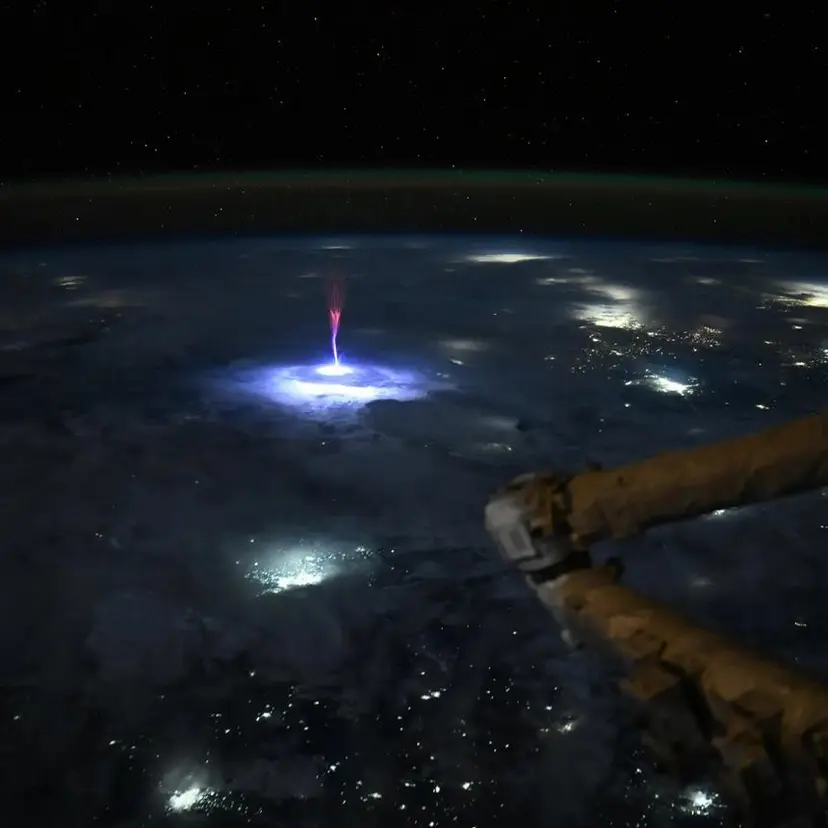
A prime example is the "red sprite," a type of red lightning that has been told like a legend since the 1880s. A very small number of people reported seeing red lightning that would flash and vanish in the blink of an eye. Because it disappeared so quickly, it was difficult to verify, and hard to capture in photos or videos, leading many to dismiss it as a hallucination for a long time. However, the legendary red sprite was finally caught on camera in 1989, and with the advent of high-speed cameras, it was confirmed to be real. Recently, it is occasionally captured even by cameras on the International Space Station orbiting Earth.
This phenomenon is hypothesized to occur when unique conditions in the upper atmosphere are met during lightning strikes on the ground, though the exact mechanism has not yet been fully uncovered. We must not overlook the fact that various natural phenomena, for which we do not yet have an explanation or which we haven't even confirmed to exist, are occurring right above our heads.
That is why astronomers have recently been seriously reconsidering the expression "UFO." The term "Unidentified Flying Object" carries the premise that it is an artificial spacecraft piloted by an intelligent life form, excluding the possibility of other natural phenomena from the start. This, ironically, creates a side effect where "straight-laced" astronomers are discouraged from looking into it seriously, preventing scientific analysis from taking place. Consequently, many astronomers now suggest the alternative term "UAP" (Unidentified Anomalous Phenomena). This shift allows for the application of traditional and systematic scientific methods without hastily filling the objects with aliens, while remaining open to the possibility that they are simply natural phenomena we have yet to understand.
This change can satisfy everyone, from astronomers skeptical of alien visitation to avid UFO enthusiasts. It leaves room for the potential that scientific secrets beyond our current laws of physics are hidden above our heads—ensuring discussions about UAPs aren't dismissed as mere conspiracy theories from the start—while also keeping the door open for explanations based on natural phenomena rather than extraterrestrials.
Whether you suspect aliens are inside UFOs or you are a rigid, traditional astronomer, both sides share one thing in common: the feeling of loneliness in the vast universe. We all hope that somewhere else, there exists another planet where life breathes and thrives, perhaps even hosting a highly advanced civilization. We only differ in our imaginations regarding how we might encounter them. I feel it, and you feel it—we are all lonely in this universe. Nobody knows how this loneliness will eventually be resolved.
About the author, Ji Ung-bae: He loves cats and the universe. After watching "Galaxy Express 999" in his childhood, he dreamed of sharing the beauty of the cosmos. He is currently an assistant professor in the Faculty of Liberal Arts at Sejong University, engaged in various science communication activities including lecturing and writing. He has authored books such as "A Piece of the Universe Every Day," "Scientists in the Starry Universe," "Unreachable but Knowable," and "Strange Questions That Come to Mind When Looking at the Universe," and has translated works such as "The Hitchhiker's Guide to the Galaxy," "How I Killed Pluto," "Quantum Life," and "Cosmigraphics."