

[비즈한국] The deadline for passing Homeplus's rehabilitation plan is less than a month away. While Homeplus seems desperate to sell its "Express" unit—its most lucrative business—the outlook for its revival remains uncertain. Given that selling assets alone has limits for fundamental financial improvement, the judgment of its largest creditor, Meritz Financial Group, has emerged as the key variable for future recovery.
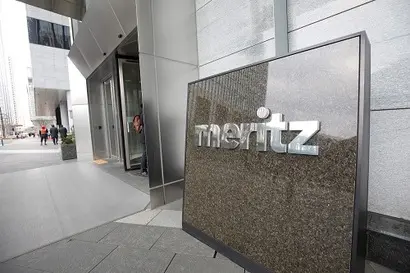
'Buying Time' Through Express Sale; Mounting Criticism of Meritz
Homeplus, currently undergoing corporate rehabilitation procedures, has initiated the sale of its "Express" business, considered its crown jewel. The Express business unit, which operates as a corporate-type supermarket (SSM), is effectively seen as the last liquid asset held by Homeplus. The current market valuation for the Express unit is around 300 billion won. If the deal goes through, it is expected to bring in hundreds of billions of won in cash.
However, many argue that the sale of Express alone cannot guarantee a full recovery. Critics point out that while the sale may provide short-term liquidity, it has limitations in fundamentally improving the company's financial structure. Lee Jong-woo, a professor of Distribution and Marketing at Namseoul University, stated, "Since the sale of Express is merely a partial asset disposal, it should be viewed separately from the overall rehabilitation," adding, "The hypermarket business is a different area, and currently, it lacks attractiveness to investors in the market."
While the sale might buy some time, the direction of the rehabilitation ultimately rests on the creditors' decisions. Consequently, the stance and judgment of the largest creditor, Meritz Financial Group, are emerging as the main benchmarks for assessing the prospect of recovery. However, there are predictions that revival will be difficult because Meritz Financial appears to be taking a wait-and-see approach.
Since entering the rehabilitation process, Homeplus has seen its operational funds rapidly deplete, leading to repeated issues such as empty shelves and unpaid wages. Its major shareholder, MBK Partners, requested DIP (Debtor-in-Possession) financing from Meritz Financial, but it is reported that Meritz did not provide a significant response. Industry insiders believe this decision served as a major turning point that exacerbated the Homeplus crisis. MBK later injected 100 billion won on its own, but it was insufficient to resolve the cash crunch, and operational disruptions only deepened.
Meritz Financial's judgment is interpreted as being influenced by the debt structure. As a senior creditor with 62 Homeplus stores secured as real estate collateral, Meritz Financial is in a relatively favorable position in both rehabilitation and liquidation scenarios. Especially since it can recover its funds through collateral even in the event of liquidation, some interpret that they may be watching the situation with asset liquidation in mind rather than rehabilitation.
An industry official noted, "Because Meritz Financial has real estate collateral, there is a calculation that they would not suffer losses even if liquidation occurs," adding, "This is why there is a somewhat cold, wait-and-see atmosphere."
Criticism is also mounting over the fact that they have been passive in supporting the rehabilitation despite having secured high-interest profits in the short term. It is reported that after providing a 1.3 trillion won loan to Homeplus in May 2024, Meritz Financial recovered over 250 billion won within a year through interest, fees, and principal repayments. While the nominal interest rate was around 8% per year, it is said that the actual high-interest structure reached 11-13% when various fees and financial costs are included.
Furthermore, Meritz Financial reported a claim in the rehabilitation process that included approximately 86.1 billion won in virtual interest for Homeplus. This was criticized for inflating the size of the debt by counting future interest that had not yet been incurred.
The argument for Meritz Financial's responsibility is growing within the industry. Last month, a joint committee for the Homeplus crisis, the Democratic Party of Korea's Euljiro Committee, the Progressive Party, and the Social Democratic Party urged Meritz Financial to take responsible action. Han Chang-min, leader of the Social Democratic Party, pointed out, "As the largest creditor, Meritz Financial has been standing by since the start of the rehabilitation process," adding, "Refusing emergency operational loans despite zero risk shows they have no intention of saving Homeplus."
Meritz Financial has not released any separate statement regarding the Homeplus situation.
Limits to Market-Led Restructuring…Growing Calls for Government Intervention
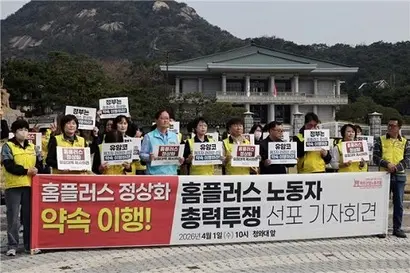
As assessments suggest that market-led restructuring has failed to work properly, voices calling for government intervention are getting louder. Recently, the Mart Workers' Union and the Homeplus Branch urged the government and the ruling party to fulfill their promises to normalize Homeplus. They announced that they would launch an all-out struggle for the month of April and hold a protest rally in front of the Blue House on May 1.
The union stated, "The government and the ruling party are only making promises but failing to fulfill their responsibilities. The Democratic Party and the Presidential Office promised to normalize Homeplus and even suggested appointing a third-party manager from UAMCO and pushing for normalization measures," adding, "However, all we got was more delay and neglect. Before the rehabilitation deadline on May 4, the government and the ruling party must provide a clear answer regarding the appointment of a UAMCO third-party manager or the pursuit of a UAMCO acquisition."
However, some interpret that the government is unable to step in proactively due to concerns over fairness issues arising from supporting a specific company. Professor Lee Jong-woo stated, "Because the gap between stakeholders is so large, it is not an easy matter for the government to intervene," adding, "It is regrettable that the Homeplus crisis did not handle restructuring or sale conditions with more flexibility in the initial response process."
There is growing concern in the industry that if Homeplus goes through liquidation, the social repercussions will be significant. Estimates suggest that 100,000 employees working at over 120 stores nationwide could lose their jobs, and the possibility of a chain reaction of bankruptcy among 4,000 partner companies has been raised. It is pointed out that this could lead to more than just a simple corporate bankruptcy, but also mass unemployment and a contraction of local economies.
A union official emphasized, "Even if about 300 billion won in funds enters through the Express sale, it won't be easy to reach normalization considering the scale of overdue payments to suppliers," adding, "Since simple cash injection has its limits, the government or a public institution, not MBK, should take the lead in restructuring and restore market confidence. Only then can partner companies and creditors continue their transactions."