

[비즈한국] Golf is a mental sport. The legendary Jack Nicklaus once said, “Golf is 50% mental. 40% is setup, and the remaining 10% is the swing.” This is a warning to amateur golfers who believe the swing accounts for more than 90% of the game. Jack Nicklaus even went on to increase the percentage of the mental aspect in later years. While it is difficult to quantify the exact ratio of the mental game in golf, we generally agree on its importance.
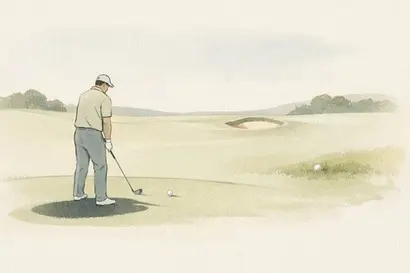
Golf is a ‘thinking sport.’ During an 18-hole, 4-hour round, the actual time spent hitting shots—including the pre-shot routine at about 40 seconds per shot—is just over an hour. The time spent actually swinging is much shorter. The rest is time for thinking. While this time is meant for strategizing and planning the game, for weekend golfers, it is mostly a time for regret. That’s right. Golf is a sport where having too many thoughts is the problem. Your score depends on how you organize and change these thoughts. What kind of thoughts, then, ruin our golf game?
The first is ‘greed.’ The greed to hit the ball even one meter further. Sometimes we say to golfers who are over-swinging at the tee box, “What are you going to do with that extra distance?” but there isn’t a golfer on earth without greed for distance. Sometimes, competitive spirit—trying to beat that rival—leads to an overly greedy swing. How often have you seen someone try to make up for a missed shot all at once on the next stroke, or try to stick a bunker shot close to the hole instead of just escaping, only to fail at getting out entirely? There is even the greed of wanting to dress better than your playing partners, leading to outfits that are stylish but physically uncomfortable. It is all greed. When greed enters the body, it means tension enters the mind. When there is tension in the mind, there is tension in the body. Where does the mind reside? Isn't it inside our bodies?
The second is ‘worry.’ Many golfers toss and turn the night before a round. This is due to two feelings. One is ‘excitement,’ and the other is ‘worry.’ You stay awake from the excitement of a picnic-like round, or you spend hours with eyes wide open because of the worry, “What if I play badly tomorrow?” You go to the driving range to improve, but you hit a shank. It’s worry. It’s a very important round tomorrow, and you want to make a good impression, but your shots haven't been working lately. It’s worry. You’ve heard the golf course you’re visiting tomorrow is difficult, that it’s narrower and longer than other courses—it’s worry. Worry never acts in favor of your golf game. Isn't there a saying: “A master hits the ball where they intend, while a beginner hits the ball where they worry it will go.”
The third is ‘doubt.’ There was a golf club advertisement that said, “Trust your iron.” Someone retorted, “I don’t even trust myself, so how can I trust my iron?” We constantly doubt ourselves and our abilities. Jack Nicklaus said, “I never missed a putt in my mind.” There is no mindset that makes you more anxious than doubting yourself.
Then, couldn't we try the opposite mindsets for these three? Let’s find the antonyms. The opposite of a ‘greedy swing’ would be an ‘empty swing.’ The direct opposite of greed is ‘non-attachment,’ but ‘empty’ seems to suit a golf swing well. Sometimes, when you have too much tension in your body, try saying “Empty!” to yourself at the driving range while swinging. You will feel the tension release. When addressing the ball, if you shrug your shoulders down, the greed might be shaken off too. You need mental training that focuses only on the relationship between you and the ball. The opposite of ‘worry golf’ is ‘positive golf.’ Negativity is repetition, while positivity is overcoming. Discard the “What if” in your mind and constantly inject “It’s okay.” “It’s okay, it’s okay. There’s another shot. There’s another hole. There’s another round.” Who knows, there might even be another life. We say we ‘speak our minds,’ but words can also shape our minds. It’s not “What if,” it’s “It’s okay.”
The opposite of ‘doubt golf’ is ‘confident golf.’ Confidence increases the probability of success. The difference between “I can’t do it” and “I’m the one” is truly immense. The legendary golf queen Annika Sörenstam reportedly repeats to herself, “I can do it, I can do it,” as soon as she stands at the 1st tee box. Thinking “I am lucky” or “I am a lucky guy” also helps in not doubting oneself.
Golfers need as much mental practice as swing practice. This is because although swinging seems like something you do with your body, it is actually performed by the mind within that body.
About the author Kang Chan-wook? An advertiser and writer. Starting as a copywriter at Cheil Worldwide, he is currently the CEO of the video production company ‘Sight of the Times.’ Passionate about golf, he obtained his USGTF teaching professional certification, and with his love for writing, he published golf books such as ‘The Joy of Golf,’ ‘Bad Golf,’ ‘Sincere Golf,’ and ‘Golf Thoughts, Thinking Golf.’ He runs the YouTube channel ‘Bad Golf,’ sharing various stories and thoughts about golf with readers and viewers.