

[비즈한국] “Dollar exchange will be restricted starting today.” This sentence spread rapidly through the market last week. It was a plausible but unverified claim that not only would there be a $10,000 daily limit, but also monthly and annual caps. The anxiety spread even faster as it was accompanied by claims that major commercial banks were simultaneously implementing these measures.
To start with the conclusion: it is not true. But more importantly, the authenticity of this rumor is not the point. The real question is why such stories are spreading right now.
When the exchange rate exceeds 1,500 won, the market does not merely accept the number. It moves on to the next level of questioning: “Could it be that we will soon be unable to buy dollars?” Investors begin to worry about the issue of accessibility rather than just the price.
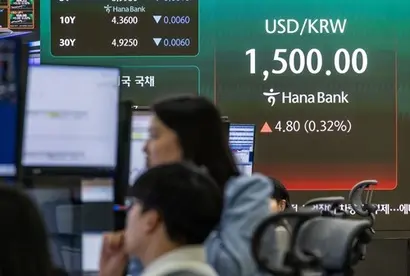
Similar stories emerged during past periods when the exchange rate skyrocketed. “Dollar withdrawals are being restricted, currency exchange is being blocked, foreign exchange controls are beginning.” Although such policies were never actually implemented, the more anxious the market becomes, the faster and more intensely these rumors spread.
Why is that? Because the nature of the current exchange rate rise is different from the past. Previously, the exchange rate surged in situations where the system itself was shaken, such as during the foreign exchange crisis.
However, today’s rise is not due to a collapse of the economy’s fundamental strength, but rather a shift in the direction of capital. Foreign capital is exiting, and global funds are flooding into dollars. Combined with rising energy prices, the won is weakening structurally.
In this structure, it is difficult for the exchange rate to skyrocket in the short term and then return to stability quickly. Looking at recent trends, the exchange rate rises quickly but falls slowly. This is a signal that the market is adapting to a new level.
Therefore, 1,500 won is no longer a simple ‘peak’ but is increasingly becoming the ‘benchmark.’ The fact that the story about ‘dollar exchange restrictions’ has spread means that market fear has moved beyond the price itself to the system. It is a state where the anxiety has extended from simply being expensive to the imagination that access might be blocked entirely.
However, looking at it coldly, such a scenario has low realism. South Korea is an economy where foreign exchange liberalization has significantly progressed, and measures to directly restrict individual currency exchange would be a policy that undermines market trust. Above all, the current policy direction is closer to stabilizing supply rather than blocking dollars.
Nevertheless, the reason these rumors gain traction is that market participants already share the premise that ‘the exchange rate could go even higher.’ And if that premise is correct, it leads to the anxiety that it might be too late if they don't buy dollars right now. Ultimately, regardless of the facts, the rumor becomes a mechanism that stimulates behavior.
From an investment perspective, there is a more important change. Many investors still perceive the exchange rate as a simple variable—a ‘burden if it goes up, an opportunity if it goes down.’ But if the 1,500 won range persists, this is no longer just a single variable issue; it means the standard for asset allocation itself has changed.
Holding a certain percentage of dollar assets is no longer a choice but a basic strategy, and domestic stocks take on completely different characteristics depending on the exchange rate. Within the same market, the gap between export companies and domestic-oriented companies is widening, and industries sensitive to energy prices bear a structural burden.
The meaning of cash also changes. Won-denominated cash can no longer be considered a safe asset. In an environment where the exchange rate is rising, its value decreases even if you do nothing. Conversely, the dollar becomes an asset where one can expect both interest and exchange gains.
Ultimately, what matters in the market right now is not ‘what the exchange rate is,’ but whether the criteria for viewing that number have changed. The fact that rumors about not being able to buy dollars circulated is a signal that the market has already moved to the next phase. It means moving from the era of price to the era of structure.
1,500 won may still be an unfamiliar number. But what is more dangerous than the number itself is the attitude of still interpreting this figure based on the standards of the past.