

[비즈한국] “Living one’s life diligently, accepting the fate laid out before you—that is life. When difficult problems arise or obstacles stand in your way, you live without resentment, thinking positively. That is how a life is built.”
Does this sound like a clichéd philosophy on life? It might feel different if you know who said it. The protagonist of this life story is Kang Soon-hee, the wife of Woo Chang-seon, an executed prisoner who was a victim of the People’s Revolutionary Party (PRP) incident. Kang lost her husband to the PRP incident, which was fabricated by the Park Chung-hee regime, and raised their four children on her own.
The PRP incident was a case in 1974 where the Korea Central Intelligence Agency (KCIA) arrested members of the National Democratic Youth and Student League (Mincheonghakryeon), a student organization opposing Park Chung-hee’s Yushin Constitution, and fabricated the existence of an organization called the “People’s Revolutionary Party Reconstruction Committee” behind them, leading to the execution of eight people. They were brought to a military trial on charges including violation of the National Security Act and incitement of rebellion. The Supreme Court finalized the death sentences for all eight within ten months, and the executions were carried out the very next morning. The International Commission of Jurists declared that day “a dark day in judicial history.” Thirty years later, in a 2007 retrial, the court declared all the executed individuals innocent.
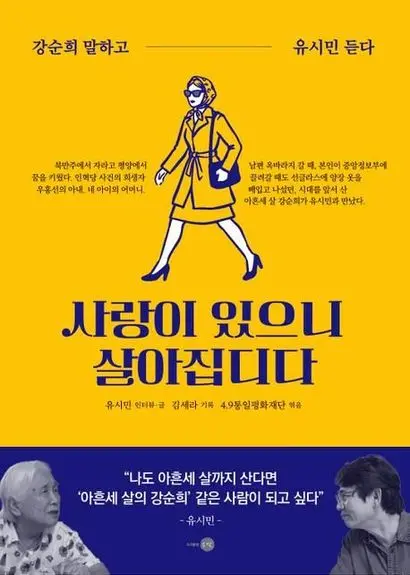
The recently published book, *I Could Live Because There Was Love*, contains the turbulent life story of Kang Soon-hee. The book is based on interviews conducted by writer Rhyu Si-min, who listened to and chronicled the story of Kang, who has diligently lived through the fate laid out before her.
“The wife of an executed PRP victim.” While this is the most representative description of Kang Soon-hee, her life is not solely defined by that incident. Born in North Korea in 1933, Kang moved to Harbin, China, at the age of three, following her father, who was a businessman. She spent her childhood there, returned to the North to attend school, and after the outbreak of the Korean War, fled to the South, living in places like Daejeon and Busan. While working at the Bank of Korea in Busan, she met Woo Chang-seon. After marriage, she began her married life and continued working in Seoul.
Born as the eldest daughter into an affluent family, she grew up loved by her parents. Perhaps because of that, she has lived her life with dignity, never tolerating unfair treatment or feeling intimidated in any situation. She also had a personality that could not stand injustice. She spoke her mind even when her husband was dragged away by the police and the KCIA, and even when she herself was taken in by the KCIA. She was also faithful to her feelings when she fell in love. Her husband always respected his wife for that.
After her husband was unjustly taken away, she actively engaged in rescue efforts. When visiting him in prison, she always wore a Western-style suit and sunglasses. She did this because, “I didn’t want to be looked down upon or ignored, with people whispering that I was from the North or a communist.” She found work again, participated in community savings funds to raise her four children, and provided money for her husband’s prison expenses. Even while detectives followed her every day, she met with foreign missionaries and attended YWCA and Amnesty International rallies to raise awareness about the injustice faced by the PRP victims. Later, she sent tearful petitions to opposition leaders, religious figures, and even Park Chung-hee and Yook Young-soo. She was also the one who revealed the fact that the trial records of the case had been fabricated.
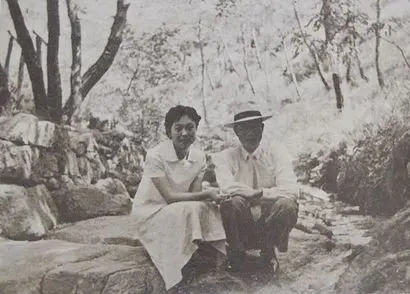
However, her husband, Woo Chang-seon, ultimately ended his life on the gallows. Even the unyielding Kang Soon-hee spent months bedridden after her husband’s death. It was for the sake of her children that she stood up again. After recovering, she sold royal jelly, reopened a dress shop, and in her fifties, worked as a director at a scholarship foundation affiliated with Sungsim Women's University.
Ninety-three years of life, lived more fiercely than anyone else. Kang Soon-hee’s life contains the pain of modern Korean history. Yet, she says, “If there is love, you can live; live diligently.” Even now, she considers the day she first went on a date with her husband as the happiest time of her life. She, who says, “I have been happy throughout my life, and I am still happy,” reflects by saying, “I could live because there was love.” *I Could Live Because There Was Love* is the life story of a woman who lived with dignity and a precious record of modern Korean history.