

[비즈한국] On March 31, President Lee Jae-myung approved a supplementary budget (supplementary appropriation) amounting to 26.2 trillion won at a Cabinet meeting. Although the government labeled it a '2026 supplementary budget to overcome the Middle East war crisis,' supplementary budgets have been compiled in all but seven years—2007, 2010, 2011, 2012, 2014, 2023, and 2024—out of the 27 years since 2000. This has led to criticism that the legal purpose of supplementary budgets, which is to respond to emergency situations, has been diluted.
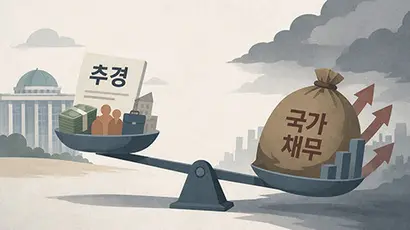
Furthermore, in recent times, the focus of these budgets has shifted away from long-term infrastructure (SOC) investments or strengthening industrial competitiveness toward short-term public works jobs and cash-based welfare spending. This has created a recurring pattern where the economy experiences a brief spark of growth only during the injection of these funds, followed by a subsequent downturn. Essentially, national debt is rising without the necessary reinforcement of national competitiveness required to pay off that debt in the future.
Following the approval of the supplementary budget, President Lee delivered a policy speech to the National Assembly on the 2nd. In his speech, he explained, "This supplementary budget is both a breakwater to protect the lives of the people from the waves of crisis and a springboard for the Republic of Korea to take a leap forward after the crisis," adding, "We must wisely resolve the crisis triggered by the Middle East war and use it as an opportunity to improve our economic constitution, placing our economy on a foundation that will never be shaken again." He requested the National Assembly's prompt processing of the bill.
Given the economic crisis caused by the Middle East war, the necessity of this supplementary budget is significant. The problem lies in the fact that such budgets have become excessively routine. Looking at the history of supplementary budget formation by successive administrations since 2000, it is easier to count the years when they were not used. Dividing by political orientation, the conservative Park Geun-hye administration formulated a supplementary budget in every year of its term except for 2014. Under progressive governments, the Roh Moo-hyun administration formulated them in four out of five years, and the Moon Jae-in administration formulated a total of 10 supplementary budgets during its five-year term. The Lee Jae-myung administration has also formulated its second supplementary budget within less than a year of taking office.
The Roh Moo-hyun administration used 7.5 trillion won in 2003 for economic stimulus and typhoon recovery, 2.5 trillion won in 2004 for stabilizing public livelihoods and supporting SMEs, 4.9 trillion won in 2005 for responding to economic stagnation, and 2.2 trillion won in 2006 for overcoming typhoon and heavy rain damage. In contrast, the Lee Myung-bak administration only formulated supplementary budgets during the 2008 and 2009 global financial crisis, with 4.6 trillion won to respond to economic downturn and 28.4 trillion won for jobs and support for vulnerable groups. The Park Geun-hye administration formulated supplementary budgets of 17.3 trillion won in 2013 for economic downturn and tax shortfalls, 11.6 trillion won in 2015 for the MERS crisis and drought, and 11 trillion won in 2016 to minimize the impact of Brexit.
Under the Moon Jae-in administration, supplementary budgets were effectively treated as permanent. The administration allocated 11 trillion won for job creation in 2017, its first year; 3.8 trillion won for youth job measures in 2018; and 5.8 trillion won for fine dust and public livelihood measures in 2019. In 2020, as the COVID-19 pandemic worsened, it formulated four supplementary budgets totaling 66.8 trillion won. In 2021, it formulated two more, totaling 14.9 trillion won and 34.9 trillion won, citing emergency employment support for small business owners and pandemic relief. In 2022, 16.9 trillion won was spent on support for small business owners. Throughout its five-year term, the Moon Jae-in administration never missed a year, injecting a total of 154.1 trillion won through 10 separate supplementary budgets.
Under the Yoon Suk-yeol administration, a supplementary budget of 62 trillion won was used in 2022 for small business support and public livelihood measures, followed by no further supplementary budgets. In 2025, ahead of the presidential election following the impeachment of former President Yoon Suk-yeol, a 13.8 trillion won supplementary budget was passed by bipartisan agreement to respond to the impeachment situation. After the election, the Lee Jae-myung administration saw the processing of a 31.8 trillion won supplementary budget in July 2025, shortly after taking office, for purposes including the distribution of public livelihood recovery consumer coupons. Now, nine months later, another supplementary budget has been brought before the National Assembly.
An official from the business sector noted, "Because supplementary budgets are focused on cash-based welfare spending, their ripple effect on the macroeconomy is diminishing. Also, when the government issues national bonds to fund these budgets, it leads to rising market interest rates, and the crowding-out effect—where companies reduce investment due to the burden of principal and interest repayments—can occur. Therefore, more cautious consideration is needed regarding where and how much these budgets are spent."