

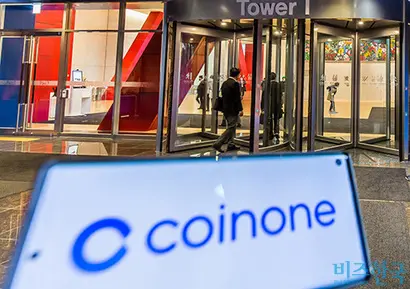
[비즈한국] It has been reported that Korea Investment & Securities is considering ways to enter the digital asset business, including the acquisition of a stake in the domestic virtual asset exchange Coinone. Korea Investment & Securities stated on the 3rd, “We are reviewing various options, but nothing has been specifically decided yet.” Although no deal has been finalized, market interest is peaking as major brokerage firms—following Mirae Asset Group’s push to acquire Korbit—are increasingly exploring exchanges as potential candidates for digital asset infrastructure.
A similar move was first seen at Mirae Asset Group. On February 13, Mirae Asset Consulting, an affiliate of Mirae Asset Group, decided to acquire 26,905,842 shares of Korbit for 133.47988 billion KRW, with an expected stake of 92.06%. However, this transaction has not yet been finalized. According to public filings, the acquisition date is set for after the satisfaction or waiver of conditions precedent, and procedures such as a review of the change of major shareholder and an evaluation by the Fair Trade Commission remain. According to reports in the virtual asset industry, the Korea Financial Intelligence Unit (KoFIU) accepted the report on the change of Korbit’s executives on March 20.
These moves align with the government’s plan to expand corporate participation in the virtual asset market. In February of last year, the government announced during the 3rd Virtual Asset Committee briefing that it would allow corporate participation in the market in phases. It explained plans to permit cash-based trading for non-profit corporations and virtual asset exchanges in the first half of this year, and to promote the issuance of real-name trading accounts for 3,500 companies, including listed companies and registered professional investor corporations, from the second half of the year onwards.
However, a cautious stance remains regarding financial companies. In the same briefing, the government stated that regarding the direct trading and holding of virtual assets by financial companies, a “cautious approach is still needed” due to concerns about potential spillover effects on the financial system. Financial companies were excluded from the list of entities allowed to participate in the second half of the year. This means that institutional constraints still remain regarding securities firms directly owning exchanges.
The roadmap for the institutionalization of security tokens is also cited as a reason for the brokerage industry’s growing interest. According to the Financial Services Commission, the amendments to the Electronic Securities Act and the Capital Markets Act, which passed the National Assembly last January, include the allowance of investment contract securities distribution and the creation of infrastructure for distributed ledger-based securities account management. It is tentatively scheduled to take effect in January 2027, one year after its promulgation. The Financial Services Commission announced that it would form a security token consultative body to conduct detailed designs for technology and infrastructure, issuance systems, and distribution systems in line with the implementation of the law.
Because of this, some in the industry view the acquisition of exchanges not just as an entry into virtual asset brokerage, but as a way to secure capabilities in blockchain-based payment, settlement, and wallet security. The market sees major brokerage firms as aiming to internalize digital asset infrastructure through these acquisitions and secure a foundation for the digital transformation of their asset management divisions.
Coinone, the target mentioned for potential acquisition, has not seen a significant improvement in its recent financial performance. In 2025, Coinone recorded 45.48814 billion KRW in revenue, an operating loss of 6.34349 billion KRW, and a net profit of 2.67746 billion KRW. While revenue increased by about 3% compared to the previous year, the operating loss widened, and net profit plunged by over 80%.