

[비즈한국] Telegram channels that illegally share problem sets and lecture videos are spreading among college entrance exam candidates. Recently, it has been pointed out that the unauthorized distribution of paid online lecture videos, beyond just textbooks, is shaking the private education market. Even after large distribution channels are shut down, similar channels repeatedly emerge, making it difficult for enforcement to keep up.
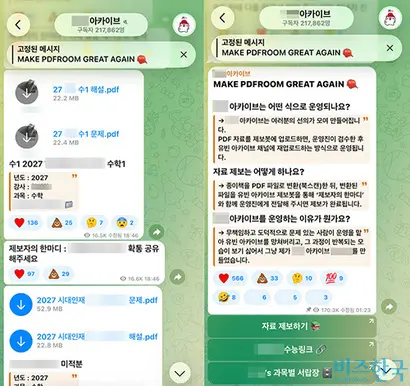
A (21), who lives in Namyangju, Gyeonggi Province, joined an illegal Telegram channel for CSAT lecture materials ahead of the exam to reduce costs. When A received the link from an acquaintance and entered the channel, hundreds of thousands of people were already subscribed. Because there were so many users, the perception that it was illegal gradually faded, and A did not feel much pressure, thinking they were just a simple user.
B (22), who was preparing to retake the exam, also entered a 'Doom-gang room (dark lecture room)' through a similar path. It was through a link shared in the comments after B posted a question on an entrance exam community asking for lecture recommendations. Although the paid lectures cost around 100,000 won each, B was able to take the classes without any extra cost through the sharing. While B had paid for a pass from a specific company, they expanded their scope of learning by taking classes from other instructors as well.
According to reports, it was found that the '○○ Archive', which distributes lecture materials, is still operating on Telegram. Having illegally distributed paid study materials for the CSAT since 2023, the channel spread as it became known as a place where one could easily obtain materials from famous academy instructors without purchasing them. Although it was shut down after the operator was arrested in August last year, illegal distribution continues as other operators have reopened it. In fact, as of this day, about 217,000 people are subscribed to the channel.
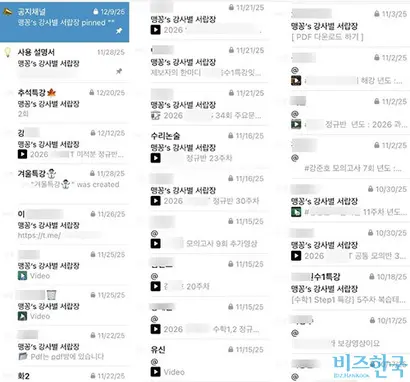
Recently, distribution rooms that share the online lecture videos themselves have also appeared. About 16,000 people are currently subscribed to that channel. In this place, a vast amount of content could be easily found as materials were organized by subject through the channel's "drawer" function.
Subscription to the channel happens through a method where subscribers or affiliates post videos on YouTube or Instagram and share the Telegram link in the comments. Users are continuously entering as links also spread within some communities. The reporter was also able to join the channel via Instagram. In some communities, cases of selling channel addresses for a small fee have also been confirmed.
The operators explained these activities by saying, "We created the channel to reduce educational inequality and dissolve the private education cartel." Another operator also stated through a notice channel, "We made it to help all students study from an equal starting line," adding, "We want to achieve standardization of the learning environment in a situation where the gap between companies is widening."
According to current copyright law, the unauthorized sharing of paid lecture videos and textbooks is illegal. However, due to the nature of Telegram, which makes server tracking difficult, and the limitation that it is not easy to apply punishment to simple users, distribution continues to be repeated.
Regarding this, Lee Min-young, a professor of law at The Catholic University of Korea, pointed out, "The illegal distribution of lectures and textbooks through Telegram constitutes a violation of Article 136 of the Copyright Act and is subject to criminal punishment," adding, "Even a simple viewer can hardly be completely exempt from responsibility as there is a probability of awareness."
At the same time, she added, "Telegram operates as a platform based on overseas servers, making it difficult to trace IPs or analyze access logs," and "Investigations may become complicated if anonymization technologies such as VPNs or Tor browsers are used."

However, experts point out that as high-difficulty questions continue to appear on the CSAT, reliance on private education is increasing, especially among middle-to-upper-tier students. As demand for mock exams and practice questions to prepare for difficult problems grows, the related market is expanding accordingly. The analysis is that students who feel the financial burden in an environment where lecture prices are high and the information access gap is large are flowing into illegal channels.
Baek Byung-hwan, head of the policy team at "World Without Worries About Private Education," added, "Legislative and institutional improvements are needed to prevent the repetition of excessively difficult test questions and questions that go beyond the high school curriculum," and "The key to solving the illegal distribution problem lies in strengthening public control over the evaluation system and the way questions are set."