

[비즈한국] Hyundai Rotem064350 unveiled its new HR-Sherpa Unmanned Ground Vehicle (UGV) series, which adds anti-drone capabilities to its multi-purpose ground unmanned vehicle, at the 'Yi Sun-sin Maritime Defense Industry Exhibition (YIDEX 2026)' held at the Naval Academy in Jinhae starting today. With the urgent need to develop countermeasures against suicide drones, which are recently active in Middle Eastern conflicts, attention is focused on whether the 'Anti-Drone Sherpa UGV,' a specialized version targeting the Middle East market, can pave the way for exports.
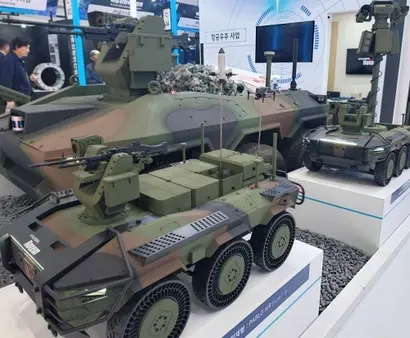
The Sherpa UGV is a ground robot that has been supplied to the Defense Acquisition Program Administration since 2021 after its concept was first unveiled in 2018. It utilizes a 6-wheel electric drive system to travel at a maximum speed of 30 km/h to support military operations. Currently, the 4th generation model is participating in the South Korean Army's multi-purpose unmanned ground vehicle project.
The base model of the Sherpa UGV currently proposed to the South Korean military is equipped with a Remote Controlled Weapon Station (RCWS) to perform joint operations with infantry, provide fire support, and transport supplies or wounded soldiers using its rear cargo bed. Hyundai Rotem is developing various derivative models with expanded features to meet overseas export demand.
In particular, to target the Middle East market, the company is collaborating with LIG D&A (LIG Defense & Aerospace) to develop anti-aircraft and anti-tank vehicles. The anti-aircraft vehicle is equipped with four Shingung surface-to-air missiles, while the anti-tank vehicle carries four Raybolt anti-tank missiles. The anti-tank vehicle is also scheduled to be equipped with the 'R05s' loitering reconnaissance and suicide drone, capable of target acquisition and attack simultaneously.
The newly unveiled model is an anti-drone (Counter-UAV) mission-specialized model known as a 'drone-catching robot.' Recently, Middle Eastern countries, including Saudi Arabia and the UAE, have suffered significant damage from suicide drone attacks such as Iran's Shahed-136. Due to the nature of Middle Eastern countries, it is difficult to protect vast key infrastructure, such as oil refineries or seawater desalination plants, from drone attacks.
Fixed deployment of anti-aircraft missiles involves high costs and quantity shortages, while self-propelled anti-aircraft guns like 'Biho' or 'Cheonho' have limitations in providing 24-hour regional patrols for defense. Furthermore, it is not cost-effective to use billion-won Patriot missiles to shoot down low-cost drones that cost only 20 to 30 million won each.
According to Hyundai Rotem, Middle Eastern nations are showing great interest in unmanned vehicles that can perform 24-hour autonomous driving and launch interceptor drones when necessary. It is reported that there was a positive response at the 'WDS 2026' defense exhibition held in Riyadh, Saudi Arabia, last February.
The 'Anti-Drone Sherpa' system largely consists of a target acquisition vehicle for detection and an interceptor drone vehicle for actual strikes.
The target acquisition vehicle is equipped with an Electro-Optical/Infrared (EO/IR) camera developed by Global Systems and an anti-drone detection radar from Toris Square. The system works by having the radar first detect the drone, followed by the camera identifying the enemy aircraft.
The interceptor drone vehicle is equipped with more than 10 drones. The 'R02s' reconnaissance drone, developed by Pablo Air, monitors the blind spots of the radar and cameras, and launches a 'C05s' interceptor drone once an enemy drone is detected. The missile-shaped C05s is a high-speed flight drone equipped with 4 motors and propellers, which flies at speeds over 200 km/h to directly collide with and destroy enemy drones.
Hyundai Rotem's Anti-Drone Sherpa is considered to have the strength of being deployable more rapidly than existing solutions and capable of 24-hour regional patrols. It is expected to have high demand from Middle Eastern countries that must defend vast areas and prepare for surprise drone attacks.
Meanwhile, Hyundai Rotem has proposed the Sherpa for the South Korean military's multi-purpose unmanned ground vehicle project, but the project is currently mired in controversy regarding the fairness of its evaluation.