

[비즈한국] The rate of parental leave usage among South Korea's top 5 construction firms improved last year compared to the previous year. However, it still remains at a low level compared to the national industry average. In particular, the low usage of parental leave by male employees highlights a clear disparity in family-friendly management between construction companies.
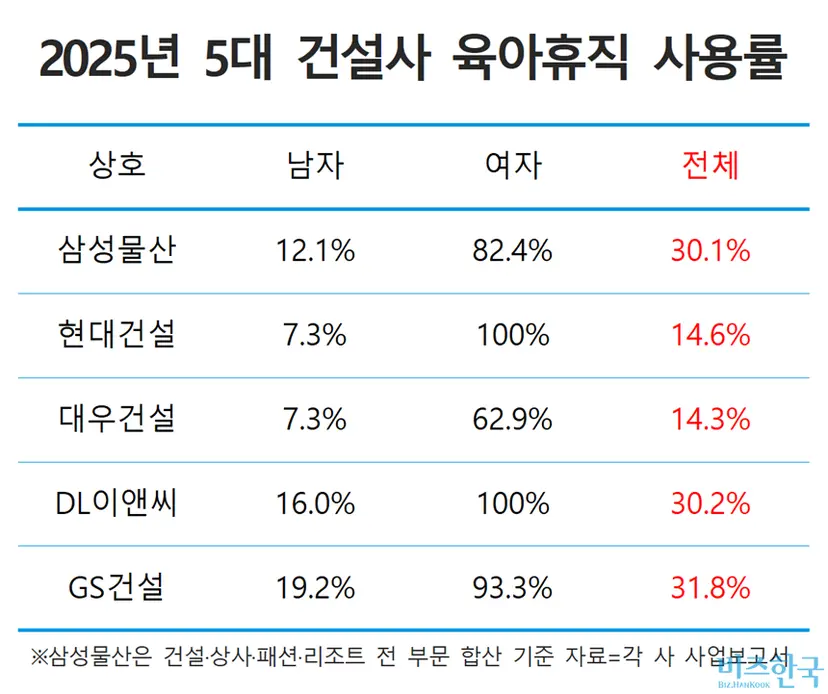
According to each company's business report, the average parental leave usage rate for the top 5 construction firms last year was around 25%, an increase of approximately 6 percentage points from the previous year. This means that 1 out of every 4 employees eligible for parental leave took it. The total number of employees on parental leave was 745—374 men and 371 women—an increase of 164 compared to the previous year. The parental leave usage rate is calculated as the percentage of employees with children under one year of age that year who used parental leave within one year after childbirth.
The report cards for each company varied significantly. Last year, the parental leave usage rate was highest at GS E&C006360 at 31.8% (96 employees), followed by DL E&C375500 at 30.2% (150 employees), and Samsung C&T028260 at 30.1% (341 employees). Conversely, Hyundai E&C000720 stood at 14.6% (118 employees), and Daewoo E&C047040 remained at 14.3% (40 employees), keeping them in the 10% range. This means there is more than a two-fold gap between the top and bottom performers even among large construction firms. For Samsung C&T, the figure is a combined total including construction and all other divisions.
The reason for the low parental leave usage rate is the low participation of men. Last year, the paternity leave usage rate was 19.2% for GS E&C, 16.0% for DL E&C, 12.1% for Samsung C&T, 7.3% for Hyundai E&C, and 7.3% for Daewoo E&C. On the other hand, the maternity leave usage rate was relatively high, with Hyundai E&C and DL E&C at 100% each, GS E&C at 93.3%, Samsung C&T at 82.4%, and Daewoo E&C at 62.9%. In short, the use of the parental leave system by male employees remains more restricted compared to their female counterparts.
Some construction companies have meaningfully increased their parental leave usage rates. The overall usage rate at DL E&C rose by 9.7 percentage points from 20.5% in 2024 to 30.2% last year, the largest increase among the top 5 construction firms. Last year, the rate for women increased from 91.3% to 100%, and the rate for men saw a significant rise from 11.0% to 16.0%. Hyundai E&C also saw its overall usage rate climb by 7.9 percentage points from 6.7% to 14.6%.
A representative from DL E&C stated, "We are continuously striving to support the work-life balance of our employees by expanding our systems, such as allowing an additional 90 days of leave for pre- and post-natal leave (90 days by law), and offering an additional year of parental leave beyond the statutory 1 year (with eligibility criteria expanded from children under 8 to children under 12)."
The construction industry has the lowest utilization of parental leave. According to statistics from the National Data Agency, the parental leave usage rate for parents of children born in 2024 was 15.1% in the construction sector, the lowest among all industries. In the same year, the industry average was 34.7%, showing a 19.6 percentage point gap. The paternity leave usage rate in the construction industry also stood at only 6.7%, falling short of the overall industry average of 10.2%.
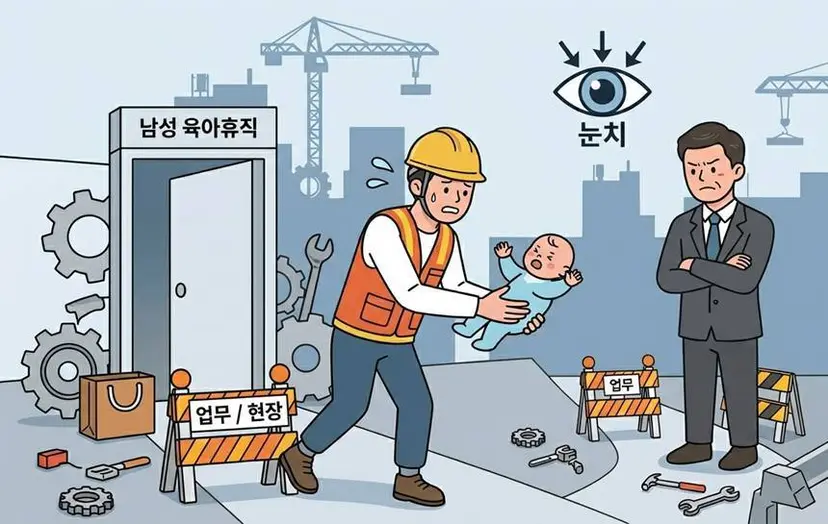
A construction industry official noted, "Due to the nature of the industry, which focuses on on-site work and has a high proportion of male employees, the adoption of parental leave is relatively slow. While maternity leave has become somewhat established in the industry, men still feel pressured about taking paternity leave. How naturally 'paternity leave' is accepted will be a key indicator distinguishing the future of family-friendly management in construction firms."