

[비즈한국] As responding to the climate crisis emerges as a national priority, movements to shift power generation structures toward a low-carbon system are accelerating. The Lee Jae-myung administration is pushing policies that treat nuclear power and renewable energy as the two pillars of carbon neutrality, but academic debate continues over whether these two energy sources can truly complement each other and coexist. Benjamin K. Sovacool, a world-renowned scholar in energy policy and professor of Earth and Environment at Boston University, who recently visited South Korea, pointed out in a National Assembly lecture that, based on decades of global data, nuclear power and renewable energy are structurally in a "competitive relationship" that makes them difficult to coexist.
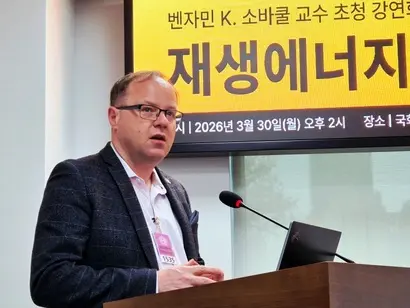
Nuclear Power and Renewable Energy, Why They Can't Be in the 'Same Basket'
On March 30, the National Assembly's Climate Crisis and Decarbonized Economy Forum and the National Emergency Action to Stop New Nuclear Power Plants invited Professor Sovacool to hold a lecture titled, "Can Renewable Energy and Nuclear Power Coexist?" Professor Sovacool stated that there is no successful case of a country that has effectively implemented a portfolio energy policy combining nuclear power and renewable energy.
The core cause he presented is the "crowding-out effect," where the two power sources push each other out during the energy transition. He argued that nuclear power and renewable energy not only have different electricity production methods but are also in fierce competition for massive capital, land, and transmission grid infrastructure.
A nation's energy infrastructure plans and budgets are limited, making them essentially a "zero-sum game." In particular, nuclear power not only requires astronomical costs but also demands a massive ecosystem of specialized personnel, including radiation experts, nuclear physicists, and nuclear engineers. The analysis suggests that pouring limited budgets into nuclear power inevitably reduces resources for investing in renewables like solar or wind power, causing the two systems to conflict economically.
It is not just a limit of resources, but also physical space constraints that were pointed out as a cause of conflict. This is because situations arise where exclusive choices must be made regarding whether to build wind or solar plants on a specific site, or a nuclear power plant instead.
Furthermore, once large-scale, centralized infrastructure centered on nuclear power is built, "path dependence" strengthens, making it difficult to transition to other alternatives later. Professor Sovacool explained that when massive capital has already been invested, sunk costs and historical legacies lock in a nuclear-centric path, making the transition to a renewable energy system or the flexible parallel operation of the two systems structurally difficult.
Expanding Nuclear Power Has No Correlation with Carbon Emission Reductions
Operating under the premise that a completely carbon-free energy source does not exist, Professor Sovacool compared greenhouse gas emissions by energy source through a "Life Cycle Assessment (LCA)," which covers the entire process from raw material mining to waste disposal, not just the plant operation phase. The analysis results showed that the lifecycle greenhouse gas emissions of nuclear power are an average of 66gCO₂e per kWh, which is significantly higher than wind (34g) or solar (50g). This is because greenhouse gases are generated throughout the entire process, including uranium mining, enrichment, fuel processing, and power plant construction and decommissioning.
However, compared to coal power (960g when exhaust gas cleaning devices are applied) or LNG (611g), it is a significantly lower level. Professor Sovacool assessed that "carbon emissions from nuclear power may be higher than what advocates claim, but they could be lower than what critics say."
What is more notable is the correlation with carbon reduction performance by country. As a result of Professor Sovacool tracking 25 years of global data, the expansion of the share of renewable energy showed a clear statistical correlation with carbon emission reductions, while the increase in the share of nuclear power showed no significant correlation with emission reductions. This indicates that even though nuclear power is theoretically a low-carbon energy source, it is less efficient than renewable energy in contributing to a nation's overall carbon neutrality.
Professor Sovacool emphasized, "National policymakers must choose between nuclear power and renewable energy," adding that "if you want faster and more substantial carbon reduction, you must choose renewable energy, not nuclear power."
Nuclear Power Projects: Uncertain in Both Economics and Safety
Professor Sovacool also touched upon the costs and safety issues of nuclear power. An analysis of 180 nuclear reactor projects worldwide from 1936 to 2024 revealed that 97.2% experienced cost overruns, with an average cost increase of 117.3%. This is overwhelmingly higher compared to wind (8%) or solar (1%). He cited the characteristics of government-led projects, tightening regulations, a lack of technical standardization, and insufficient learning effects as causes. Even assuming the industry's optimistic outlook, Small Modular Reactors (SMRs), touted as the next-generation alternative, are analyzed to incur costs at the level of existing large-scale nuclear plants and will be much more expensive than renewable energy.
Because most nuclear power projects are driven by the government from a security perspective rather than market logic, there are weak incentives for cost reduction or profit generation. As the average construction period is 7.5 years, it is common for regulatory changes resulting from accidents during that time to lead to additional costs. Furthermore, Professor Sovacool's analysis suggests that because each plant has different designs and specificities, it is difficult to standardize, which makes learning-based cost reduction effects appear slowly.
There were also notable results regarding safety. An analysis of accident data by low-carbon energy source from 1950 to 2014 showed that 48.8% of the 686 accidents that occurred during this period were related to wind power. In terms of human casualties, 97.2% of the total 182,794 deaths occurred in hydroelectric accidents, such as dam collapses.
On the other hand, a characteristic of nuclear power accidents is that they involve massive economic damage when they occur. Of the total $265.1 billion (405 trillion KRW) in property damage from low-carbon energy source accidents, 90.8% stemmed from nuclear power accidents. Even when measuring the scale of damage relative to unit power generation (TWh), it was confirmed that nuclear power has overwhelmingly the largest impact among all energy sources.
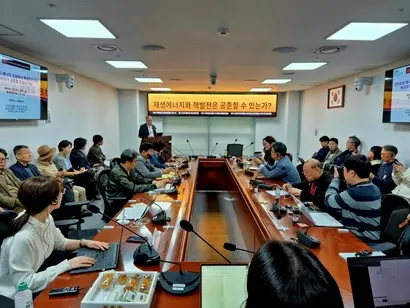
Critical perspectives from experts continued during the Q&A session after the lecture. Lee Joon-taek, Professor Emeritus of Physics at Konkuk University, stated, "Even Germany, which has less sunshine than South Korea, currently has a renewable energy share exceeding 50%," adding, "The intermittency problem can be solved with energy storage systems (ESS), which are becoming cheaper rapidly." Voices filled the lecture hall that since the expansion of nuclear power could actually hinder the growth of renewable energy and reduce the efficiency of carbon reduction, policymakers should make choices based on data.