

[비즈한국] A massive black hole is hiding at the center of our galaxy. This is now considered common knowledge. While mysteries remain regarding the exact origin of supermassive black holes—specifically how such a giant mass came to exist at the center of a galaxy—there seems to be little disagreement that its identity is indeed a black hole. However, a claim has been raised that it might be something entirely different. If it is not a black hole, then what is at the center of our galaxy?
The existence of the black hole at the center of our galaxy was first identified by astronomers Andrea Ghez and Reinhard Genzel. Starting in the early 1990s, they aimed the Keck Observatory at the galactic center. They discovered that stars at the center of the galaxy were orbiting at extremely high speeds within a very tight region of only a few light-years. Most notably, they tracked the orbit of a star known as S2 for decades, finding that it traced a highly elongated elliptical orbit at a very high speed. It clearly appeared that something with immense gravity was holding the stars in place at the center. Yet, no light leaked from the very spot where something should have been. A being that emits no light but possesses powerful gravity: they concluded it was the legendary black hole.
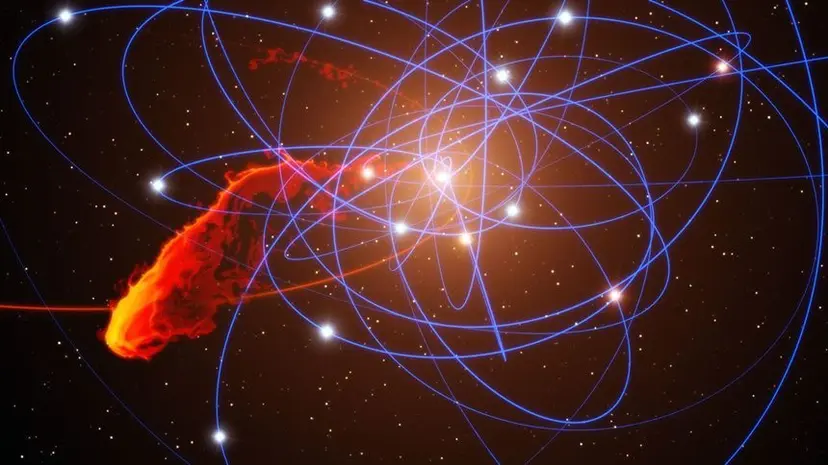
The mass of the Sagittarius A* black hole at the center of our galaxy, inferred through the orbits of central stars, is approximately 4 million times that of the Sun. Observations also show the so-called G-type gas clouds that are rapidly orbiting and disintegrating, which is further evidence that a very heavy and powerful entity is hiding at the center. Ghez and Genzel were awarded the 2020 Nobel Prize in Physics for providing the most direct evidence of this terrifying monster hidden at the galactic core.
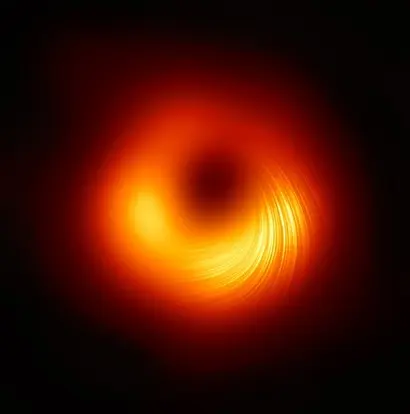
The backdrop to their Nobel Prize was the successful observation by the Event Horizon Telescope (EHT) just prior. By mobilizing radio telescopes across the globe, they captured the shadows of light from the black holes at the center of the M87 elliptical galaxy and our own galaxy. The results were exactly as predicted by Albert Einstein's theory of relativity. This was the most definitive evidence that effectively cemented the existence of a giant black hole at the center of the galaxy as established fact.
However, there is still much controversy regarding the center of our own galaxy. This is because the Milky Way's black hole is unusually quiet. In other galaxies, central black holes demonstrate their presence by emitting violent X-rays and gamma rays. There is little disagreement about such highly active black holes. But our galaxy's black hole shows no such activity. Furthermore, while it was expected that gas clouds passing close by would be completely destroyed, resulting in intense bursts of light, these events have sometimes passed quietly. It is not even certain whether our galactic center black hole has ever been violent. Although some minor X-ray flares have been captured over the past few years, it appears far too quiet and timid compared to other, more massive black holes.
Recently, however, unexpected phenomena have been captured in Gaia observational data, which has precisely mapped the distances and velocities of stars in our galaxy. Gravity is a force that weakens as distance increases. Typically, however, even as one moves far from the center, the velocity of stars in a galaxy remains flat without significantly decreasing. The fact that stellar velocity remains high even in the outer reaches of the galaxy, where gravity is weak, has been considered the most important evidence for dark matter, showing that invisible mass is widely distributed. This phenomenon was also well-known in our galaxy.
But as Gaia's observations became more precise, that common knowledge was shaken. In 2023, astronomers discovered that stars on the outskirts of our galaxy move slower than expected. When plotting the 'velocity curve'—which shows how the orbital speed of stars changes as they move further from the center—the curve does not stay flat but instead dips downward as it heads outward. This phenomenon begins at a distance of 52,000 light-years, effectively the outer boundary of our galaxy, where stars in the outskirts move 30 km/s slower than originally anticipated. This perplexing finding led to suspicions that our galaxy might contain less dark matter than previously thought, or that its distribution might be entirely different.
In summary, the issue of slowed stellar velocity in the outskirts of the galaxy, recently confirmed by Gaia, implies that our galaxy is not as heavy or gravitationally strong as we thought. If so, what did we misunderstand, and why did we think our galaxy was a stronger, heavier entity? This is where this new study calls into question the existence of the black hole, which we had so naturally assumed was at the center.
This study argues that the identity of this central object is not a heavy black hole with mass concentrated at a single point, but merely a dense cluster of very light subatomic particles known as fermions. Fermions are very light particles, and like other subatomic particles, they follow the Pauli Exclusion Principle. Two or more particles cannot occupy the same quantum state, which creates a repulsive force. Consequently, a fermion cluster does not collapse into what is commonly known as a singularity.
Here, astronomers assumed the existence of 'dark fermions,' which are currently cited as the most likely candidates for dark matter particles. They interact via gravity just like dark matter. Therefore, they would not be scattered throughout space but instead highly concentrated at the center of the galaxy, where gravity is strongest. Thus, stars orbiting nearby would move in a manner very similar to how they would behave near a typical black hole. However, since this fermion cluster is not an actual black hole with an event horizon, the destructive events involving the tearing apart of stars and gas clouds might not occur. This aligns perfectly with the characteristics of the 'something' at the center of our galaxy, which we have observed to be very quiet yet capable of holding surrounding stars with strong gravity.
The research attempted a simple statistical analysis. It assumed two possibilities for the identity of the object at our galactic center: a black hole and a fermion cluster, and compared how well each reproduces observed patterns. The study assumed two energy levels for the fermions, 56 keV and 300 keV; higher-energy fermions tended to cluster at much higher densities at the center. However, in both cases, the results did not differ significantly from the presence of a black hole at the center and described the movement of stars in our galaxy almost perfectly.
But a significant question remains. The evidence that makes us believe in the supermassive black hole at the center of our galaxy is not just the rapid movement and orbits of the stars. Haven't we already confirmed its existence with an actual photograph? Specifically, the ring of light captured by the Event Horizon Telescope. If so, can a fermion cluster—not a black hole—explain the famous portrait of the black hole?
Surprisingly, this study argues that a fermion cluster can explain the exact same appearance. It claims that a super-dense fermion cluster, like a black hole, can refract surrounding light and imitate the shape of the shadow of light associated with the famous black hole.
In conclusion, the claim can be summarized as follows: we cannot distinguish whether the 'something' at the center of our galaxy is a black hole or a fermion cluster. The most compelling observational evidence cited for a black hole—the orbits of surrounding stars and the shadow of light captured by the Event Horizon Telescope—cannot exclude the possibility of a fermion cluster.
Of course, this analysis has a critical limitation. It is possible that this claim fits the observational results well because it is an analysis based on a hypothetical fermion cluster constructed to satisfy the two known observational characteristics. However, such criticism can be applied equally to the argument that there is a black hole at the center of our galaxy. Ultimately, we have never directly seen a black hole. We have only seen various phenomena that could appear assuming a black hole exists, which is why we naturally assume there must be a black hole at the center.
Is there no way to distinguish between a black hole and something else? There is only one thing left: verifying the 'photon ring' that occurs only around a black hole singularity. We need to be able to see not only the accretion disk around the black hole and the round shadow of light but also the photon ring formed right at the edge of the event horizon. Because gravity near a black hole is so strong, light not only bends but can even be sent back in the direction it came from like a boomerang, causing light to pile up in an extreme way. This should form a small, sharp photon ring right around the event horizon. Its size is only about 1.5 times that of the event horizon. The 'red donut' seen in the Event Horizon Telescope observations was a look at the region further out than that. The photon ring is essentially the final boundary where we can effectively see light around a black hole.
Some astronomers claim that they have already seen this photon ring in the previous Event Horizon Telescope observations, but there is still much disagreement. As of now, this photon ring is the only clue to conclude whether the object at the center of our galaxy is truly a black hole or something else. As more radio telescopes are mobilized and a more powerful Event Horizon Telescope is developed, we may eventually reach a conclusion.
Unexpectedly, the premise that 'a giant black hole must be hidden at the center of a galaxy' is not always true. There are quite a few galaxies that show no distinct signs of a central black hole. At the high end, nearly 30% of galaxies appear to hold their stars together using only their own gravity, without a black hole at the center. And in fact, the mass of a black hole is less than one-thousandth of the total mass of the galaxy. A galaxy is far heavier than a single black hole. Therefore, it would not be strange at all if there were no black hole in our galaxy.
While the conclusion is still unknown, thinking that there might not be a giant black hole at the center of our galaxy somehow makes the Milky Way feel a bit plain. Though, since black holes are invisible, the landscape of the Milky Way as we see it wouldn't change regardless of whether a black hole is there or not.
Reference
https://academic.oup.com/mnras/article/546/1/staf1854/8431112?login=false
Who is the author, Woong-bae Ji? He loves cats and the universe. After watching 'Galaxy Express 999' as a child, he dreamed of sharing the beauty of the universe. He is currently an assistant professor in the Faculty of Liberal Arts at Sejong University, engaging in various science communication activities including lectures and writing. He has authored books such as 'A Piece of the Universe Every Day,' 'Scientists of the Starry Universe,' 'Cannot Go But Can Know,' and 'Strange Questions That Come to Mind When Looking at the Universe,' and translated books including 'The Hitchhiker's Guide to the Galaxy,' 'How I Killed Pluto,' 'Quantum Life,' and 'Cosmographic.'