

[비즈한국] On the last weekend of March 2026, global financial markets began to price in not just simple volatility, but a 'change in world order.' On the surface, it appears to be a military conflict occurring in the Middle East.
However, the market is reacting differently than in the past. While there are optimistic arguments for an 'end to the war within weeks,' asset prices are reflecting even greater anxiety. This is a signal that the market is focusing less on the outcome of the war and more on the structural changes that will follow.
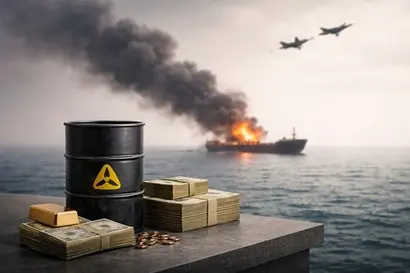
In fact, foreign media are not stopping at simple war reporting. The UK's The Times pointed out that "the U.S. is considering redeploying weapons from Ukraine to the Middle East," suggesting that this conflict might not be a shift in the battlefield but a signal of global strategic realignment. They also mentioned concerns in Europe over a 'potential deal' between the U.S. and Russia, showing that the risk facing the market is not just a military conflict, but a fracture in the alliance structure.
In particular, the crux of this war is that its impact is simultaneously affecting the core pillars of the real economy—energy, logistics, and food—more than the military conflict itself. The New York Times noted that "the war is threatening global food supplies," pointing out that fertilizer shortages and production disruptions have already begun. This is a very important signal to investors. When a shock that starts in energy spreads to food, the market prices in not just a simple rise in oil prices, but a second cycle of inflation.
The financial market is already reflecting this structure rapidly. The Wall Street Journal analyzed that "fear of war on Wall Street is growing," indicating that the market is recently re-evaluating war risks as a persistent shock rather than a short-term event.
The unusual trend of both stocks and bonds weakening simultaneously is not just simple risk aversion. It means that traditional asset allocation strategies are no longer working. In other words, the market is pre-emptively pricing in a stagflationary environment where inflation and economic slowdown exert pressure at the same time.
The Financial Times' expression is even more direct: "The Iran war shock has hit investors' portfolios." This is perhaps the most accurate sentence describing the current market situation.
The problem is not the loss itself, but the structural change where portfolios no longer function as intended. More importantly, this shock does not end with rising energy prices.
The tension surrounding the Strait of Hormuz is not merely an issue of crude oil supply. It is a core axis of the global supply chain connected to fertilizer raw materials, chemical products, and logistics. If this axis is shaken, the shock moves from energy to food, and then back to inflation. What the market fears is not the $100 oil price itself, but the resurgence of inflation that follows.
Geopolitical variables are not simple either. Contrary to political messages claiming that "the war could end within weeks," the UK's Guardian diagnosed that the actual situation is seeing a higher possibility of escalation. The Washington Post also analyzed that the war has moved beyond a short-term conflict into a matter of a sustainable war, highlighting inventory of missiles and military logistical burdens.
Investment strategies must now change as well. In the past, when stocks fell, bonds provided a defense, but now both assets are under pressure simultaneously. The standard for safe assets is shifting from interest rate sensitivity to stability based on tangible reality.
Energy and raw materials can no longer be viewed solely as assets that move according to economic cycles. As supply chains are shaken, they are changing from assets that reflect prices into variables that dictate inflation, interest rates, and ultimately the direction of the market itself.
The meaning of cash is also changing. Cash is becoming a strategic asset that secures options amidst uncertainty, rather than an asset that forfeits returns. What is important in the market right now is not the rate of return, but the flexibility to act in the next phase.
This is not a phase to find the bottom, but a phase to assess the viability of your portfolio. The war may end, but the order that the war has reshaped will not easily return. The market has already begun to reflect those changes.