

[비즈한국] The reason 'taxes' and 'loans' have emerged as key issues in the current real estate market is not simple. It is because they are not merely pricing issues, but structural factors that determine the feasibility of transactions, the sustainability of ownership, and the realization of final profits.
While the real estate market of the past could be explained to some extent by analyzing 'location' and 'supply', the current market requires an understanding of institutional variables—specifically taxes and loans—to be fully interpreted.
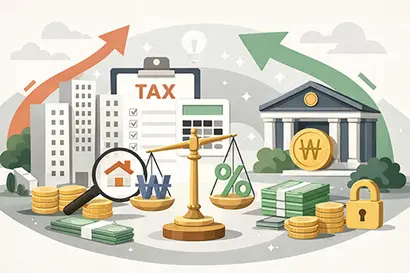
Real estate is inherently a high-value asset, and most transactions rely on leverage. Therefore, loans are the most direct means of determining market liquidity. When loans are readily available, demand expands, transactions become active, and prices face upward pressure. Conversely, when loans are restricted, the number of potential buyers shrinks, leading to market contraction and price adjustments.
These changes prevent us from viewing the market as a monolith. Even within the same city of Seoul, markets within price ranges accessible through loans show completely different trends compared to those that are not. The former maintains a relatively stable flow driven by actual demand, while the latter moves restrictively, influenced only by a few buyers with high cash reserves. This represents not just a price difference, but a difference in liquidity and, further, the fragmentation of the market structure. Ultimately, loans are evolving beyond mere tools for price adjustment into core variables that reshape the market itself.
The jeonse (lump-sum housing lease) market is also directly affected by financial regulations. As regulations on jeonse loans tighten, tenants' purchasing power decreases, which leads to a contraction in jeonse demand or a shift toward monthly rent. At the same time, landlords face situations where it becomes difficult to secure tenants or they are forced to adjust lease terms. The jeonse market should not be seen as an independent domain separate from the sales market, but as a single system closely linked through the common variable of loans.
Taxes are another pillar that drives the market. Acquisition taxes determine entry costs, holding taxes influence decisions on long-term ownership, and capital gains taxes dictate the timing of sales. In particular, holding taxes make people perceive real estate not as an 'asset' but as an 'object that incurs costs.' A tax burden above a certain level can act as selling pressure on multi-home owners, appearing in the market as an increase in the number of properties for sale.
At the same time, strategic moves to avoid tax burdens can cause market distortions, such as delaying transactions or concentrating them at specific times. In this respect, taxes should be understood not merely as tools to suppress or ease the market, but as variables that determine the timing and direction of transactions.
Capital gains tax is particularly important, as it is the tax that finally determines the results of an investment. Even if the price increase is the same, actual profits vary significantly depending on the holding period, residency requirements, and the number of homes owned. This applies equally to single-home owners. Failing to meet the requirements for tax exemption for a single-세대 (household) owning one home can result in an unexpected tax burden, which can have a fatal impact on 'trade-up' strategies.
Acquisition tax should also not be overlooked, as it acts as a factor determining the rate of return at the start of an investment. For multi-home owners or corporations, tax rates can increase significantly, meaning initial investment costs vary remarkably depending on the acquisition structure, even for the same asset.
Therefore, real estate investment is no longer just about 'how much to buy and how much to sell it for,' but has expanded to the issue of 'how to structure the acquisition, how to hold it, and when to dispose of it.'
As such, taxes and loans do not operate as independent elements but as a single system. For those who do not own a home, understanding loans means understanding the possibility of entering the market. If you do not accurately grasp your income level and loan regulation conditions, you may miss opportunities even when a purchase is actually feasible.
Conversely, entering the market through excessive loans can leave one vulnerable to interest rate hikes or changes in income. Therefore, those without homes should base their decisions not on 'how expensive a house can I buy,' but on 'what level of repayment structure can I handle.'
Single-home owners are the representative group that must consider taxes and loans simultaneously. In the process of trading up, the disposal timing of the existing house, the acquisition timing of the new house, the tax burden during the temporary dual-ownership status, and the succession or new application of loans are intricately intertwined. If any part of this is misjudged, one may fail to fully enjoy the expected asset appreciation.
For multi-home owners, investment has reached a stage where it is impossible without an understanding of the tax structure. Comprehensive management is required, including not only holding taxes, capital gains taxes, and acquisition taxes, but also taxation on rental income. Especially in an environment where tax rates can change rapidly according to policy shifts, the stability of after-tax profit becomes a more important criterion for judgment than short-term capital gains.
In conclusion, the current real estate market is shifting from a 'price-centered' market to an 'institution-centered' market. Taxes and loans are the core pillars of that system, and investments made without understanding them inevitably carry high uncertainty. Conversely, investors who accurately understand taxes and loans and can strategically utilize them can achieve entirely different results in the same market.
True competitiveness in the real estate market no longer lies solely in the amount of information or the ability to analyze locations. It lies in the ability to interpret systems and design them to fit one's own investment structure. Ultimately, the market is simple: it acts as an opportunity for the prepared and as a risk for the unprepared.
※ Kim Hak-ryeol, the head of the Smart Tube Real Estate Research Institute, well-known by his pen name 'Pashong', previously served as a team leader at the Real Estate Research Division of Gallup Korea. He operates and hosts the Naver blog 'Pashong's World Exploration' and the YouTube channel 'StuTV'. His books include '3040 Real Estate Beginner's First Investment (2026)', 'Rewriting the South Korean Real Estate User Manual (2025)', 'The Power of Gyeonggi Real Estate (2024)', 'Absolute Principles of Seoul Real Estate (2023)', 'The Future of Incheon Real Estate (2022)', 'Kim Hak-ryeol's Absolute Principles of Real Estate Investment (2022)', 'Future Map of South Korean Real Estate (2021)', and 'From Now On, Only Places That Will Rise Will Rise (2020)'.