

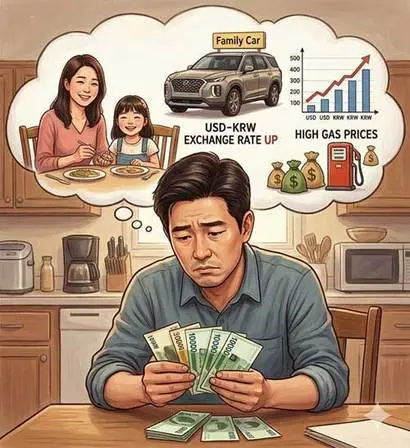
[비즈한국] Mr. A, in his early 40s, is currently stationed at a US factory of a major domestic company in a management role. Lately, he checks the exchange rate trends every day. He arrived in the US earlier this year when the rate was in the mid-1,400 won range to begin life with his family, but with the recent surge, the rate has surpassed the 1,500 won mark. Mr. A monitors the news so closely because of his "living expenses." He receives his salary based on the annual salary contract he signed in Korea, and the skyrocketing exchange rate has put his household budget in a state of emergency.
Mr. B, also in his early 40s, who is in the US for training, is also feeling the burden of the recently increased exchange rate. Since the company covers his training expenses, he receives a base salary and some living stipends, but it is difficult for a family of three—him, his wife, and his child—to get by considering the increased cost of living in the US. He has been exchanging lump sums of money from selling domestic real estate to supplement his living costs, but as the exchange rate continues to climb, the "burden" is growing.
Effectively a 5–10% pay cut
With the dollar recently trading at the 1,510 won level—an increase of nearly 10% compared to the second half of last year and nearly 5% since mid-February—the fortunes of overseas expats from domestic companies are mixed. This is because companies have different policies regarding if and when they apply exchange rates to salary payments. In particular, for expats who receive their salaries in "won," it is essentially equivalent to a 5–10% pay cut.
The recent rise in US prices also adds to the burden. The US is also seeing a rise in base inflation due to factors like increased oil prices. Mr. A explained, "Even though I receive about 2 million won in local stay support in 'dollars,' after sending my child to daycare and eating out once or twice a month, there is absolutely nothing left. Daycare alone costs over 1.5 million won a month, and eating out easily costs 150,000 won including tips. With fixed costs like car insurance being so high, it's not easy to save money in the US with an annual salary in the mid-100 million won range, and now the exchange rate is rising on top of that.
Mr. B is also facing significant pressure. His wife recently arrived in the US with their child, requiring the purchase of an additional vehicle. To buy a car in the $20,000 to $30,000 range, which was their original budget, they now have to spend 8–10% more than expected.
"If I had known this, I should have exchanged about $50,000 when I first arrived in the US last December," Mr. B said. "I waited, thinking the exchange rate would drop, but I ended up taking a loss. Hearing from others in training, they say they are losing about 20 million won a year.
Stay allowances are based on standards from several years ago
This issue arises because quite a few domestic companies pay "salaries" based on domestic annual salary contracts. While some companies pay in dollars, many others pay base salaries in won based on the standards for when the employee worked in Korea. Instead, they provide local stay allowances in dollars for things like housing, car maintenance, and children's education. These incidental local stay allowances vary by region, but are generally around 2 million won for rural areas and 4 million won for cities.
However, as prices rise along with the exchange rate, the impact is even greater even with the stay allowance. "I originally planned to visit Korea once a year to see my parents, but I found out that the plane tickets for the three of us would cost 10 million won," Mr. B said. "It's not just the exchange rate; the cost of living has jumped so much that everyone living here on a 'won-based salary' is having a miserable time."
Mr. A added, "When I was in Korea, I saved 1–1.5 million won a month, but after living in the US for two months, I find I can't save a single cent even while living more frugally. When I first came to the US, I wanted to travel and make good memories, but now I understand why many employees avoid being US expats. The support is based on figures from several years ago. If I could go back, I wouldn't have applied to be a US expat."