

[비즈한국] OCI Holdings010060, the holding company of OCI Group, has reorganized its leadership from a three-person structure to a two-person co-CEO system featuring Lee Woo-hyun and Lee Soo-mi. Lee Soo-mi, recognized as the group's top financial strategist, has stepped to the forefront as the actual helmsman of the holding company's management. Notably, CEO Lee recently attended the Bukwang Pharm003000 shareholders' meeting in person, maintaining a meaningful silence, which has led to speculation that the holding company's stern financial scrutiny of Bukwang Pharm is about to begin in earnest.
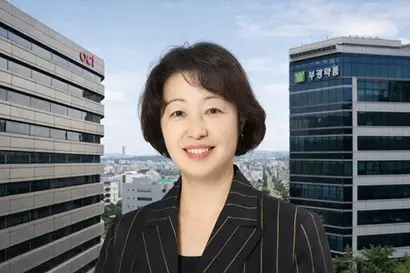
On the 26th, OCI Holdings held its regular general shareholders' meeting and board meeting, reorganizing the previous three-person co-CEO structure of Lee Woo-hyun, Lee Soo-mi, and Kim Taek-joong into a two-person system of Lee Woo-hyun and Lee Soo-mi. With Vice Chairman Kim Taek-joong, who oversaw the chemical division, stepping back from the front line to serve as board chair, management of the holding company OCI Holdings will now be led by Chairman Lee Woo-hyun and CEO Lee Soo-mi.
CEO Lee in particular was promoted to President in this personnel reshuffle, a move viewed as a significant expansion of her power as a control tower to coordinate the group's overall portfolio and manage risks. The consensus is that while owner-Chairman Lee Woo-hyun presents major new business visions, CEO Lee holds the power to decide the fate of businesses through rigorous profitability verification.
CEO Lee appeared at the regular shareholders' meeting of subsidiary Bukwang Pharm on the 24th. As she has not been very active in public despite being appointed CEO of OCI Holdings in March last year, industry interest is focused on the strategic choices she might make regarding Bukwang Pharm in the future.
At the Bukwang Pharm shareholders' meeting, the question of whether OCI Holdings would acquire additional stakes in Bukwang Pharm was a hot topic. Shareholders, weary of falling stock prices and poor performance, directed sharp questions at Bukwang Pharm's management, including CEO Lee Je-young, regarding OCI Holdings' willingness to increase its stake and the possibility of a future exit (recovery of investment). However, CEO Lee, who was present, listened to the shareholders' complaints and the reports from Bukwang Pharm's management, and then quietly left the scene after the meeting without expressing a position.
The reason CEO Lee's silence is viewed as significant lies in the current situation facing OCI Holdings. Under the Monopoly Regulation and Fair Trade Act (Fair Trade Act), a holding company (OCI Holdings) is obligated to hold at least 30% of the shares of a listed subsidiary (Bukwang Pharm). OCI Holdings, which was launched as a holding company in September 2023, was required to meet this requirement by last September, but failed to do so as its stake in Bukwang Pharm remained at 17.11%.
OCI Holdings eventually received a two-year extension from the Fair Trade Commission last September, until September 2027, regarding the stake acquisition requirement for Bukwang Pharm. While there is room for an additional two-year extension if conditions such as a sharp stock price drop or special managerial reasons are acknowledged, the fact remains that they must acquire about 13% more in stakes. This is a daunting task, requiring approximately 122.1 billion won based on the closing price (9,600 won) on the 27th.
The market is predicting the future of Bukwang Pharm by linking CEO Lee's past cold-headedness as a CFO with the risk-management-oriented management she has recently emphasized. CEO Lee has experience leading the disposal of major non-core businesses, such as the 2014 sale of a 50% stake in OCI-SNF, a joint venture for wastewater treatment chemicals, and the 2015 sale of high-value subsidiaries like OCI Materials and OCIR, back when OCI Group was suffering from a liquidity crisis due to the downturn in the solar power industry.
The current financial state of OCI Holdings is considered to be just as unstable as it was back then. Last year, the company recorded an operating loss of approximately 57.6 billion won on a consolidated basis, with a net loss of a staggering 146.2 billion won. All the key cash cows that supported the group have turned into loss-making entities.
The renewable energy sector, including polysilicon for solar power, recorded a massive operating loss of 88.7 billion won alone; the energy solutions sector, including cogeneration and solar power generation, recorded a loss of 13 billion won; and the chemical materials sector, including polysilicon for semiconductors, recorded a loss of 12.2 billion won. It can be seen that the holding company's coffers are drying up rapidly as the cash-generating ability of its core businesses has shrunk completely.
Given this situation, the industry view is that CEO Lee's consistent silence at the Bukwang Pharm shareholders' meeting suggests that OCI Holdings' willingness to acquire additional stakes in Bukwang Pharm has become opaque. The belief is that rather than pouring in cash to increase the stake immediately, they will maximize the two-year grace period to weigh Bukwang Pharm's self-sustainability, but they might even abandon the acquisition of Bukwang Pharm depending on the circumstances.
Furthermore, CEO Lee has recently put risk management back at the top of the group's management agenda. At an ESG Management Council meeting in late January with executives from major OCI Holdings subsidiaries, she said, "The ESG Management Council is a core organization that reviews the ESG management status of all domestic and overseas subsidiaries and sets standards and directions at the group level," adding, "We must not stop here, but practice sustainable management through decision-making and risk management across overall management."
In relation to this, an OCI Holdings official said, "Nothing has been decided yet regarding the acquisition of Bukwang Pharm shares," drawing a line against overinterpretation.