

[비즈한국] Goo Yun-cheol, Deputy Prime Minister and Minister of Economy and Finance, stated on the 29th that the government may consider introducing a 5-day vehicle rotation system for the private sector if international oil prices rise to the $120–$130 per barrel range. This implies that the rotation system, currently implemented primarily in the public sector, could be expanded to private vehicles in the event of an oil price spike. Appearing on KBS’s ‘Sunday Diagnosis’ that day, Deputy Prime Minister Goo said, "If international oil prices reach $120 to $130, wouldn't we need to move to a Level 3 crisis alert? We could consider introducing a vehicle rotation system for the private sector as well."
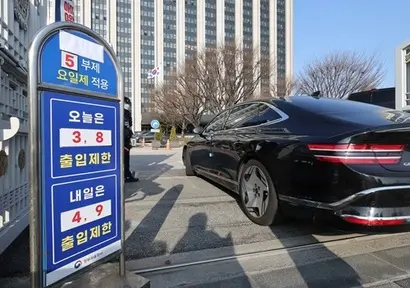
This statement is an extension of the energy demand reduction measures recently announced by the government. President Lee Jae-myung ordered a review of demand reduction measures, such as the 5-day and 10-day vehicle rotation systems, during a Cabinet meeting on March 17 to prepare for the possibility of a prolonged energy crisis stemming from the Middle East. The 5-day and 10-day vehicle rotation systems, which restrict driving based on the last digit of the license plate, are considered representative tools to reduce consumption during periods of high oil prices.
Public Sector Already Implementing... Private Sector Still 'Voluntary'
Following the President’s directive, the government began actual implementation starting with the public sector. As of midnight on March 25, a 5-day rotation system became mandatory for public sector passenger vehicles, excluding electric and hydrogen vehicles, while voluntary participation is requested from the private sector. The public sector rotation system has expanded its scope compared to previous iterations, now including some vehicles such as light cars and hybrids. However, exceptions remain for vehicles used by people with disabilities, vehicles carrying pregnant women or infants, long-distance commuting vehicles in areas with low public transport accessibility, and electric/hydrogen vehicles.
The government has set the end point for the public sector 5-day rotation system as the 'lifting of the resource security crisis alert.' While ordinary citizens are not currently restricted from driving based on their license plate digits, the possibility of a policy shift remains if oil prices and the situation in the Middle East deteriorate further. With Deputy Prime Minister Goo now providing a specific benchmark of $120–$130 for international oil prices, the possibility of expanding this to the private sector has become much clearer.
However, the government's decision to mandate the system for the public sector first appears to be a way to gauge policy effectiveness and potential disruptions in the field before expanding it to the private sector. Since public institutions are relatively easier to manage and monitor, and their exception criteria are administratively simpler to organize, this can essentially be seen as a pilot phase. Given the significant impact that an immediate expansion to the private sector would have on daily life, including commuting, business, and caregiving, the government appears to be adjusting the level of its response while monitoring the impact on reducing vehicle traffic and public sentiment within the public sector first.
Support Requested from Financial Sector... Insurance and Card Industries Concerned About 'Profitability'
The government's response is not limited to restricting vehicle operations. The Financial Services Commission (FSC) is also reviewing measures for the financial sector, having recently requested that non-life insurers and credit card companies come up with support plans for high oil and high inflation conditions.
The FSC reportedly met with executives from non-life insurance companies on the 27th to discuss ways to discount or refund auto insurance premiums in connection with driving restriction policies like the 5-day rotation system. Since fewer cars on the road could lead to lower accident rates, ideas such as lowering premiums or providing partial refunds were discussed. However, the insurance industry is under significant pressure, as it recorded a deficit of approximately 708 billion won in the auto insurance sector last year due to deteriorating loss ratios. In effect, they are facing pressure for discounts just after raising premiums by the 1% range this year.
A request to prepare measures to ease the burden of fuel costs was also sent to the credit card industry. On the 26th, the FSC ordered credit card companies through the Credit Finance Association to consider providing additional benefits beyond existing per-liter discounts. Examples mentioned include an additional 50 won discount per liter when refueling 50,000 won or more, or a 5% credit or cashback on the payment amount. This appears to reflect the fact that the perceived effect of fixed-rate discounts has diminished as fuel prices have risen rapidly. However, the credit card industry is also concerned about the decline in profitability due to expanded discounts.
The government is ramping up its response to high oil prices by simultaneously pushing for public sector energy savings, voluntary participation from the private sector, and support from the financial sector. Whether the private sector 5-day vehicle rotation system will actually be implemented is expected to be decided by comprehensively weighing the trends in international oil prices, the situation in the Middle East, and the status of resource security crisis alerts.