

[비즈한국] The Middle East war initiated by President Donald Trump, who had been pressuring the U.S. Federal Reserve (Fed) to cut base interest rates, has slammed the brakes on the global trend of rate cuts. Countries that had decided on rate cuts as recently as late last year and early this year—including the U.S., U.K., Europe, New Zealand, Mexico, and Turkey—have shifted into wait-and-see mode, while Australia decided to raise its base rate during this month’s monetary policy meeting.
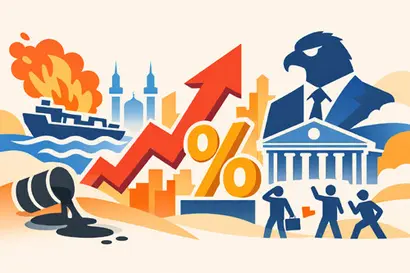
Furthermore, as central banks around the world have successively raised their annual inflation forecasts, economic institutions are increasingly predicting that these banks will pivot back toward tightening this year. With total national debt in South Korea exceeding 6,500 trillion won, the possibility of 5 base rate hikes has even been raised, fueling concerns that Korean companies and households could face a crisis.
As Iran blocked the Strait of Hormuz late last month in response to President Trump’s attacks, there are signs that global prices are becoming volatile. With the supply of crude oil, the foundation of every industry, being blocked, not only has the price of oil surged immediately, but the ripple effects are spreading to other industries as well. Consequently, despite President Trump’s continued pressure to lower interest rates, the Fed continues to hold rates steady. Fed Chair Jerome Powell said after the Federal Open Market Committee (FOMC) meeting on the 18th, "We are fully aware of the risk that inflation could rise again due to the recent surge in oil prices."
In fact, the Fed has revised its annual inflation forecast upward from 2.4% to 2.7%. The European Central Bank (ECB) also left its base rate unchanged at its monetary policy meeting on the 19th and significantly raised its annual inflation forecast from 1.9% to 2.6%. Such adjustments suggest that the focus of future monetary policy may shift toward defending against inflation. ECB President Christine Lagarde expressed concern, stating, "If high energy prices persist, inflation could spread widely through indirect and second-round effects."
The Bank of England (BOE) also expected inflation to stabilize at 2.1% in the second quarter as of February, but at its March monetary policy meeting, it raised the forecast to around 3% due to the Middle East war. After freezing the base rate at the meeting on the 18th, Governor Andrew Bailey warned, "Long-term disruptions in the supply of oil, natural gas, and other raw materials increase the upside risks to inflation."
The Central Bank of Turkey defied market expectations of a rate cut and decided to freeze rates at its monetary policy meeting on the 12th. Governor Fatih Karahan signaled that the bank would maintain a hawkish stance for the time being, stating, "We will firmly maintain a tight monetary policy stance until price stability is achieved."
The Reserve Bank of Australia has gone even further, shifting to a base rate hike. At its monetary policy meeting on the 17th, it raised the base rate from 3.85% to 4.10%. Governor Michele Bullock emphasized, "While I don’t want to cause an economic downturn, if we fail to curb inflation and allow companies to keep passing on rising costs to prices, the worst-case scenario will ultimately arrive for everyone," adding, "Now is the time to firmly control prices."
As central banks around the world express concerns over the inflation caused by the Middle East crisis, economic institutions are viewing the potential for a shift toward tightening as a fait accompli. According to the Chicago Mercantile Exchange (CME) FedWatch tool on the 26th, the interest rate futures market estimates a 21.5% probability of a 0.25 percentage point hike by the Fed by the end of this year, and a 2.5% probability of two hikes. The market sentiment has shifted 180 degrees from just a month ago, when the probability of a hike this year was 0%, and the probability of cuts was 93.3% (23.8% for one cut, 33.7% for two, 24.4% for three, and 11.4% for four or more cuts).
Expectations for an ECB rate hike are also rising. Goldman Sachs, revising its previous forecast that the ECB would hold rates steady through the end of the year, now expects the bank to raise rates by 0.25 percentage points each in April and June. Additionally, JPMorgan Chase predicts hikes in April and July, while Barclays expects them in April and June.
For the Bank of Korea (BOK), which will see a new governor take office next month, the forecast for a hike is gaining momentum faster than the forecast for a freeze. In a recent report, Citi predicted that the BOK would raise the base rate by 0.25 percentage points each in July and October. In the bond market, yields on government bonds have surged, with market expectations pointing to a 76.6bp (1bp=0.01% point) rise over the next 6 months and 121.8bp over 9 months. In effect, the market is pricing in the possibility of up to 5 base rate hikes by the BOK within the year. This is interpreted as being influenced by both the Middle East-induced inflation crisis and the hawkish perspective held by incoming Governor Hyun Song Shin.