

[비즈한국] The Middle East risk stemming from Iran is once again striking the weakest link in the German economy. On the 26th (local time), Reuters, citing a report from the German Institute for Macroeconomic Research (IMK), expressed concern that “if the Middle East conflict triggered by Iran persists, Germany’s economic growth rate for this year could fall to 0.2% from the initially projected 1.2%.” This serves as a warning of effectively “zero growth.” Sebastian Dullien, Director of IMK, highlighted the intense sense of crisis, stating, “This war will aggravate the risk of deindustrialization for Germany.” For Germany, a manufacturing powerhouse, “deindustrialization” is synonymous with a “death sentence.”
Every time energy prices fluctuate, German manufacturing faces immense pressure. This is a moment confirming how vulnerable the industrial structure—once labeled “the sick man of Europe”—is to external shocks. As the realization spreads that a traditional manufacturing-centered structure can no longer withstand this uncertainty, Germany is fundamentally shifting its response strategy at the national level. One of the breakthroughs Germany has proposed is the startup.
More Than Doubling the Investment Attraction Goal
According to data released by the German Bundestag on the 19th, the German government is pushing to increase the scale of its WIN (Wachstums- und Innovationskapital, Growth and Innovation Capital) initiative to 25 billion euros (approximately 44 trillion KRW). This is more than double the goal announced about a year and a half ago in September 2024, when the target was 12 billion euros.
The WIN initiative is a program launched jointly by the German government, major corporations, and financial institutions. It focuses on supplying capital necessary for the scale-up stage, where startups transition from the idea phase into actual industrial application.
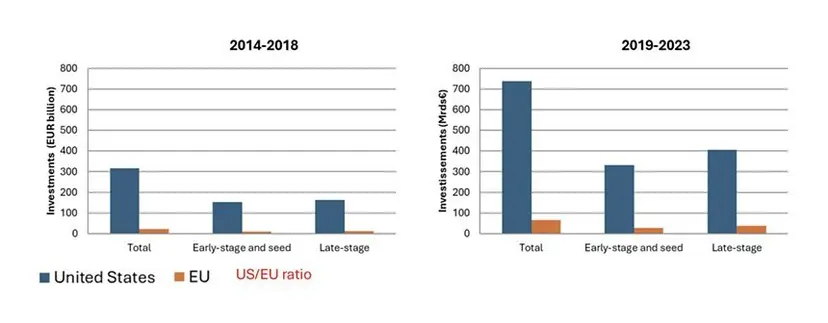
The problem Germany faced was not a lack of technology, but a lack of capital flow. While competitive in research and initial startup phases, many startups were forced to relocate abroad or halt growth because they could not secure large-scale funding during the growth stage. In fact, a study last year showed that about 26% of German startups were considering moving overseas due to lack of funds. Furthermore, according to a report by the Bank of France, the total VC investment in the EU from 2014 to 2023 was 89 billion euros (154 trillion KRW), while in the U.S., it exceeded 1 trillion euros (1,738 trillion KRW). Europe is fighting with less than one-tenth of the capital available in the U.S.
WIN is a mechanism designed to overcome this high threshold. Rather than the government investing directly in startups, it supplies funds to venture capital and growth funds, designing a structure that draws private capital—such as pension funds and insurance money, which were previously conservative about startup investments—into the market. By using public funds as a catalyst to attract private capital, the goal is to institutionalize the startup investment market as a distinct asset class.
When Systems Aren't Enough, the Government Buys Directly
Alongside this, Germany is also pursuing a strategy of betting directly on specific startups in strategically important technology areas.
A prime example is Black Semiconductor. In June 2024, the German federal and state governments decided to provide a subsidy of approximately 228.7 million euros to the company. Including private investment, the total scale exceeds 250 million euros (approximately 440 billion KRW).
Black Semiconductor is developing graphene-based optical communication chip technology that overcomes the limitations of existing silicon semiconductors. Because it can improve data transmission speed and energy efficiency simultaneously, it is considered a core technology that will impact the overall automotive, industrial, and AI infrastructure. The company is accelerating its technology acquisition by acquiring the Dutch graphene firm Applied Nanolayers in March of this year.
The backdrop for this unusual support from the German government is a strategy to secure industrial sovereignty by directly intervening in the growth path of early-stage technology companies. This is because, in a situation where dependence on the U.S. and Asia for core components, including semiconductors, is high, failing to seize the initiative in next-generation technology could destabilize industrial competitiveness itself.
Large Corporations Form 'Survival Alliances,' AI Startups Respond with 'Pragmatism'
Due to the influence of WIN, the cooperation structure between large corporations and startups is also being reorganized rapidly. The Schwarz Group, which operates Lidl, and the automotive and industrial technology company Bosch have made large-scale investments in German AI startup Aleph Alpha, establishing an industrial AI cooperation system. The strategy is to process core industrial data—such as production, logistics, and customer data—within Europe rather than relying on clouds in the U.S. or China.
Aleph Alpha shifted its direction once more after this. The company stepped back from the race to develop general-purpose Large Language Models (LLMs) and completely transitioned into an AI operation platform exclusively for corporate and government clients. The founder explained the reason, saying, “The world has changed. A business model cannot be built on a single European LLM alone.”
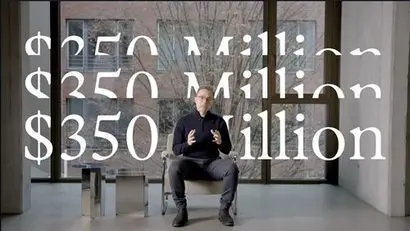
This choice symbolizes the direction of the entire German AI ecosystem. Berlin startup Parloa is the evidence. Parloa raised a whopping $350 million (approx. 530 billion KRW) in its Series D round this January. It broke the investment record from just seven months prior during its Series C round by more than five times, while simultaneously nearly tripling its corporate value to approximately $3 billion (approx. 4.4 trillion KRW). Both the scale and speed of this fundraising are unprecedented in German startup history. It is the result of securing major corporate clients such as Allianz, SAP, and Booking.com with a service that is strictly B2B industry-aligned: an AI call center agent.
Now, Private Capital is Setting the Stage
If the government-led WIN was a structure to systematically bring in private capital, private capital has now begun to set the investment stage itself.
DTCP, which separated from Deutsche Telekom’s investment division, announced this January the launch of “Project Liberty,” a 500 million euro (870 billion KRW) venture capital fund dedicated to the defense industry, stating that it had already secured 300 million euros (521.8 billion KRW) in investment commitments. It is the largest private VC fund dedicated to the defense industry in Europe.
What is noteworthy is their shift in direction. DTCP, originally an investor in enterprise software startups, expanded its investment territory into defense. It clearly demonstrates where capital flows as security risks rise.
This change is not merely investment diversification, but a shift in market leadership. Initially, the government pulled private capital into the startup market through WIN, but now, private capital is leading the market by expanding its own investment areas. It shows that the structure is moving beyond the government simply “supporting” startups to a system where startups, large corporations, private capital, and the state all need each other.
South Korea, Like Germany, Cannot Rely on 'Materials, Parts, and Equipment' Alone
The industrial structures of South Korea and Germany are similar. In both countries, manufacturing is the backbone of GDP, and the ecosystem of large corporations and their suppliers is robust. They were also similar in that they treated startups as entities “separated from the mainstream” of the industrial ecosystem.
However, when a crisis hit, Germany changed the question itself—from “How do we foster startups?” to “How can the state and large corporations coexist with startups?”

South Korea has had attempts like support programs for “materials, parts, and equipment” (so-bu-jang) startups. Semiconductors, batteries, and defense are all fields where Korea already holds strengths, and there are clearly areas where startups can fill critical niches in the supply chains of large corporations. However, a significant number of these programs have not yet escaped the subcontracting frame of “let’s foster startups to make them suppliers.” It is likely a problem of framing rather than a lack of institutions.
Germany elevated startups to strategic partners in the face of crisis not because they changed laws, but because of desperation. Just as Black Semiconductor is digging into a new layer called inter-chip optical communication rather than competing in the same areas as TSMC or Intel, Korean startups can also become indispensable links within the Samsung or SK supply chains. Ultimately, the problem is not technology, but the fact that we do not yet possess that desperation.
The author, Lee Jung-woo, has worked as a journalist for 17 years, covering various fields including major industries such as automobiles, secondary batteries, and heavy industry, as well as national defense, diplomacy, environment, education, and health and welfare. In particular, he has covered industrial structural changes centered on mobility, energy transition, and sustainability on the ground. He currently resides in Berlin, Germany, and works as a partner at the startup accelerator '123 Factory'.