

[비즈한국] June 25, Seogyo-dong, Mapo-gu, Seoul. Black tablet-style Toss terminals were visible at every checkout counter in the stores. Upon entering a cafe and selecting a menu item, a screen for points accumulation and coupon information appeared. The terminal supported various payment methods, including Samsung Pay, Apple Pay, QR payments, and even facial recognition payments.
After checking 20 cafes near Hapjeong Station that day, the reporter found that nine out of the total number of stores were using Toss terminals. Among them, not a single store with a Naver035420 Pay terminal was found. The awareness was so low that even among merchants, some mentioned they were unaware that Naver was in the terminal business.

Toss's influence in the offline payment terminal market is rapidly expanding. Its strategy is to secure market leadership by prioritizing terminal distribution to capture touchpoints with self-employed business owners. Payment terminals are recently attracting attention as key channels for customer management beyond simple payment tools, as they integrate various technologies such as facial recognition and QR codes. While Naver Pay has also entered the market as a latecomer with its integrated terminal 'Connect', evaluations suggest there is still a gap in terms of adoption speed and brand awareness.
According to the financial sector, Toss Place recorded a net loss of 21.9 billion won in 2023, followed by an expansion of its deficit to 53.6 billion won in 2024. The strategy is to focus on building infrastructure to secure the market, even while bearing the burden of costs such as providing terminals free of charge.
Thanks to such investment, the number of merchants with Toss terminals installed across the country has exceeded 240,000 this year. In Seogyo-dong, Mapo-gu, Seoul, about 30% of all shops have installed and are operating Toss Place terminals, and Yeoksam-dong in Gangnam-gu was identified as the region with the highest total number of merchants and payment transactions. In fact, it was confirmed that a significant number of stores in densely populated commercial areas in Seoul use Toss terminals.
Meanwhile, Naver Pay entered the market by launching its offline terminal 'Connect' last November. While it emphasizes its integration with Naver services such as reservations, memberships, and points as a strength, evaluations indicate that as of five months after launch, it remains behind Toss in terms of adoption speed and awareness.

A person named Kwon, who has been running a cafe in Gangnam-gu, Seoul for nine years, said, "I have been using Toss terminals for a long time, but this is the first time I've heard that there is a Naver terminal." A person named Lee, who operates a restaurant in the same area, also explained, "I adopted it naturally because most of the surrounding stores use Toss."
Although both companies are introducing similar features like facial recognition payments, it appears that the preemptive distribution of terminals has a greater impact in reality. The analysis suggests that a network effect is at play, where the high awareness of Toss terminals leads to continued adoption even at new business sites. At the site, it was difficult to find customers using facial recognition payments, with most transactions being card-based.
A, a 27-year-old resident of Songpa-gu, Seoul, said, "I knew about the Toss terminal because I see it often, but I didn't know Naver was doing a terminal business." B (24), who works part-time in Suwon, also said, "The store uses a Toss terminal. It's more convenient than taking orders directly." However, regarding facial recognition payments, they added, "I've barely seen anyone around me use it," and "People seem to feel burdened by the need to register personal information."
Among consumers, the perception of the Toss terminal was clear. There were many positive evaluations that it stood out due to its clean design and screen layout. Some stores were even utilizing it as a way to attract consumer attention by setting images such as pet dogs on the screen.
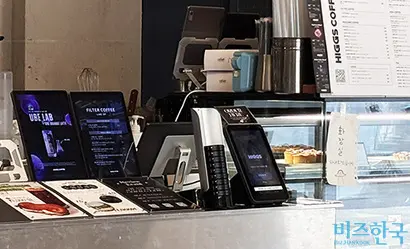
Although latecomer Naver Pay puts forward its service linkage as a strength, assessments suggest that challenges remain in securing offline touchpoints. Given that the competition in the terminal market depends on distribution, it is expected that it will take time to narrow the gap.
Regarding this, Naver Pay explained, "The strength of Connect is that it can naturally link Naver Place reviews or coupon functions with the payment process," adding, "We are focusing on such user convenience and service linkage rather than a competitive edge. Since the launch last year, we believe it has been spreading at a fast pace internally."
They added, "The number of terminals currently installed in stores is being prepared separately and will be disclosed at a later date, and it is difficult to provide it at this moment.”
Meanwhile, Toss is focusing on expanding the scope of utilizing merchant data based on terminal distribution. The goal is to centrally manage payment, settlement, and sales data collected through the payment terminals and, based on this, make it easier to manage cash flow and utilize financial services.
A Toss official stated, "We plan to expand our business by providing financial services linked to store operation data and personalized benefits for customers," adding, "Ultimately, we will become the partner that business owners use most frequently and trust the most."