

[비즈한국] In 2023, a strange entity was discovered right next to the Andromeda Galaxy. Amateur astrophotographers spent 111 hours of exposure capturing Andromeda using a filter that selectively records only the light of ionized oxygen, and they discovered a massive blue gas cloud right next to it. This was a shape never seen before. It has been named DSO 1, incorporating the names of the three amateur astrophotographers who first discovered it.
This baffling gas cloud continues to puzzle astronomers. However, a paper has finally been published claiming to have identified its true nature. What exactly is this gas cloud?
Typically, standard telescopes use filters that capture hydrogen light, not oxygen, when imaging interstellar matter. That is why the existence of this suspicious gas cloud remained hidden for so long. Upon its initial discovery, astronomers pondered what it could be. If it is located at the same distance as Andromeda, its scale would be at least 100,000 light-years. This would be a massive size for pure gaseous material drifting in intergalactic space. Alternatively, it could be a small gas cloud drifting nearby within our own galaxy's halo, completely unrelated to Andromeda. However, this is not a satisfying explanation either, as there is no obvious light source bright enough to illuminate this gas cloud.
The current situation, debating whether it is a small nebula within our galaxy or a massive celestial body millions of light-years away outside our galaxy, brings to mind the Great Debate in astronomy exactly 100 years ago. As it happens, the Andromeda Galaxy is the very site where that Great Debate took place. It is a strange coincidence.
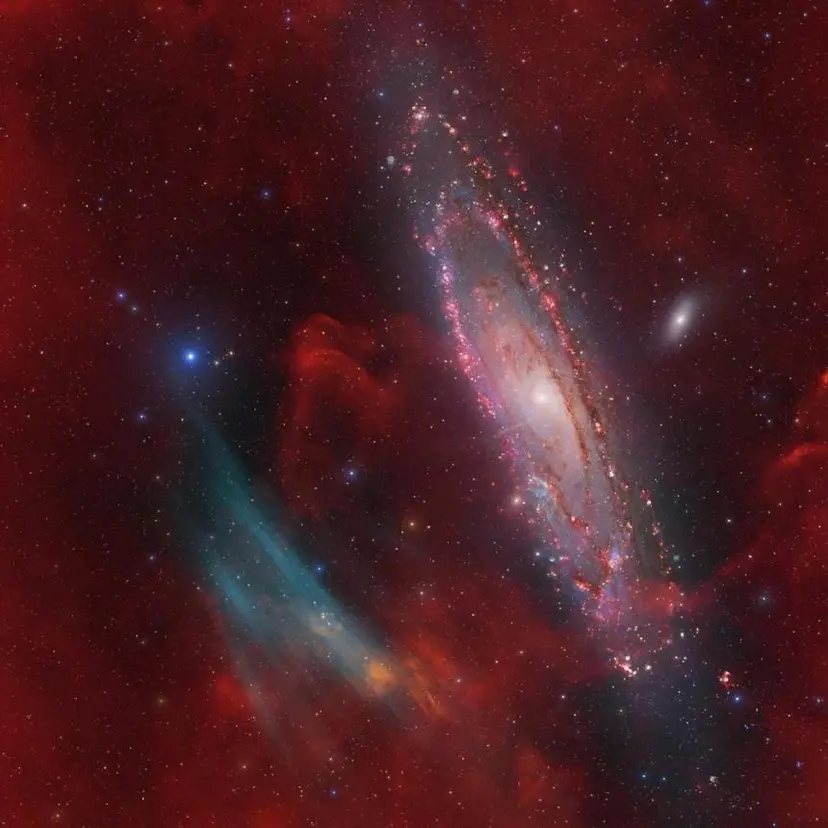
There were even speculations that it might be a trace of a shockwave formed as the halos of our galaxy and the Andromeda Galaxy collide in preparation for their eventual merger. Some suggested that the two galactic halos had only recently begun to make contact, leaving these traces at the interface. However, this hypothesis was quickly dismissed. Subsequent spectral observations revealed that this blue gas cloud is moving at a very slow speed of only about 10 km/s. This is extremely slow compared to the movement of the Andromeda Galaxy, which is approaching much faster. Therefore, it cannot be seen as a shockwave caused by a collision.
Observations and analyses continued to determine its identity. Finally, astronomers found a new clue: it is a type of "ghost" planetary nebula scattered by a nearby star as it collapsed into a white dwarf. The Southern Ring Nebula is a representative example of a ghost planetary nebula. When a star as light as the Sun completes its nuclear fusion and collapses into a white dwarf, the ejected outer layers can ionize surrounding interstellar material, leaving behind such bright traces.
This analysis points to the star EG Andromedae as the culprit behind the blue nebula. Despite its name, this star is in the constellation Andromeda and has no relation to the Andromeda Galaxy. It is a nearby star within our own galaxy, located about 2,000 light-years away. This star is drifting across our galactic halo at a very high speed of 107 km/s. Therefore, the material ejected by the star can strike the interstellar medium of the Milky Way, creating a spherical shockwave. It is similar to a bullet flying through the air, creating a bow shock in front of it.
The direction in which this star is moving points exquisitely toward the blue nebula. Additional observation photos reveal a 145-light-year-long gas tail left behind by the star, which connects to the blue nebula. This lends weight to the hypothesis that it is a shockwave generated by the star as it travels rapidly through space. If this proposal is true, it seems this nebula simply happens to be passing directly in front of the Andromeda Galaxy by pure coincidence, which has caused all the confusion.
Of course, there are counterarguments. Because the blue nebula's speed is still slow, it is difficult to definitively conclude that it is a shockwave spread by a star moving at high speed through the halo space. It might be that this blue nebula is cleverly disguising its true identity by overlapping, purely by chance, in the same direction not only with the background Andromeda Galaxy but also with the gas tail shed by the star pointed out as its cause.
In the paper, the researchers also presented the existence of other ghost nebulae similar to the contentious blue nebula. When they imaged sites where surrounding shockwaves and planetary nebulae were created by the shockwaves of collapsed stars using the same ionized oxygen filter, similar patterns emerged. This tells us that the space in our galaxy is a remarkably chaotic and crowded world. If we were to map the entire Milky Way and halo space using new ionized oxygen filter imagery, we might encounter a much more turbulent landscape than we ever imagined.
Recently, astronomers have been carrying out large-scale observation projects aimed at the center of our galaxy, which has long been hidden by dense dust clouds, using new light in the form of radio waves. They have meticulously mapped the complex shockwaves and traces of collisions with interstellar material created by the roar of the supermassive black hole hidden within. The area is tangled with numerous thin, long dust filaments. However, there has never been a systematic, large-scale observation of the empty galactic halo. While there is a clear object of interest in the galaxy's center—the supermassive black hole—there was no particular interest in the galactic halo, where the density of stars is low.
Yet, amateur astrophotographers attempted an unprecedented feat in this dull territory that professional astronomers had overlooked, and they encountered a scene no one had expected. Great discoveries in astronomy still owe a great debt to amateur enthusiasts. Astronomers have now begun to ponder that our halo might not be a dull, empty world after all. I wonder where else in that pitch-black night sky faint, shimmering fragments of blue nebulae might be drifting.
About the author, Ji Woong-bae? He loves cats and the universe. As a child, he watched 'Galaxy Express 999' and dreamed of sharing the beauty of the universe. He is currently an assistant professor in the Faculty of Liberal Arts at Sejong University, engaging in various science communication activities including lectures and writing. He has authored books such as 'A Piece of the Universe Every Day', 'Scientists of the Starry Universe', 'Things You Can't Visit But Can Know', and 'Strange Questions That Arise When Looking at the Universe', and has translated books including 'The Hitchhiker's Guide to the Real Universe', 'How I Killed Pluto', 'Quantum Life', and 'Cosmographic'.