

[비즈한국] It has been found that the Seoul Hangang Bus is about twice as slow on average as the Australian Brisbane water bus it used as a benchmark. According to internal reports compiled by the Seoul Housing and Communities Corporation (SH)—the majority shareholder of the Hangang Bus operator—following their field survey, as well as recent audit findings from the Board of Audit and Inspection, the speed competitiveness of the Hangang Bus falls short of both international standards and initial expectations.
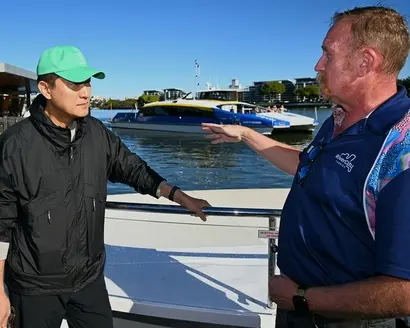
In August last year, one month before the official launch of the Hangang Bus, SH visited the operating site of 'CityCat,' the Brisbane water bus in Australia, to benchmark advanced water transportation practices. The CityCat, operated by the Brisbane City Council through private delegation, currently services 22 ferry terminals along the Brisbane River. Previously, Seoul Mayor Oh Se-hoon visited the CityCat operation site in July last year and ordered a field survey by working-level staff. Consequently, SH conducted a site visit and produced an overseas business trip report that included plans to supplement the Hangang Bus operation plan.
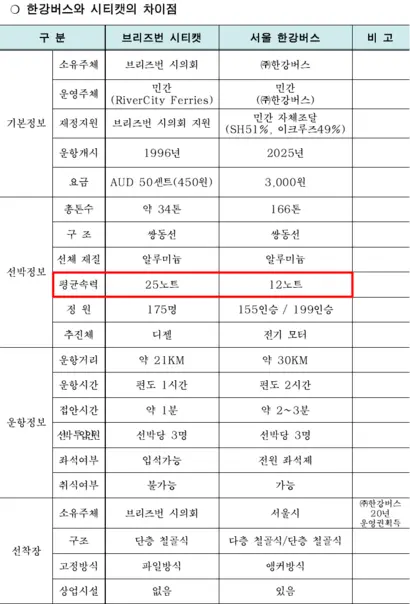
According to the August SH Australia business trip report obtained by Bizhankook, the average operating speed of the Brisbane CityCat was 25 knots, which was about twice as fast as the 12 knots identified by SH for the Hangang Bus at the time. One knot is the speed at which a vessel travels 1 nautical mile (1.852 km) per hour. In other words, the average speed of the Hangang Bus was 22 km/h, about twice as slow as the CityCat's average speed of 46 km/h. The report noted that while the CityCat covers a 21 km route in one hour one-way, the Hangang Bus takes two hours one-way for a 30 km route.
Of course, there are differences in the vessel specifications. Both the Hangang Bus and the CityCat are aluminum-based catamarans. They increase stability by connecting two lightweight, durable aluminum hulls in parallel with a deck on top. However, the Hangang Bus weighs 166 tons, about 132 tons heavier than the 34-ton CityCat. While the Hangang Bus has an all-seated configuration with a capacity of 199 for vessels 1–8 and 155 for vessels 9–12, the CityCat accommodates 175 passengers, including some standing room. The Hangang Bus uses electric motors (hybrid for vessels 1–8), while the CityCat uses diesel propulsion.
The operating conditions for the water buses also differ. According to SH’s interviews with the CityCat operator, while the Brisbane River depth is between 3 and 15 meters, the CityCat’s route is maintained at a depth of 10 meters through dredging. In contrast, according to a 2023 report by the Seoul Metropolitan Government's Future Hangang Headquarters, the average depth of the Hangang Bus route was between 3.3 and 6.7 meters. Generally, shallow water increases water resistance and can cause changes in the vessel's attitude as the flow around the hull accelerates. Therefore, shallow water is considered a constraint not only for maintaining speed but also for safe operation.
The speed issue of the Hangang Bus was also highlighted in a recent audit. The Board of Audit and Inspection released the results of its audit on the 'National Assembly's Request for Audit Regarding the Hangang Bus and Yeouido Ferry Terminal Construction Project' on the 16th. According to the audit report, although the Seoul Metropolitan Government recognized through a model ship experiment report in December 2023 and a meeting on vessel speed in April 2024 that the expected speed was only 14.5 to 15.6 knots, it announced an operating speed of 17 knots and launched the project. Based on 17 knots, the travel time was calculated as 54 minutes for the express route and 75 minutes for the local route.
However, the actual operating speed of the Hangang Bus confirmed by the audit did not meet the Seoul Metropolitan Government's announcement. A simulation requested by the audit board from the Korea Maritime Transportation Safety Authority showed an operating speed of 12–16 knots, with travel times of 64–85 minutes for the express route and 78–100 minutes for the local route, differing from the official announcement (17 knots, 54 minutes for express, 75 minutes for local). Furthermore, in a direct measurement taken by auditors while riding the Hangang Bus Line 1, the average speed was found to be 12.5–13 knots.
The Board of Audit and Inspection stated, “It is unlikely that the 12 vessels of the Hangang Bus project will meet the travel times announced by the Seoul Metropolitan Government (54 minutes express, 75 minutes local) based on 17 knots, raising concerns that the project objective of improving citizen commuting convenience through the revitalization of new water-based public transport may not be achieved.”
Meanwhile, during SH’s field survey of CityCat, safety vulnerabilities in the Hangang Bus were also identified. On the CityCat, if the bow is docked first, the captain can intuitively see the bollard to tie the mooring lines from the wheelhouse. In contrast, Hangang Bus vessels 101 and 102 have blind spots where the side of the bow is difficult to see with the naked eye. The ferry terminal is also designed too close to the vessel compared to the CityCat. After identifying these safety issues, SH took measures such as installing additional CCTVs and fenders.
However, the timing of SH's field trip to benchmark the CityCat leaves much to be desired. August of last year, when SH went to Australia for the field survey, was only one month before the official launch of the Hangang Bus. There was very little time to control for vessel defects or external variables before the first voyage. In particular, the 12 Hangang Bus vessels contracted in 2024 had expected delivery dates of September 2024 (vessels 1–8) and May 2025 (vessels 9–12). However, the actual delivery dates were delayed to February 2025 (2 vessels), September 2025 (6 vessels), and early this year (4 vessels).
An official from the Seoul Metropolitan Government’s Water Transportation Division explained, “The speed difference between CityCat and Hangang Bus is due to water depth and vessel scale. As the vessel scale gets smaller and the water gets deeper, speed increases. Seoul is conducting dredging with the goal of securing the depth (2.5m) essential for safe operation.” The official added, “I think it would have been better if the field survey of the CityCat had taken place sooner, but there were things we could learn through the on-site survey, such as docking/undocking methods and the arrangement of boarding areas.”
The Hangang Bus is Seoul's first water-based public transport system. It was introduced last September to help alleviate severe road traffic congestion and public transport crowding during commute hours. It operates as a passenger ship connecting seven terminals along the Hangang River—Magok, Mangwon, Yeouido, Apgujeong, Oksu, Ttukseom, and Jamsil—totaling 28.9 km. The operator, Hangang Bus Co., Ltd., is a joint venture between Seoul’s SH and E-Land Group’s E-Cruise. The two companies hold 51% and 49% stakes, respectively, meaning the Seoul Metropolitan Government is effectively the largest shareholder.
The Hangang Bus halted operations in some sections last November due to an incident. At that time, Hangang Bus vessel 102 ran aground in a shallow section near Jamsil Ferry Terminal around 8 PM. The cause of the accident was determined to be route deviation and insufficient lighting on navigational buoys. Since the accident, the Hangang Bus suspended operations between Apgujeong and Jamsil and operated only between Magok and Yeouido. Seoul resumed full Hangang Bus operations on the 1st after finishing dredging to ensure depth and completing safety inspections.