

[비즈한국] With the rapid expansion of the artificial intelligence (AI) industry, the surge in power demand from data centers has turned energy infrastructure shortages into a key variable hindering industrial growth. In major global technology hubs, including the U.S., delays in building new energy infrastructure have led to frequent situations where the launch of AI data centers is postponed by years. Amid this trend, technical efforts are intensifying to utilize data centers not just as static power-consuming facilities, but as 'energy resources' that can flexibly adjust consumption according to the status of the power grid.
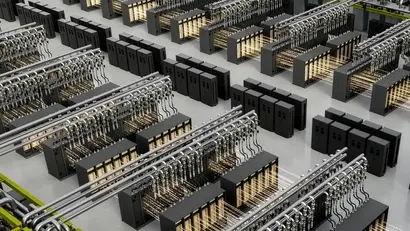
On the 23rd (local time), Emerald AI, a startup invested in by NVIDIA, announced at 'CERAWeek 2026'—the world's largest energy industry conference held in Houston—that it is developing a data center equipped with software technology that controls energy usage in real-time to match power grid demand. Their 'Emerald Conductor' platform dynamically adjusts the data center's computing operations during peak grid hours.
According to field test results in Phoenix, Arizona, this system reduced the power consumption of AI workloads (the amount and type of work to be processed within a specific time) running on a cluster of 256 NVIDIA GPUs by approximately 25% during three hours of high grid load. This demonstrated the potential to redefine data centers as flexible resources that provide practical support to power grid operations.
The core of the technology lies in classifying the priority of AI tasks. Less time-sensitive tasks, such as training or advanced processing of Large Language Models (LLMs), are temporarily slowed or paused during peak hours when power demand is high. On the other hand, AI inference services requiring immediate responses are rerouted to data centers in other regions where power availability is sufficient. The Emerald simulator and AI agents automatically coordinate these tasks to maintain a balance between energy consumption and computational performance.
The industry is taking note of the economic value this flexibility will bring. According to research by Duke University, reducing power consumption by just 25% at data centers during the less than 200 annual peak hours is equivalent to securing about 100 gigawatts (GW) of new power capacity. This is comparable to investing roughly $2 trillion in data center infrastructure and provides a rationale for expanding AI facilities more rapidly by leveraging existing power grids.
This technology, which previously remained in the experimental phase, is now entering the process of large-scale commercialization. NVIDIA has decided to deploy Emerald AI's software at the 'Aurora' data center being built in Virginia by global data center developer Digital Realty. The Aurora facility is expected to be recorded as the world's first case to receive industry-standard flexible power certification.
Virginia is the world's most densely populated region for data centers, making the urgency for power demand management extremely high. The project involves joint participation from PJM, a regional grid operator in the U.S., and the Electric Power Research Institute (EPRI). They plan to precisely verify whether this software-based task-shifting technology enhances the actual reliability of the power grid.
The flexibility of data center power consumption also has a positive impact on reducing regional energy costs and integrating renewable energy. Since renewable energy has high generation volatility, a buffer mechanism is essential. If data centers actively adjust their demand in line with power supply changes, the resilience of the power grid is strengthened, and the operation rate of fossil fuel-based generators can be reduced.
The International Energy Agency (IEA) predicts that global data center electricity demand will more than double by 2030 compared to current levels. Consequently, the regulatory environment is changing, with some regions like Texas in the U.S. preparing legislation that mandates power consumption cuts for data centers during grid overloads. In this context, the collaboration between NVIDIA and Emerald AI is viewed as a strategic self-rescue measure by the industry to respond to regulations while ensuring the scalability of AI infrastructure.