

[비즈한국] Following the 'First Mass-Produced Unit Unveiling Ceremony' held in Sacheon, Gyeongnam, on March 25, the detailed mass production plan for the KF-21 Block 1 has been confirmed. The KF-21 Block 1 maintains virtually the same configuration as the six previously built prototypes, excluding special flight test equipment. In particular, it has been identified that all of the initial production units, from the first to the sixth, are being manufactured as 'two-seaters' capable of carrying two pilots. Out of the total 40 units for Block 1, the final number of two-seater units to be produced has not yet been specified.
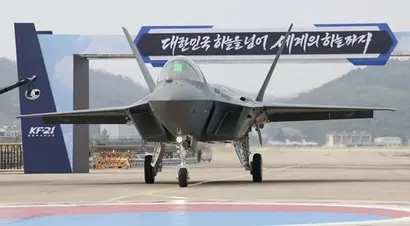
Since the rollout of the first prototype on April 9, 2021, the KF-21 has successfully completed the development of the basic Block 1 model by conducting 955 ground tests and 1,601 flight tests with a total of six prototypes by the end of last year. It is evaluated as having proven high completion even at the prototype stage, having completed development on schedule without a single accident, even during dangerous test flights exploring uncharted territory. In fact, these mass-produced units are considered an unparalleled achievement, as they are produced with little difference from the prototypes, excluding test equipment such as pitot tubes or spin recovery parachutes.
Normally, a prototype is a test aircraft used to verify performance against design blueprints, and it is common to modify or supplement designs during the development process. In particular, because fighter jets involve massive production costs and many unforeseen variables during flight, it is common for the designs of prototypes and mass-produced units to differ. France's Rafale had different engines in its prototype and production versions, leading to differences in airframe size, and the F-35 is also notorious for 'prototype verification' difficulties, such as having to change specifications due to parts becoming discontinued during development delays.
In contrast, the KF-21 became the world's first to adopt a 'Digital Twin' method, undergoing precise simulation and optimization from the design stage. Thanks to this, the gap between the prototype and the production aircraft was minimized, effectively resolving risks related to additional costs and schedule delays. This stands in stark contrast to Turkey's KAAN fighter, which is currently building a second prototype (P1) that is completely different in form due to inevitable, extensive design changes following the first flight of its initial prototype (P0) in 2024.
The next task for the thoroughly vetted KF-21 is 'rapid force integration.' According to a military official, the Defense Acquisition Program Administration (DAPA) has adopted a 'two-seater first' production policy, meaning that all units from the second to the sixth, currently being assembled on the production line, will be produced as two-seaters.
In general, fighter jets are produced primarily as single-seaters, and it is customary to produce them before two-seaters. Most modern major fighter jets, such as the F-16, F/A-18, Eurofighter Typhoon, Gripen, and Su-57, followed this sequence; the only notable exception to produce the two-seater (B-model) first is France's Rafale.
The reason the South Korean military is exceptionally prioritizing the production of six two-seaters is directly related to pilot training. Two-seaters are essential not only for high-difficulty missions like night attacks or suppression of enemy air defenses (SEAD) but also for 'aircraft conversion training' to adapt to new models. Filling the initial quantity with two-seaters is interpreted as a strategy to secure a sufficient number of pilots and accelerate the timing of operational deployment. Accordingly, it is known that the first unit to receive the KF-21 will likely be the Republic of Korea Air Force's 16th Fighter Wing in Yecheon, which is responsible for aircraft conversion training, rather than the previously rumored Gangneung Air Base.
Meanwhile, during the event, DAPA and Korea Aerospace Industries (KAI) also unveiled their future roadmap and production capabilities. Currently, KAI can produce a maximum of 50 units per year combined for the KF-21 and FA-50 series, and plans to double this capacity in the long term. In addition, they formalized phased improvement plans, such as 'Block 2' equipped with air-to-ground capabilities, the 'KF-21 EJ' dedicated to the suppression of enemy air defenses, and the 'KF-21EX' which will evolve into a 5.5-generation stealth fighter, signaling their readiness to respond to future battlefield environments.