

[비즈한국] The automotive industry is in flux again over leadership in autonomous driving technology. Tesla, which has stuck to a vision-centered system for years by claiming that "cameras are enough," has hit a wall in the form of strict safety regulations from the U.S. federal government. Conversely, the "sensor fusion" camp, which minimizes recognition errors by combining cameras, LiDAR (laser sensors), and radar (radio sensors), is receiving renewed attention thanks to its technical reliability and falling hardware costs.
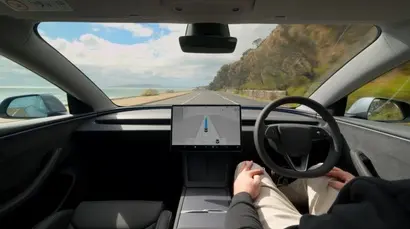
U.S. National Highway Traffic Safety Administration Expresses Serious Concerns
On March 18, the U.S. National Highway Traffic Safety Administration (NHTSA) expanded its investigation into 3.2 million vehicles equipped with Tesla's Full Self-Driving (FSD) software, elevating it to an "engineering analysis" stage. This is the final step taken before deciding on a mandatory recall, and it essentially reveals the federal government's distrust of Tesla's "Vision-only" strategy.
The core of the investigation is that camera sensors fail to properly recognize surrounding obstacles or vehicles ahead in environments with significantly reduced visibility, such as fog, intense glare, or airborne dust. At least nine cases have been identified where the system failed to send appropriate warnings to the driver until moments before a collision, including a fatal pedestrian accident in a dust storm in Arizona in 2023. Regulators are seriously concerned that the software Tesla prides itself on only acts in a "reactive" manner during physical limit scenarios.
The point the NHTSA is raising is not merely the number of accidents itself. The key is whether Tesla's FSD "performance degradation detection system" could autonomously detect reduced camera recognition performance in low-visibility situations and provide sufficient warning time to the driver. The NHTSA estimated the scope of this engineering analysis to be approximately 3.2 million vehicles, including 2016-2026 Model S and X, 2017-2026 Model 3, 2020-2026 Model Y, and 2023-2026 Cybertruck models.
What is even more notable is that regulators believe Tesla's post-remedial measures are insufficient. According to the NHTSA, Tesla began developing an update for the performance degradation detection system at the end of June 2024, but authorities have yet to clearly grasp when or to which vehicles that update was distributed. Tesla's own analysis also suggested that if this update had been installed at the time, it might have only affected three of the nine cases. The NHTSA has also raised the possibility that similar accidents have been undercounted due to the limitations of Tesla's internal data classification, stating they will look into an additional six potentially related accidents.
Falling Production Costs Bring Focus to 'Sensor Fusion'… Tesla Also Re-evaluating
In the past, the biggest obstacle for the sensor fusion approach was cost. High-performance LiDAR, which cost $75,000 per unit in 2015, was an overly high barrier for standard mass-produced vehicles. However, market conditions have changed. Thanks to mass production by Chinese suppliers and technological innovation, the cost of LiDAR has now dropped to several hundred dollars, with some entry-level models falling into the $200 range, reaching a level where it can be equipped as a standard feature in mass-produced cars. This price drop has served as a catalyst for significantly increasing the economic viability of the sensor fusion approach.
An interesting point is that Tesla is also re-evaluating sensor fusion internally. Tesla removed radar in 2021, but its latest hardware (HW4), introduced in 2023, includes support for a high-performance radar dubbed "Phoenix Radar." However, opinions are still divided on whether this radar is directly involved in driving across all models.
European premium brands like Mercedes-Benz and BMW are already making aggressive moves regarding legal liability for autonomous driving accidents, based on their trust in sensor fusion. Mercedes-Benz has gained consumer trust by declaring that the manufacturer will take legal responsibility for accidents that occur while its "Drive Pilot" (which includes LiDAR) is engaged. Hyundai Motor Group’s Motional has also demonstrated the stability of its multi-sensor system by passing the U.S. Federal Motor Vehicle Safety Standards (FMVSS) with its Ioniq 5 robotaxi.
As the maturity of autonomous driving technology increases, the market's interest is shifting beyond driving performance to "defensive capabilities in exceptional situations." This Tesla FSD recall crisis serves as a reminder that no matter how much vast driving data and software training is accumulated, physical blind spots that are difficult to overcome exist for the Vision-only approach.
The speed of autonomous vehicle adoption ultimately depends on how much the immense social costs and legal risks incurred in the event of an accident can be reduced. This is why attention is focused on which method—Vision-only or sensor fusion—will eventually establish itself as the standard for the autonomous driving market.