

[비즈한국] Discussions on virtual asset taxation have re-emerged ahead of the 9th National Simultaneous Local Elections this coming June. On March 25, the People Power Party (PPP) held a session to gather opinions on virtual asset-related regulations from the CEOs of five domestic KRW-based exchanges. With the opposition party also reaching out to virtual asset investors, particularly the younger demographic, attention is focused on whether this push for abolition will lead to a fourth postponement of the crypto tax.
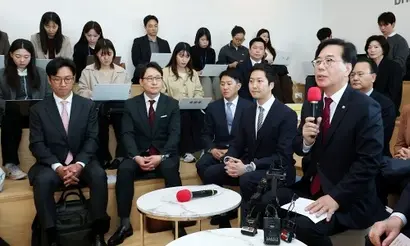
On March 25, a 'Seminar on Improving the Digital Asset Taxation System,' hosted by the People Power Party, was held at the Coinone headquarters in Yeouido, Seoul. Industry leaders in attendance included the heads of the five major domestic KRW virtual asset exchanges: Dunamu (Upbit) CEO Oh Kyung-seok, Bithumb CEO Lee Jae-won, Korbit CEO Oh Se-jin, Coinone CEO Cha Myung-hun, and Streami (Gopax) Deputy CEO Choi Han-gyeol. Representing the PPP were Floor Leader Song Seok-un, Policy Committee Chair Jung Jeom-sik, Senior Deputy Floor Leaders Yoo Sang-bum and Kim Eun-hye, as well as lawmakers Park Soo-young, Choi Bo-yoon, and Park Choong-kwon. Following the opening ceremony, the lawmakers and exchange executives held a closed-door meeting to discuss current industry issues and legislative direction.
On March 19, Lawmaker Song Seok-un and 11 others proposed a 'Partial Amendment to the Income Tax Act' aimed at abolishing the 'other income tax' currently imposed on virtual assets. The core of the bill is the deletion of tax regulations in the Income Tax Act that apply to income generated from the transfer or rental of virtual assets. Current law classifies income from virtual asset transfers or rentals as 'other income,' imposing a 20% tax (22% including local tax) on gains exceeding 2.5 million won. The effective date is currently scheduled for January 1, 2027.
The People Power Party argues that virtual asset taxation is unsuitable for investor protection and industry growth. Their stance rests on two main points: first, it could constitute double taxation since value-added tax is already paid on exchange fees; second, it lacks consistency and equity, especially since the financial investment income tax was abolished for the sake of investor protection and capital market development. During the seminar, Lawmaker Song Seok-un emphasized the irrationality of the tax, stating, "There are over 13 million virtual asset investors. It is inappropriate to implement taxation on virtual assets starting in 2027 while we are simultaneously scrapping the financial investment income tax."
Lawmaker Park Soo-young, the ranking member of the National Assembly's Strategy and Finance Committee, emphasized, "We are not ready to tax virtual assets. The National Tax Service lacks a sufficient understanding of them. Even if we adopt the Crypto-Asset Reporting Framework (CARF) to exchange global transaction data, individual transaction information is not included. It is also a problem that tax information systems only exist at the five major KRW exchanges. There is a possibility that assets will increasingly flow to overseas exchanges. Ultimately, we are ill-prepared to impose income tax."
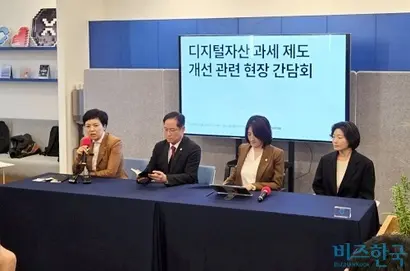
During the event, the PPP highlighted the protection of young investors as a way to appeal to voters ahead of the local elections. Lawmaker Park remarked, "I believe that abolishing the virtual asset tax will be of great help to young people in building their assets." Lawmaker Kim Eun-hye also noted, "The criteria and definition of virtual asset income remain ambiguous, yet the government is rushing to collect taxes. Young people are taxpayers and investors as well. They should be approached from the perspective of protection, not as targets for uniform regulation."
Regarding coordination with the ruling party, Lawmaker Park Soo-young said, "We haven't received a response from the ruling party yet. We hope to hear their position before the Tax Subcommittee, which reviews tax laws, makes a decision." Previously, on the 19th, Lawmaker Kim Han-gyu, Senior Deputy Floor Leader of the Democratic Party, commented on the abolition bill, saying, "Now that the bill has been proposed, it will have to be discussed in the Strategy and Finance Committee," while adding, "There is no internal consensus or shared position on this within the party."
The heads of the five major exchanges left after the closed-door meeting with the lawmakers. It was reported that in addition to the tax system, they presented opinions on promoting institutional and foreign investment in the sector.
The virtual asset taxation system was originally scheduled to be implemented on January 1, 2022, but was postponed by one year to January 1, 2023, due to a market downturn in 2021. However, due to strong resistance from investors and concerns over inadequate infrastructure in 2023, it was delayed again to January 1, 2025. After the tax infrastructure remained insufficient following that two-year delay, the implementation date was pushed back once more to January 1, 2027.
Some suggest a fourth postponement may be necessary. Kim Gap-lae, a senior research fellow at the Korea Capital Market Institute, pointed out the need for a reform of the tax system in his report, 'Thoughts on Taxation of Virtual Asset Income Under the 2025 Income Tax Act Amendment.' The senior researcher noted that before implementation, it is necessary to: define the targets, methods, and timing of taxation for individual virtual asset income by income type; build an efficient tax system for collecting and reporting transaction data; and support the activation of efficient tax service platforms linked to virtual asset exchanges and personal wallets.
In his report, Kim concluded, "In the long term, we need a fundamental discussion on whether it is desirable to systematize virtual asset transfer and rental income as 'other income.' We must deeply discuss issues such as loss-profit aggregation, carry-over deductions, tax equity, and the imposition of health insurance premiums, while taking into account the unique characteristics of virtual assets."