

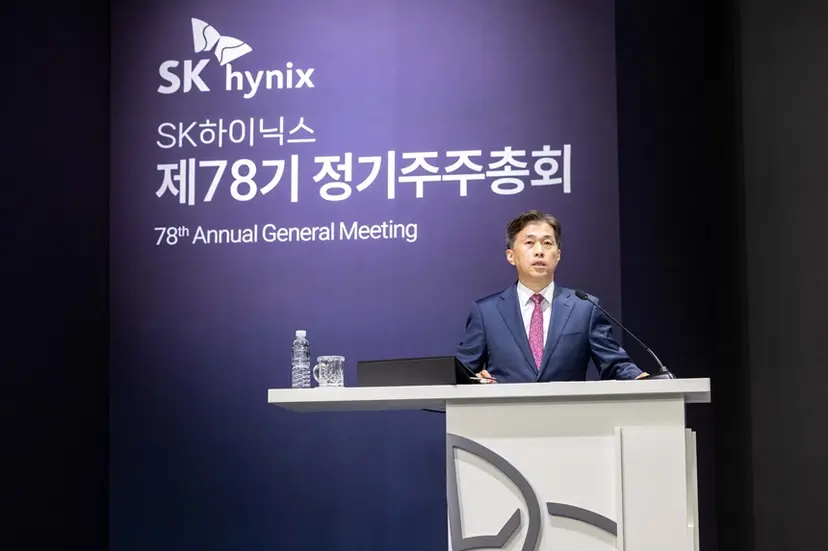
[비즈한국] At the shareholders' meeting, SK Hynix CEO Kwak Noh-jung000660 unveiled a mid-to-long-term financial goal to secure more than 100 trillion won in net cash, aimed at enhancing responsiveness to the AI-centric semiconductor market. Addressing criticism from some shareholders regarding underwhelming shareholder returns and the net cash target, he pointed to the current stock price, which has risen approximately fivefold compared to last year, emphasizing, "A certain level of cash is necessary to deliver consistent results regardless of short-term fluctuations." He also made official the plan to list American Depositary Receipts (ADRs) in the U.S. in the second half of this year.
1.1 Million Retail Shareholders, an Increase of 400,000 from Last Year
SK Hynix held its 78th Regular General Shareholders' Meeting on the 25th at the SUPEX Center at its headquarters in Icheon, Gyeonggi Province. The meeting proceeded with the deliberation of agenda items such as the approval of financial statements, amendments to the articles of incorporation, and the appointment of directors, followed by a business report and a Q&A session.
CEO Kwak diagnosed 2025 as "a year where the demand structure fundamentally changed as memory demand expanded beyond HBM (High Bandwidth Memory) to general DRAM and NAND." He specifically noted that HBM revenue grew more than twofold compared to the previous year, with the company securing a 64% market share, proving its leadership. Last year, SK Hynix achieved record-high results since its founding, with consolidated revenue of 97 trillion won and an operating profit of 47 trillion won. This represents a 47% increase in revenue and a 101% surge in operating profit compared to the previous year.
CEO Kwak stated, "For DRAM, while HBM continued to drive demand expansion, the growth of the AI and data center industries also fueled demand for high-performance premium products such as DDR5 and low-power LPDDR5. In NAND, the adoption of high-performance, high-capacity enterprise SSDs in AI infrastructure led the demand increase."
He expressed confidence regarding the progress of HBM4, including NVIDIA qualification tests. CEO Kwak explained, "We established the world's first mass production system last September and are supplying products smoothly according to the customer's requested schedule."
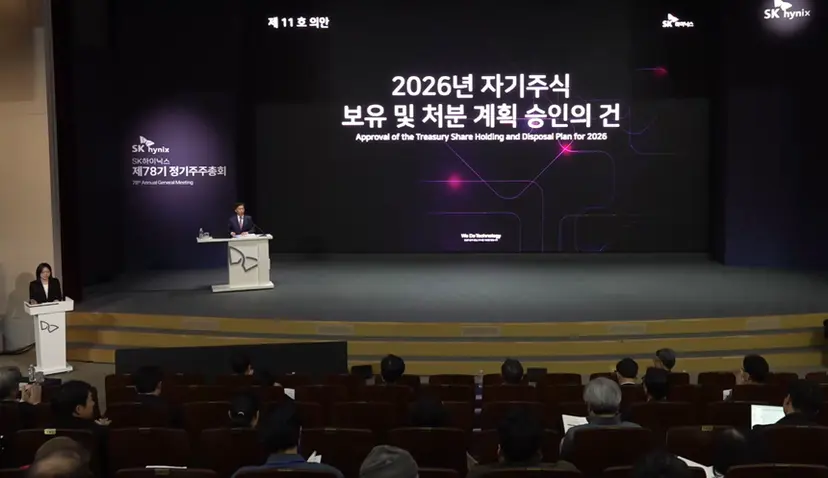
As of 10:00 AM that day, the number of shareholders attending in person or via electronic voting was 6,163, representing 77.8% (545,974,904 shares) of the total voting shares. According to the business report, as of the end of last year, SK Hynix had 1,186,328 retail shareholders. This marks an increase of approximately 400,000 from the end of the previous year (780,867), with the number of retail shareholders surpassing the 1 million mark.
Ample Cash as an Asset and Insurance
Attention was also focused on the plan for a U.S. stock market listing. The day before (the 24th), SK Hynix announced that it had confidentially filed a draft registration statement for an ADR listing with the U.S. Securities and Exchange Commission (SEC). ADRs are securities issued to allow foreign company shares to be traded on U.S. stock exchanges.
CEO Kwak said, "This decision is to have our corporate value re-evaluated in the U.S., the world's largest stock market. We will proceed in a direction that helps enhance shareholder value, reflecting shareholder feedback." He added, "While the scale and method have not been finalized and I cannot disclose details due to domestic and international regulations now that the listing review process has begun, we are preparing with the goal of listing in the second half of this year."
Regarding the financial structure, he unveiled the mid-to-long-term goal of securing 100 trillion won in net cash. CEO Kwak explained the rationale: "Although financial stability has recently improved, it is still insufficient when compared to global top-tier companies that lead AI technology and drive memory demand. Sufficient cash is a strategic asset for future growth and, at the same time, excellent insurance to prepare for market uncertainties."
He further promised to execute long-term, strategic investments based on stable cash holdings and build a long-term growth foundation equipped with global top-tier financial strength, including production infrastructure, to respond to global customer orders in a timely manner. This is a measure to stably continue large-scale facility investments, such as the Yongin Semiconductor Cluster and the Indiana packaging plant in the U.S.
"Dividends are Too Low," CEO Responds: "Maintaining Growth Momentum is the Priority"
Despite record-breaking results, sharp questions regarding shareholder return policies continued throughout the meeting. One shareholder pointed out, "It is difficult to understand how the dividend is only 3,000 won per share when the operating profit exceeds 47 trillion won," adding, "Isn't shareholder return a priority over the plan to accumulate 100 trillion won?"
CEO Kwak replied, "The company has been focusing on repaying debt, and this is the point where we have only just shifted to a net cash position. A certain amount of cash is essential to continue investing without wavering even in market cycles like those in the past." He added, "The stock price, which has risen about fivefold compared to last year, was possible because of timely investment and technological prowess. We have strived to enhance shareholder value through efforts like the 1,500 won per share special dividend and the cancellation of treasury shares worth 14.5 trillion won. We will continue to review additional dividends and share buybacks by closely monitoring future cash flow."
Regarding whether a stock split is being considered to increase accessibility, he stated, "There are no plans at the moment, but we will carefully review it by comprehensively considering trading volume and market prospects."
SK Hynix is drawing up a blueprint to actively respond to global AI market changes through an 'AI Company' (tentatively named AI Co.) it intends to establish in the U.S., and to discover investment and business opportunities in companies possessing core AI capabilities. Regarding the Kioxia stake invested in the past, he explained that the company is considering the best way to utilize it while protecting asset value.
At the meeting, all agenda items were passed as proposed, including the approval of financial statements, amendments to the articles of incorporation (such as deleting the cumulative voting exclusion clause), appointment of directors (Cha Seon-yong as executive director, Jung Duck-kyun, Kim Jung-won, and Choi Kang-guk as independent directors, and Kim Jung-kyu as non-executive director), approval of the director compensation limit (15 billion won + 30,000 treasury shares), reduction of capital reserves, and approval of treasury share retention and disposal plans.