

[비즈한국] Scalping is an act of interfering between artists and fans, stripping fans of their rights and generating unfair profits. For those who previously had no interest in an artist to hijack viewing opportunities from fans for profit is a crime akin to kidnapping. This is because a 'kidnapped' ticket can only be retrieved by paying a relatively high price. That ticket should have gone to the fan in the first place. Furthermore, it is inappropriate for non-fans to watch and critique these performances. After all, they are in no position to understand or empathize with the content. It is only fitting that a concert be planned and delivered from the perspective of the fans and the artist.
However, even normal ticket purchasing is not necessarily fair these days. Because they are sold on a first-come, first-served basis online, those who are quick with their hands have a higher chance of securing them. It is impossible to know if they are 'true fans.' If macro programs are involved, it is even worse. For ticket sales to be fair, they must go to true fans. The record of consistently purchasing or listening to albums and music could be an objective criterion for distinguishing true fans.
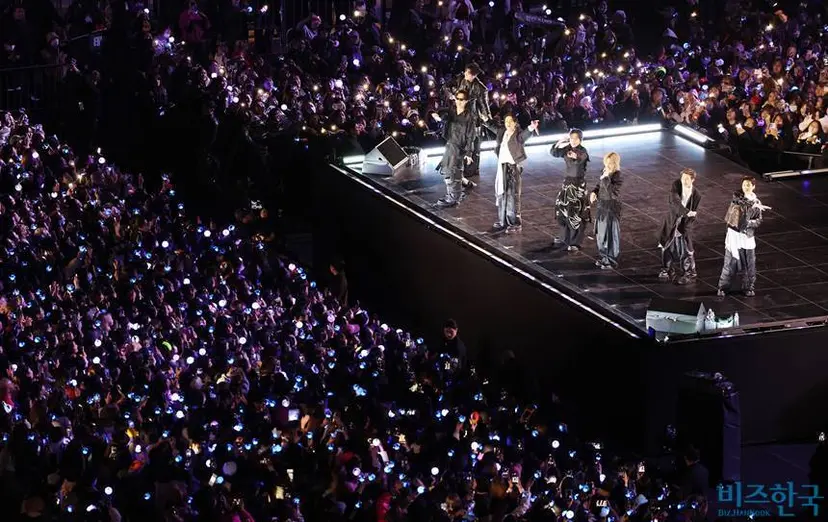
In this regard, two recent stage performances by BTS can be compared. While there was still much debate over the Gwanghwamun concert in Korea, BTS performed in New York on the 23rd at 7 PM (local time). It was just two days after the Gwanghwamun concert that they took the stage in the U.S. That day's event, titled 'BTS SWIMSIDE,' was comparable to the Gwanghwamun show.
At the 'Pier 17' venue in lower Manhattan, New York, only 1,000 audience members were admitted, rather than the 22,000 capacity of Gwanghwamun Square. It allowed for an intimate sharing of the performance from a very close distance. This method made it easier to manage risky variables, preventing various controversies. Above all, all 1,000 were true fans. The criterion was how frequently they listened to BTS songs on the streaming platform Spotify. There could be no more objective evidence than this. There was no room for scalping at all. If this had been in Korea, it would have been a method of selecting 1,000 people from among Melon music platform users.
It is unclear how much of the 22,000-strong Gwanghwamun audience were true fans. Regardless, they must have had fast internet speeds or quick hands. The very fact that scalping controversy arises is because tickets were sold on a random, first-come, first-served basis. At the very least, the free Gwanghwamun concert should have been considered in this context. It was a place for them to return to their fans after about four years. It was reasonable to open the seats beyond the regular ones to the general public and foreign visitors.
However, providing free tickets only to frequent VIP customers could create another form of class contradiction. Instead, one could consider distributing seats by receiving stories from fans. If fans submit various stories related to BTS, the members could read and select the attendees themselves. If the individuals are called out on stage during the performance and their stories are shared, the artist and fans will come to cherish each other even more. While this can't be done for every concert, what if this method was used for at least one show during a world tour? The same applies to other idol groups.
Now, live location-based concerts can be broadcast live not only from Gwanghwamun Square but from various spaces. The 'BTS SWIMSIDE' case shows that the Hangang Park, which has become a favorite among global fans, could also become an important performance venue. Pier 17 is located on the East River, which flows east of Manhattan. Using the river as a backdrop fit perfectly with BTS's title track, 'SWIM.' It would be possible to expand to other regions, not just Gwanghwamun or the Han River. To do so, infrastructure construction such as convenience facilities and accessibility would need to follow.
The Gwanghwamun concert was a reunion between the returning BTS and their fans, and an opportunity to promote Korea through Netflix. It just needed to meet the necessary requirements. Aspects like exaggerated crowd estimates or excessive investment of material resources remain a bit regrettable. Bearing this in mind, it is necessary to prepare for the era of live concert streaming. We should effectively capitalize on the brand of being the first country in the world to hold an OTT live broadcast based on a real-life location.
The author, Kim Heon-sik, has been walking through and navigating the forest of popular culture phenomena since his 20s with the expectation that there is a way to make the world a better place through culture. In the 21st century, where artificial intelligence and quantum computers are active, he continues to follow the same path with the same belief.