

[비즈한국] The purple wave adorning Gwanghwamun was more than just a concert scene. What the BTS comeback concert created was not just music, but an 'economy.' The scene where convenience store sales soar and department stores and duty-free shops are packed with foreign customers has now moved beyond a one-time event to settle as a robust consumption structure.
It is difficult to explain this phenomenon using existing consumption cycles. General consumption is influenced by interest rates, income, and the economy. However, fandom consumption is different. It does not decrease even when prices rise, and it does not falter even during economic downturns. This bears a completely different character from traditional, economy-sensitive consumption and can be seen as offering a new type of safe asset to investors.
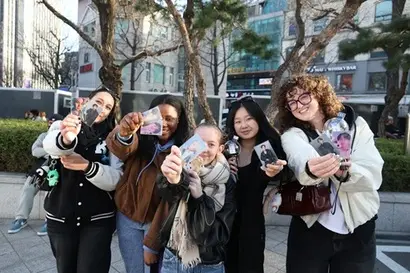
What is particularly noteworthy is that this phenomenon can spread across the entire industry. According to Daishin Securities, the number of foreigners visiting Korea has already exceeded 19 million annually, breaking all-time records, and foreign card spending has reached 20 trillion won, accounting for about 3% of the domestic retail market. The BTS concert is acting as a powerful tourism platform that attracts global capital into Korea beyond mere ticket sales.
Such structural changes are similar to the cases Japan experienced in the past. Between 2022 and 2024, when foreign tourists surged, the stock prices of major Japanese department stores rose by three to four times, driven by an explosive increase in tax-free sales.
In Korea, the combination of a weak won and the popularity of K-content has allowed foreign consumption to start acting as a new engine for domestic growth. Experts say that department stores and duty-free shops should be re-evaluated not as simple domestic sectors but as core channels for global inbound consumption, and that the value of major retailers like Shinsegae004170 should be redefined.
Ultimately, the essence of 'ARMYnomics' lies in the fact that content moves capital beyond mere consumption. In the past, goods crossed borders, but now people are moving. Fans who enter the country to watch a concert lead to consumption in accommodation, shopping, and dining, making the entire city a single consumption platform. The fact that the Gwanghwamun area functioned as an 'offline platform' demonstrates this symbolically.
At the center of this change are companies that hold content intellectual property (IP). According to IBK Securities, with the resumption of BTS's activities, HYBE's352820 revenue for this year is expected to reach 4.6 trillion won, with operating profit hitting around 580 billion won. The 4.06 million pre-orders recorded by their 5th full-length album 'Arirang' and the Netflix live stream broadcast to 190 countries show how content combines with global platforms to maximize profits.
In particular, the 360-degree open stage adopted for the 6 million-strong world tour demonstrated a strategic evolution that maximizes profitability by increasing seating efficiency. This is why the content IP industry, which has low marginal costs and infinite scalability unlike manufacturing, should be treated as a platform company rather than just an entertainment company.
Investors' strategies must also change. Companies that hold content IP should be viewed as 'platform companies' rather than entertainment stocks. Furthermore, it should be recognized that department stores and duty-free shops are no longer just domestic sectors but core channels for inbound consumption, and offline retailers like convenience stores can serve as opportunities for event-based trading.
However, high reliance on a specific IP can be a risk factor. Unless a 'second BTS' emerges, the sustainability may weaken. Also, if there is a lack of policy support connecting tourism, content, and retail, the effects could remain a one-time occurrence. Nevertheless, it is encouraging that the systemization of these processes is shortening the growth cycles of subsequent artists.
The power moving the market is now shifting from interest rates and policy to content that moves people's hearts. The purple wave witnessed in Gwanghwamun has served as a signal that the era of fandom capitalism—where fandom becomes capital and content becomes the foundation of the economy—has begun in earnest.