

[비즈한국] The National Pension Service (NPS) has decided not to exercise its voting rights on the motion to appoint Chairman Choi Yun-beom as an executive director at the Korea Zinc010130 regular general shareholders' meeting. Although the official stance is an "abstention," because the NPS identified certain candidates, including Chairman Choi, as "individuals with a history of damaging corporate value or infringing on shareholder rights," the market interprets this as a de facto vote of opposition. With this decision by the NPS, market attention is shifting toward the financial authorities' decision on potential sanctions.
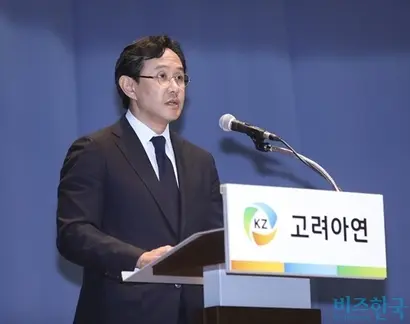
The NPS Fund's Stewardship Responsibility Committee deliberated on how to exercise voting rights for 13 listed companies, including Korea Zinc, on the 19th. Regarding the appointment of directors to be addressed at the Korea Zinc shareholders' meeting on the 24th, it decided to "abstain" on candidates Choi Yun-beom, Hwang Deok-nam, and Park Byeong-wook, and voted "against" the appointment of Kim Bo-young as an audit committee member and Lee Min-ho as an outside director serving on the audit committee. The NPS explained that these candidates fall under the category of "individuals with a history of damaging corporate value or infringing on shareholder rights."
Regarding the Korea Zinc shareholders' meeting motion to determine the number of directors to be appointed via cumulative voting, the NPS voted in favor of both the "appointment of 5 directors" and "appointment of 6 directors" motions. Furthermore, for the appointment of four directors—Walter Field McLellan, Choi Yeon-seok, Choi Byeong-il, and Lee Sun-sook—the NPS decided to split its voting rights equally based on the shareholder proposals put forth by the respective proposers. It voted in favor of all other agenda items, including the approval of financial statements and amendments to the articles of incorporation.
The weight of the NPS's decision to abstain is significant. It is not merely that the NPS stated it would not cast votes for Chairman Choi and others, but that it explicitly cited a history of damaging corporate value or infringing on shareholder rights as the reason. Therefore, there is a strong view that this decision is more than a simple neutral stance or reservation, but rather an official formalization of a negative judgment against certain candidates. Consequently, the market atmosphere is one that treats the NPS's abstention policy as a "de facto opposition."
Interpretations suggest that this judgment aligns with the trend of strengthening shareholder rights, which has been emphasized since the launch of the new administration. In his policy briefing to the Ministry of Health and Welfare last December, President Lee Jae-myung stated, "The National Pension Service, which holds the people's stocks, must exercise its voting rights properly," adding, "It must actively exercise them for companies engaging in backward management practices." Given that this is a case where the NPS reached a negative judgment based on management risks, some see it as a turning point for gauging the future direction of stewardship code operations.
Attention now turns to the judgment of financial authorities. In October 2024, the Financial Supervisory Service (FSS) launched an accounting audit regarding the appropriateness of accounting practices by Korea Zinc and Young Poong000670. The market identified the timely reflection of investment losses from One Asia Partners funds and the appropriateness of accounting related to the acquisition of Igneo Holdings as key issues. While this matter was transferred to a formal accounting review in November of the same year, no conclusion on sanctions has been reached to date.
Some criticize that the delay in the financial authorities' decision has forced general shareholders to vote without an official assessment of the issues. In 2022, the financial authorities announced plans to improve accounting review procedures, stating that the investigation period would, in principle, be limited to one year. An official from a civic group pointed out, "Even the National Pension Service pointed out a history of corporate value destruction; it is enough to raise suspicions of leniency that the Financial Services Commission, which protects the market, is dragging out the investigation. If the government's pro-market policy is to succeed, it must first eradicate such practices of 'lenient investigations.'"