

[비즈한국] The business ecosystems of South Korea and the European Union (EU) are evolving beyond simple trade partnerships into a technology alliance encompassing joint research and development (R&D) and advanced manufacturing. Since the Korea-EU Free Trade Agreement (FTA) took effect in 2011, bilateral trade and investment have steadily increased, establishing the EU as one of Korea's top three trading partners and a leading source of foreign investment. As of last year, the scale of trade in goods and services between Korea and the EU exceeded 155 billion euros (approximately 267 trillion won), with an investment stock of around 95 billion euros (approximately 164 trillion won). Against this backdrop, European innovative small and medium-sized enterprises (SMEs) and startups are actively targeting Korea’s healthcare and deep-tech markets.
At the center of this cooperation is the ‘EU Business Hub’ program, designed to assist European companies in entering the Asian market. Launched in 2024, the program aims to introduce approximately 1,000 innovative European companies to Japan and Korea by holding a total of 20 business sessions through 2027. Half of these sessions, totaling 10, are scheduled to take place in Korea, focusing on sectors such as semiconductors, digital solutions, green energy, carbon reduction technologies, and healthcare and medical devices.
Bizhankook conducted a written interview with Walter van Hattum, Minister-Counsellor for Economic and Trade Affairs at the Delegation of the European Union to the Republic of Korea (EEAS), who leads this program, to learn about why European companies are paying attention to the Korean market and the vision for future cooperation.

The EU is Korea's Largest Foreign Investor… European Healthcare Companies Seek Partners
Minister-Counsellor van Hattum cited strategic value and commercial potential as the reasons European companies are showing a strong commitment to cooperating with Korea. "Korea is one of the most advanced and innovative economies in Asia," he explained. "Its robust industrial base, highly sophisticated consumer segment, and a stable business environment underpinned by the Korea-EU FTA are attracting European firms." The EU is currently one of the largest investors, accounting for over 25% of Korea’s total foreign direct investment (FDI) stock. With the conclusion of the Korea-EU Digital Trade Agreement last March, the legal foundation for bilateral digital business is also expected to be further strengthened.
Van Hattum emphasized that what European companies want from Korea is a long-term, substantial partnership that goes beyond simple market entry. "European companies are looking for Korean partners to engage with through various methods such as joint R&D, joint development, licensing, advanced manufacturing, and supply chain cooperation," he said.
The areas receiving the most attention are healthcare and medical devices. Driven by Korea’s rapidly aging demographic and the government’s strong commitment to fostering bio-health and AI-based healthcare solutions, demand is growing rapidly. "Korea is a very attractive market for medical devices, assistive technology, digital health, telemedicine, and regenerative medicine," van Hattum said. "European companies highly value the unique engineering prowess, rapid execution, digital integration capabilities, and the ability to quickly commercialize innovation typical of Korean firms."
Stability is the European Market's Biggest Strength
Amid the acceleration of global supply chain restructuring following the launch of the second Trump administration in the U.S. and the implementation of new tariff policies, van Hattum identified stability as the European market’s greatest strength. As both Korea and the EU support a WTO-centered, rules-based multilateral trading system, the judgment is that they can build mutually reliable partnerships even in an uncertain trade environment.
Korea became the first Asian country to sign an FTA with the EU in October 2010, and this agreement is considered one of the most successful trade models the EU has ever concluded.
Van Hattum stated, "In today's trade environment marked by increased uncertainty, the EU and Korea are working closely as like-minded partners that value openness, stability, and predictability. The Korea-EU FTA has not only driven substantial growth in trade and investment but is also playing a pivotal role in creating quality jobs and strengthening supply chain resilience."
Expanding Substantial Bilateral Cooperation through the 'EU Business Hub Program'
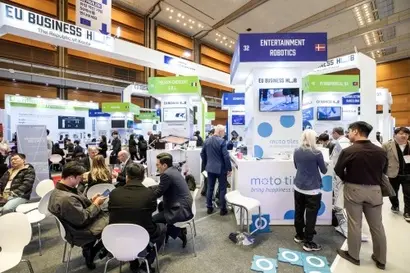
Van Hattum assessed that the EU Business Hub program is gaining momentum rapidly in Korea. He cited the 'Semiconductors Korea 2026' event held last February as a prime example. "What is noteworthy is that these missions are already leading to concrete business outcomes," he explained. "44 European SMEs and startups visited Seoul and held over 520 business meetings with Korean companies."
He added, "These meetings went beyond simple networking to lead to actual partnership discussions in various forms such as pilot projects, joint development, and supply chain cooperation, even achieving concrete progress like signing MOUs. The fact that this is developing beyond just increasing the visibility of innovative companies into actual contracts and technological cooperation is most encouraging."
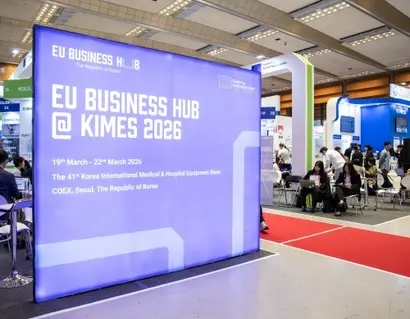
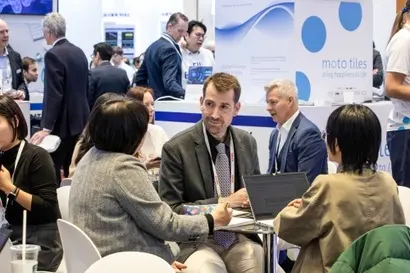
The EU Delegation to Korea expanded its cooperation in the medical device sector through KIMES 2026 (Korea International Medical & Hospital Equipment Show), held at COEX in Gangnam-gu, Seoul, from the 19th to the 22nd. Noting the growing demand for digital and home care due to Korea’s aging population, they introduced about 50 European companies in fields such as assistive technology, medical devices, digital health, medical ICT, remote patient monitoring, nanotechnology, and regenerative medicine and tissue engineering. One notable result was the partnership agreement signed between the Polish medical AI firm Medicalgorithmics and a Korean wearable ECG company.
The next EU Business Hub is scheduled for May 20-22, focusing on clean energy technologies, energy systems, circular economy, and environmental and climate change mitigation technologies and solutions.
Korea Participates in 'Horizon Europe', the World's Largest Research Program
There are still challenges to address to make the business ecosystems of Korea and the EU more closely integrated. Van Hattum suggested that further progress is needed in terms of regulatory cooperation, market access, and interoperability between systems. In particular, he noted that for the bio-health industry, where regulatory barriers are high, streamlining administrative procedures is crucial.
"If procedures ranging from testing and certification to procurement and commercialization in sectors like medical devices operate more efficiently, European innovative companies will be able to move much faster from initial contact to actual market entry," van Hattum predicted.
Van Hattum believes the future prospects for forward-looking cooperation between the two sides are bright. This is because Korea has been participating as an associate member of the second pillar (Pillar II) of the EU’s ‘Horizon Europe’, the world's largest multilateral research and innovation program, since 2025.
"Now, Korean and European institutions can participate in large-scale projects on near-equal terms in fields such as AI, quantum technology, health/bio, and carbon neutrality," van Hattum emphasized. "This will contribute to strengthening the business partnership between the two countries to the next level, going beyond simple research cooperation."