

[비즈한국] About three months after the year-end parliamentary hearing, Harold Rogers, interim CEO of Coupang, participated in an on-site early morning delivery experience. While images of CEO Rogers personally delivering and collecting 'Fresh Bags' drew attention, critics argue that the experience failed to fully reflect the reality of the field as it was conducted with 'Coupang Friends'—directly employed staff—rather than 'Quick Flex' drivers, where concerns regarding overwork are concentrated.
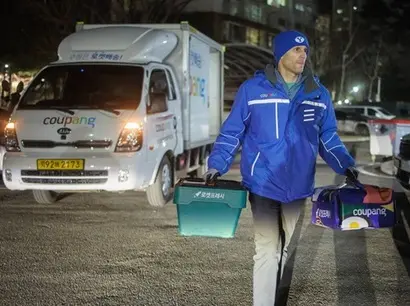
Early Morning Delivery Experience, Three Months After Hearing
On the 19th, Harold Rogers, interim CEO of Coupang, personally experienced the early morning delivery scene. According to Coupang, CEO Rogers performed delivery duties in the Jungwon-gu district of Seongnam-si, Gyeonggi-do, from 8:30 PM on the 19th to 6:30 AM on the 20th.
This experience was carried out as a follow-up to criticisms raised during a National Assembly hearing regarding a "lack of understanding of the field." During a hearing of the National Assembly's Science, ICT, Broadcasting and Communications Committee last December, Rep. Yeom Tae-young of the Democratic Party of Korea pointed out issues with Coupang's working environment, citing cases of deaths among early morning delivery workers.
At the time, Rep. Yeom suggested, "Let's experience the difficulties of night deliveries firsthand," to which CEO Rogers replied, "I have had similar experiences," and added, "I hope to do it with you, Representative." Coupang stated, "This early morning delivery experience was conducted to fulfill the promise made at the National Assembly and to strengthen trust."
The experience, initially expected to take place shortly after the hearing, occurred about three months later. This is interpreted as being due to delays in coordinating schedules and conditions during the working-level consultation process. Rep. Yeom stated on his personal social media, "We had to accommodate Coupang's repeated requests for delays and strict conditions, and it was very regrettable that fellow representatives who had planned to join could not participate."
After completing safety training and loading work at the Coupang Logistics Service (CLS) delivery camp in Yatap, Seongnam, CEO Rogers and Rep. Yeom rode along with 'Coupang Friends'—Coupang's directly employed delivery drivers—to begin their deliveries. It is reported that they made deliveries to apartments, villas, and detached houses around the Jungwon-gu area of Seongnam. The experience reportedly included tasks such as sorting, loading, delivery, and the collection/return of Fresh Bags.
Prior to this, CEO Rogers also held a rehearsal at a Coupang camp near Seongnam on the 12th. He went through a preparation process, familiarizing himself with logistics sorting, loading, and delivery routes in advance. CEO Rogers stated, "I am proud of all our employees, including the delivery staff," adding, "I will continue to do my best to create a safe and advanced working environment."
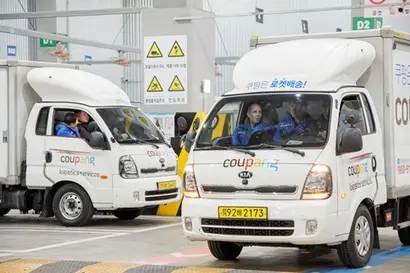
"Lacks Reflection of Reality" for Experiencing 'Coupang Friends' Instead of 'Quick Flex'
There are voices expressing disappointment regarding this experience, as it was conducted with 'Coupang Friends,' the company's directly employed drivers, rather than 'Quick Flex' drivers, who face concentrated concerns regarding overwork.
Coupang's delivery workforce is largely divided into Coupang Friends, who are directly employed, and Quick Flex drivers, who operate under a subcontracting structure. While Coupang Friends have guaranteed working hours and breaks, Quick Flex drivers are classified as independent contractors and are often exempt from the protections of the Labor Standards Act.
Because of this, industry experts have pointed out that labor intensity and overwork issues are primarily concentrated on Quick Flex drivers. According to the Courier Workers' Union, most recent deaths attributed to overwork have occurred among Quick Flex drivers.
The Courier Workers' Union stated, "We cannot deny the significance of the attempt to experience the field firsthand," but added, "However, we express deep regret that this experience failed to properly reflect the reality of delivery labor that has been collapsing due to overwork."
They further pointed out, "CEO Rogers and Rep. Yeom each delivered about 150 items. According to the union's confirmation, they did not deliver the entire volume of that zone but only a portion, while other workers covered the rest. There were also two 30-minute breaks during the delivery process. Quick Flex couriers cannot work under these conditions. In a structure where they must complete the entire daily quota within a set time, they have to keep running without rest."
Rep. Yeom also mentioned the gap between the experience and the reality of the field. Rep. Yeom explained that he had previously experienced night deliveries separately with a Quick Flex driver, noting, "The delivery volume at that time was about 340 items, far higher than this experience, and the work continued without any breaks." He added, "Quick Flex drivers go up and down alleys and stairs without a moment's rest. The labor intensity is bound to be extremely high in a structure where they have to generate income solely through their own labor."
Rep. Yeom stated that during the experience, he showed CEO Rogers actual footage from the field to convey issues regarding labor intensity and working environments. In particular, he emphasized the need to implement social agreements, such as 'guaranteeing appropriate night working hours' and 'excluding sorting work,' while pointing out the structure where income does not improve even if delivery volume increases.
Coupang stated, "We plan to actively listen to the voices from the delivery field and take the lead in strengthening employees' working conditions and their right to health."