

[비즈한국] On March 10th, BioNTech, a leading German biotechnology company, made an unusual personnel announcement. Co-founders CEO Uğur Şahin and CMO Özlem Türeci announced that they would be leaving the company at the end of 2026, upon the expiration of their contracts, to establish a new venture focused on next-generation mRNA technology. BioNTech gained global recognition during the pandemic by developing the COVID-19 vaccine in collaboration with Pfizer.
The market reacted immediately to this news. On the day of the announcement, BioNTech's stock price plummeted by approximately 22%. However, this decline was not solely due to the announcement of the founders' departure. It was a complex shock fueled by the fact that the Q4 2025 earnings released on the same day fell short of market expectations, and the annual revenue forecast for 2026 (2 billion to 2.3 billion euros, approximately 3.4 trillion to 3.9 trillion KRW) was also significantly lower than what market analysts had projected.
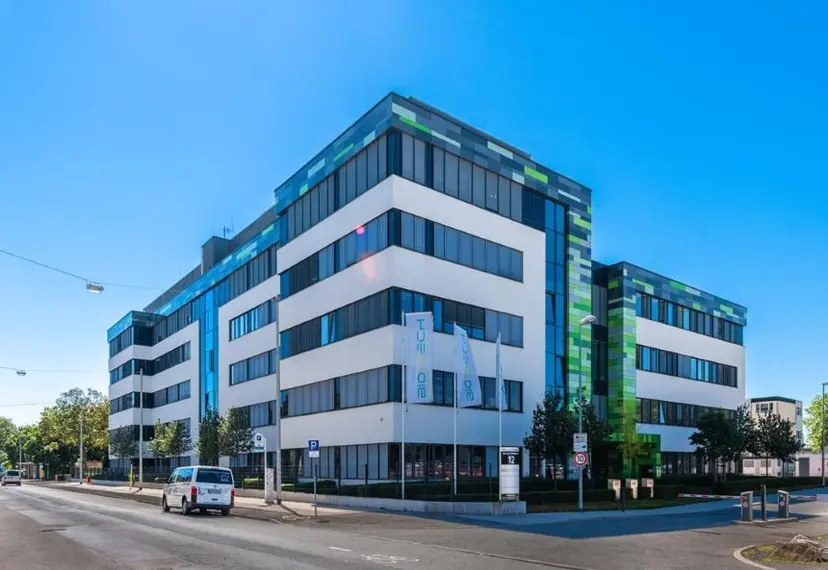
Becoming Pioneers Again: The Serial Entrepreneurship Ecosystem of Europe
This news is drawing attention not merely because of a leadership change. It is rare for the founder of a major company in the European startup ecosystem to choose to return to early-stage research. BioNTech has already become a global publicly traded company and a large biotech firm pushing for the development of anticancer drugs and immunotherapies, backed by the vast cash reserves accumulated since the pandemic. As of the end of 2025, it held approximately 17.2 billion euros (about 29.2 trillion KRW) in cash, cash equivalents, and securities, and continues to sustain large-scale R&D despite reporting a net loss of 1.14 billion euros (about 1.9 trillion KRW).
The founders' explanation is clear. As BioNTech increasingly focuses on late-stage clinical development and commercialization, it has become difficult for them to dedicate sufficient time to the early-stage research and exploration where their strengths lie. In a joint statement, the two noted that they are “ready to become pioneers again,” adding that their new company will conduct early-stage mRNA-based drug research prior to human trials. BioNTech is considering transferring certain mRNA-related rights and technologies to the new company in exchange for a minority stake and performance-based compensation. The two founders plan to retain their roughly 15% stake in BioNTech, making the structure more of a division of roles rather than a complete separation.

This decision demonstrates that the role of a startup founder can change according to the company's growth stage. In the biotech field, organizational structures tend to become complex and decision-making slower as the focus shifts toward late-stage clinical trials, regulatory compliance, manufacturing, and commercialization. This is Şahin and Türeci's third startup venture. The two co-founded Ganymed Pharmaceuticals in 2001, which was later sold to Astellas for 460 million dollars (approximately 670 billion KRW). The pair established BioNTech in 2008. This new company is an extension of their serial entrepreneurship.
The Challenge of a Growing Company: A Biotech Firm's Pipeline
In the short term, the risk to BioNTech is clear. Markus Manns, a fund manager at the German asset management firm Union Investment, described the founders' departure as “very bad news that leaves many questions,” adding that BioNTech is “losing its heart and mind.” While U.S. investment bank Leerink Partners assessed this transition as a “logical step,” they also raised questions about whether BioNTech could effectively repeat and expand its approach without its founders. Particularly, since BioNTech faces the task of transitioning from a COVID vaccine company to a multi-product biotech firm after the pandemic, the simultaneous departure of both founders increases uncertainty regarding strategic continuity.
Conversely, the company stated that its anticancer drug pipeline and COVID vaccine business would not be affected. It has also begun the process of selecting a successor leadership team. The requirements for the new CEO include “experience in late-stage clinical development and commercialization execution.” With the goal of leaping into a commercial biopharmaceutical company with multiple products by 2030, BioNTech is conducting 15 Phase 3 oncology clinical trials as of the end of 2026. Phase 3 clinical trials are the final hurdle in new drug development, a stage where actual therapeutic efficacy and safety are verified on a large scale with hundreds to thousands of patients. Only after passing this stage can a drug receive regulatory approval and be released to the market.
In 2025, BioNTech signed a strategic partnership worth up to 11.1 billion dollars (about 16 trillion KRW) with Bristol Myers Squibb (BMS), strengthening its next-generation immuno-oncology pipeline. This aligns with the direction of redefining the company as a platform firm that runs capital, clinical, and business development structurally, rather than relying on the scientific capabilities of individual founders.
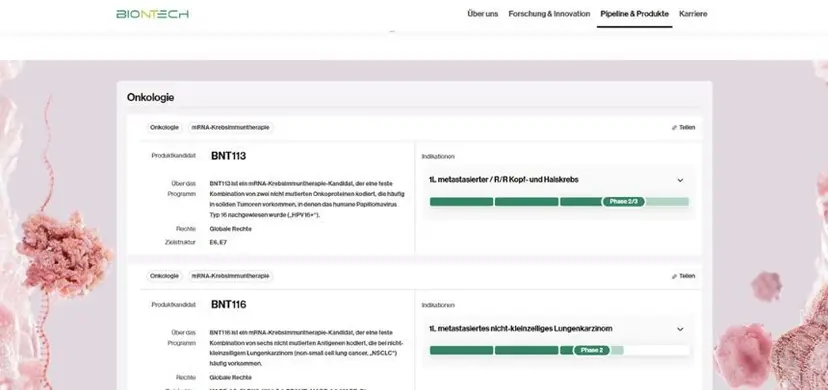
In a biotech company, a “pipeline” refers to the list of drug candidates currently under development and their respective development stages. For general manufacturing firms, factories and facilities are the core assets, but in biotech, “how many drugs can be sold in the future” determines the company's value. The lifespan of a single new drug is finite based on its patent period, and developing one requires over a decade and hundreds of billions of won. Therefore, investors invest based on how well the drugs currently in clinical trials will sell in the future, rather than current profits. The pipeline is effectively a preview of future revenue. Typically, only about 10% of drugs that enter clinical trials actually make it to market. Thus, the more candidate substances there are and the more advanced the development stage, the more the risks are diversified.
In BioNTech's case, aggressively expanding its anticancer drug pipeline to reduce its dependence on the single COVID vaccine product is currently the most important task. The reason investors reacted sensitively to the founders' departure is that they believe the success or failure of the pipeline ultimately depends on the founders' scientific judgment.
Founders Who Left a New Benchmark for the European Ecosystem
This case is also meaningful from the perspective of the European, and specifically German, startup ecosystem. Europe has long been evaluated as having “strong basic science but weakness in growing it into large-scale enterprises.” BioNTech was a rare case that broke this mold. A science-based startup that started in Mainz became a core company in the global pandemic response, and it is now executing a strategic transition shifting its center of gravity toward anticancer drugs. The fact that those founders are creating a new company again can be read as a signal that the ecosystem's virtuous cycle is beginning to work, where one success becomes a resource for the next innovation, and a grown company serves as the technical foundation for a new startup.
From the perspective of mRNA technology, the background of this choice is also understandable. While the COVID vaccine proved the commercial potential of mRNA, vast areas remain clinically unverified, such as next-generation cancer therapies, personalized immunotherapies, the expansion of indications to non-communicable diseases, and improvements in delivery system technology. This early exploration stage is exactly what the new company is aiming for. However, specific details such as the new company's name, headquarters location, and budget scale have not yet been disclosed.
This case poses several questions for the Korean startup ecosystem as well. There is a tendency to understand the success trajectory of a founder linearly as “remaining as a manager after growing the company,” but in deep-tech and biotech fields, the founder's comparative advantage often lies in the early exploration and hypothesis testing stages. Different skills are needed at each growth stage of a company, and it may be more efficient for the ecosystem as a whole for the founder to adjust their role to match those changes. The BioNTech case forces a rethinking of the criteria for judging a founder's departure: should it be viewed as a corporate failure, or as one cycle in a technological innovation system?
The author, Lee Eun-seo, majored in law in Korea and studied theater in Berlin. Based in Berlin, a city of art and a European startup hub, she leads 123factory, which bridges the startup ecosystems of Korea and Germany while growing alongside the city.