

[비즈한국] Every day, countless job postings appear on employment communities and recruitment platforms. However, not every posting leads to an actual hire. Suspicions have been raised that some companies post job openings merely to gauge market reactions. With the emergence of job postings from companies whose existence cannot even be verified, confusion among job seekers is growing.
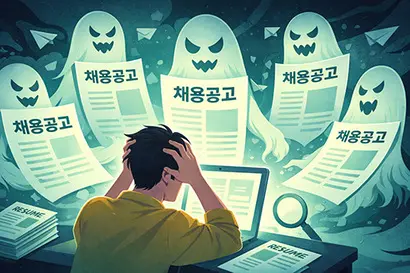
I Applied, But… Suspicions of 'Ghost Postings' Among Job Seekers
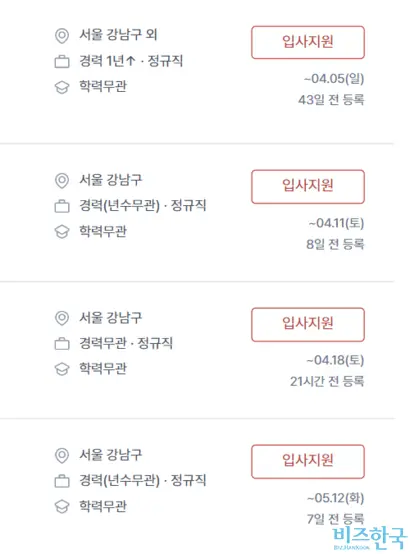
Job seeker 'A' recently submitted applications to about 40 companies through recruitment platforms over the past month. However, at more than half of them—about 20 companies—the recruiters did not even open the resumes even after the deadlines had passed. Despite the postings closing without being viewed, these companies reposted the same job openings at the top of the list.
Job seekers point out that when a posting period is excessively long or the same job opening is repeatedly uploaded, one should suspect it might be a 'ghost posting.' One netizen stated, "There are cases where the posting is uploaded again without even viewing the resumes despite having many applicants," adding, "Isn't it for company promotion rather than actual hiring?"
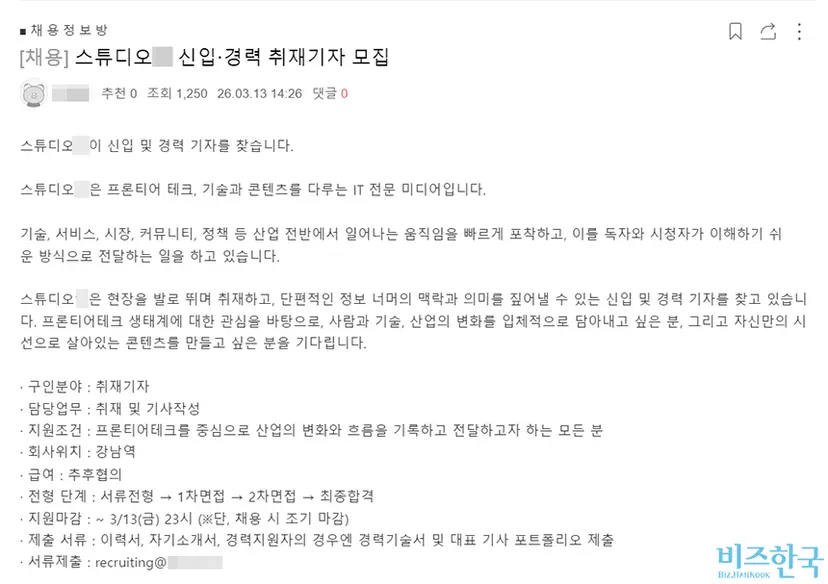
There have even been cases where the hiring company was a 'ghost company.' On the 13th, a job posting was uploaded to a community for aspiring journalists, stating that an IT-specialized media outlet called 'Studio ○' was hiring reporters. However, when the reporter verified the company information listed in the posting, it was difficult to find any related corporate details. Only a film production company with the same name was identified, and the email domain provided for applications was linked to an overseas-based Web3 infrastructure service site irrelevant to an IT media outlet.
Cases suspecting 'ghost postings' are also continuing in the Albamon community. One member complained, "I arrived at the company after receiving a call to come to work, but they wouldn't pick up the phone," adding, "Isn't this just a waste of time for applicants?"
‘Ghost job postings’ that do not lead to actual hiring not only waste the time and opportunities of job seekers but also carry a high risk of being misused as a channel for personal data collection. Concerns are also being raised that if such incidents repeat, it could undermine trust in job postings themselves and exacerbate chaos in the recruitment market.
According to the Ministry of Employment and Labor's 'First Half of 2024 Fair Hiring Act Guidance and Inspection' results, 341 cases of unfair hiring practices were uncovered from an investigation of 629 workplaces. Major violations included requesting personal information irrelevant to the job, failing to return or destroy application documents, and failing to notify unsuccessful applicants of the results.
A representative from a recruitment platform stated, "We manage issues regarding false postings through monitoring and automated systems," adding, "There is no separately tracked data."
To Reduce Ghost Job Postings… Platform Verification Responsibility Must Be Strengthened
Complex factors are analyzed to be at play behind the posting of such advertisements. Labor Attorney Kim Jae-min (Labor Law Firm Phil) added, "There are cases where companies want to secure on-call personnel due to high turnover rates, or where hiring is prolonged because they cannot find a suitable candidate," noting, "There is also a possibility that the hiring process is being used to manage company image or to collect ideas and the latest labor market information from applicants."
Article 4 of the current Fair Hiring Act prohibits acts that promote a business or collect ideas under the guise of hiring, and violations can result in a fine of up to 5 million KRW. Article 34 of the Employment Security Act also prohibits the act of posting false job advertisements or offering terms that differ from the facts during the process of employment placement or worker recruitment.
However, the problem is that it is difficult for such cases to be deemed actual violations of the law. Labor Attorney Kim Jae-min explained, "Since hiring decisions are fundamentally a matter of corporate management judgment, it is not easy to prove that a company had no intention of hiring from the very beginning."
To address this, the government has begun institutional improvements. While reviewing amendments to the Employment Security Act to strengthen the responsibility of job portal operators to verify recruitment information, they have set a policy to establish a public-private integrated monitoring system to conduct regular checks on suspicious job advertisements. A budget of 1.74 billion KRW has been allocated for this project.
Critics point out that to solve the fundamental problem, the responsibility of platforms must be strengthened. Labor Attorney Kim Jae-min advised, "Under the current legal system, the verification responsibility of platforms that broker job postings is relatively limited," adding, "If obligations are strengthened to more clearly verify basic information such as business registration status or workplace addresses, it could help reduce false job postings."