

[비즈한국] On the 19th, the inauguration ceremony for the 9th CEO, Kim Jong-chul, was held at the Korea Aerospace Industries (KAI)047810 headquarters in Sacheon, Gyeongnam. This marks the end of an eight-month leadership vacuum following the departure of the previous CEO. It is no exaggeration to say that the CEO of KAI, who serves a three-year term, is not merely a public institution representative appointed by the majority shareholder, the Export-Import Bank of Korea, but a key figure who will determine the future of South Korea's defense industry. This is because KAI's role is absolute in the numerous ongoing national defense improvement projects and overseas export fronts.
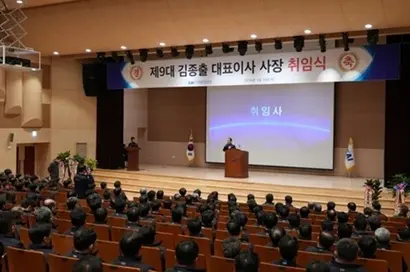
In this context, the background of the new CEO, Kim Jong-chul, can be evaluated as an optimal appointment that fits the serious reality KAI faces.
First, his practical experience gained in the Air Force and his project management expertise honed at the Defense Acquisition Program Administration (DAPA) will be solid assets for overall management. If the 8th CEO was an expert in piloting and test flights, CEO Kim is an 'acquisition policy expert' who was a founding member of DAPA in 2006 and served as the Director of the Unmanned Systems Division and the Director of the Command & Reconnaissance Division. This means he understands the mechanisms of large-scale defense R&D projects, which take over a decade and require trillions of won in budget, better than anyone else.
Second, he possesses expertise optimized for uncovering KAI's 'post-KF-21' business opportunities. KAI currently stands at a crossroads, needing to secure next-generation growth engines to succeed the KF-21. CEO Kim's expertise in unmanned aerial vehicles and command and reconnaissance, fields he previously managed, is expected to play a key role in KAI's efforts to secure a leading position in the micro-satellite business and the Collaborative Combat Aircraft (CCA) market.
Third, his government communication skills, cultivated through his experience working in the Office for Government Policy Coordination, are also noteworthy. KAI's core products, such as the FA-50, KF-21, and LAH (Light Armed Helicopter), follow a structure where government feasibility reviews and purchase decisions must precede overseas exports. CEO Kim's political sensibility will act as a strength in fostering organic cooperation between the military, the government, and the company.
Finally, his experience in cost-benefit analysis for trainer aircraft programs will provide powerful momentum for performance improvement projects for core aircraft models. The installation of a domestic AESA radar and weapon expansion for the FA-50, as well as the military requirement verification for the KF-21 'Block 3', are tasks KAI must overcome. In particular, the KF-21 Block 3 is currently subject to much debate within the military regarding the application of stealth technology and internal weapon bays. CEO Kim faces the challenge of persuading the military with an analytical perspective and finding the optimal balance between export competitiveness and operational requirements.
Fortunately, in his inaugural address, CEO Kim emphasized an R&D culture that embraces innovation, challenge, and failure, clearly expressing his will to cultivate future growth engines such as unmanned aircraft and space projects. To realize this, more concrete strategies must be backed.
I believe a 'two-track' strategy of enhancing the competitiveness of existing platforms while pioneering new businesses is valid. For example, by first applying the stealth technology needed for the KF-21 Block 3 to the AAP AI unmanned aerial vehicle currently under development, the mission capabilities of the drone can be expanded, which will not only contribute to strengthening the export competitiveness of the KF-21 and FA-50 but also serve as a testbed for KF-21 stealth functions.
Approaches that circumvent massive R&D costs for performance improvements through creative methods are also worth considering. For instance, before introducing internal weapon bays to the KF-21, developing stealth-shaped external fuel tanks like the recent U.S. F-22 case, and collaborating with missile manufacturers to apply stealth-shaped new air-to-air/air-to-ground missiles to semi-recessed weapon mounts could maximize the KF-21's operational capabilities at a minimal cost.
The 8-month leadership vacuum was a painful time for KAI, but it was also a period of endurance preparing for a new leap forward. On the path to becoming an aerospace powerhouse, I hope KAI, led by CEO Kim Jong-chul, will prove the expectations of the defense industry with concrete results.